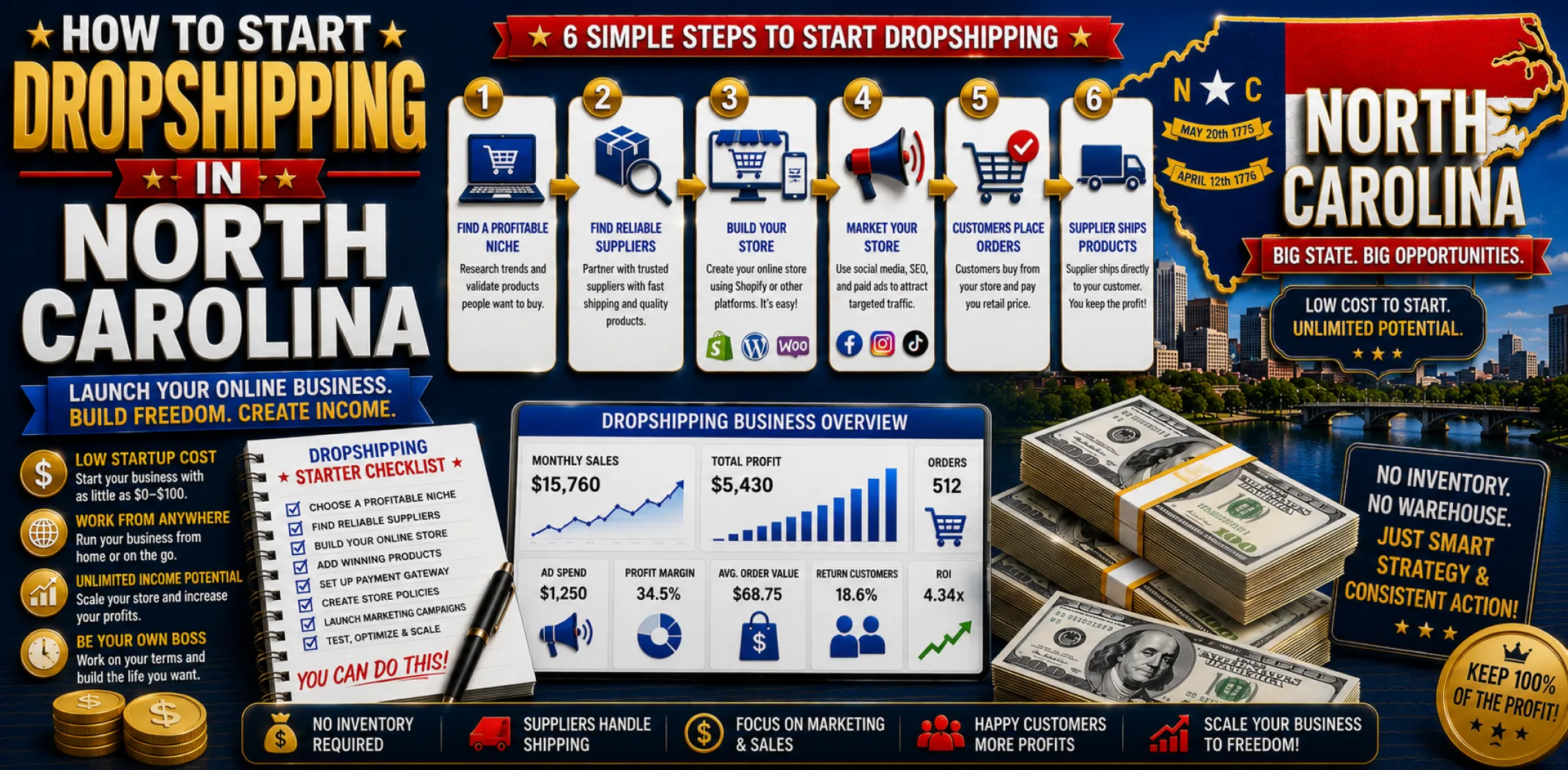
Every month, thousands of North Carolina residents search for how to start an online product business from home. The idea is simple: find something to sell, list it online, collect money when orders come in. No office, no commute, no boss.
For a lot of people in the Tar Heel State – parents in Fayetteville juggling two jobs, retirees in Asheville looking for supplemental income, young adults in Wilmington trying to build something before their thirties – that idea feels like the thing that could change everything.
The challenge is that the traditional model most people picture – sourcing physical products, managing suppliers, waiting on deliveries – is significantly harder and more expensive than most guides let on. Supplier relationships fall apart. Products arrive late. Margins get squeezed by fees. You spend more time solving logistics problems than actually selling.
Quick Answer: Starting an online product business in North Carolina is absolutely achievable – but the model matters more than most guides admit. Selling digital products online eliminates the complexity of physical goods entirely: no suppliers, no delivery wait times, no inventory. It is faster to set up, lower risk to start, and easier to scale from a laptop or phone anywhere in North Carolina.
This guide walks through the full picture – why online selling works in North Carolina, how the main models compare honestly, what taxes and registration actually cost, and how to take a real first step. If you are ready to explore the broader landscape, the guide on how to start an online business in North Carolina covers every model in detail.
Why online selling works in North Carolina
North Carolina is one of the more compelling states for online sellers in 2026 – and not just because of the Research Triangle tech corridor. The numbers tell a more complete story.
The state has more than 10.7 million residents, a median household income of $74,000, and internet access in approximately 76% of households. That is a large, connected consumer base.
US ecommerce sales reached $1.23 trillion in 2025 – a 5.4% increase from 2024 – and North Carolina consumers are participating in that growth at a rate that reflects the state’s rapid population expansion. North Carolina was among the fastest-growing states in the country over the past decade, adding more than 1 million new residents since 2010.
The state’s income tax rate has been falling steadily. It stands at 4.25% for the 2025 tax year and drops to 3.99% in 2026 – one of the lowest flat rates in the Southeast. For an online business owner, keeping more of your earnings matters. North Carolina’s improving tax environment makes it a better place to build an online income than it was even five years ago.
Perhaps most importantly for anyone considering running a business from home: North Carolina has no requirement for a statewide general business license. You can start selling online as a sole proprietor with no upfront registration fees and no state formation paperwork. That is a genuine advantage over states that require licenses to operate.
Online business models for North Carolina residents – a real comparison
Before committing to any path, it is worth understanding what each major online selling model actually requires – not in theory, but in practice. Here is an honest side-by-side comparison of the four models most North Carolina residents consider.
The table does not declare a winner – it shows the honest trade-offs. Physical product stores offer the broadest product variety but require the most work and capital to manage well. Affiliate marketing and freelancing are accessible but cap at your time or audience size.
A digital product store offers the highest margin, lowest setup complexity, and fastest path to a first sale – with the trade-off that you are paying a monthly platform fee after the free trial ends.
Tax considerations for online sellers in North Carolina
Taxes are not the most exciting topic, but getting them wrong is expensive. Here is what North Carolina online sellers need to know.
State income tax
North Carolina taxes all income – including online business profits – at a flat rate of 4.25% for the 2025 tax year. The rate drops to 3.99% in 2026. As a self-employed online seller, your business profits pass through to your personal return and are taxed at this rate, plus applicable federal income tax.
If your online business generates more than $1,000 in annual profit beyond any withholding, you are generally required to make quarterly estimated tax payments to both the IRS and the NC Department of Revenue. Quarterly deadlines are typically April 15, June 15, September 15, and January 15 of the following year.
Sales tax for North Carolina online sellers
North Carolina’s base state sales tax rate is 4.75%. Local county rates add between 2% and 2.75%, bringing the total combined rate to between 6.75% and 7.5% depending on your customer’s location. North Carolina uses a destination-based system – you apply the rate for the customer’s address, not your own.
Economic nexus applies if your online business generates more than $100,000 in gross sales to North Carolina customers in a calendar year. Once you cross that threshold, you must register with the NC Department of Revenue and begin collecting sales tax. If you are selling exclusively through a marketplace platform that collects and remits tax on your behalf, the platform handles compliance for those transactions.
For digital products specifically – the model Sellvia is built on – North Carolina taxes digital property including certain downloaded products. Your specific obligation depends on the product type. The NC Department of Revenue at ncdor.gov provides current guidance.
Marketplace facilitator rules
North Carolina has a marketplace facilitator law. If a platform facilitates more than $100,000 in gross sales from North Carolina customers in the current or previous calendar year, the platform is required to collect and remit sales tax on behalf of third-party sellers. For sellers on qualifying platforms, this removes the individual compliance burden for those sales.
Key principle: Register with the NC Department of Revenue before you need to – not after your first audit notice. Registration is free, and staying current with quarterly filings protects you from penalties.
See your state tax breakdown at a glance
Simply enter your annual net profit, select your state, and the calculator will instantly generate a detailed tax breakdown while showing how your state’s tax burden compares to others.
How to register your online business in North Carolina
Registration in North Carolina is simpler than most people expect – and cheaper than in many other states.
If you start as a sole proprietor, there is no state formation fee and no Articles of Organization to file. You simply begin operating under your own name. If you want to use a different business name, you register an Assumed Business Name with your county register of deeds for a small fee (typically around $26).
To form an LLC – which gives you personal liability protection – you file Articles of Organization with the North Carolina Secretary of State and pay a $125 filing fee. Standard processing for online submissions is generally faster than mail. Once formed, your LLC must file an annual report each year by April 15, with a filing fee of $200.
You can start the registration process at the official NC Secretary of State portal at sosnc.gov. The business name search tool there is free and lets you confirm your desired name is available before you file.
Important: Most North Carolina online business beginners start as sole proprietors and form an LLC after generating consistent income – not before. The $325 first-year cost of an LLC is real money when you are not yet earning. Start lean, build evidence the model works, then formalize.
Step-by-step guide to starting an online product business in North Carolina
Here is a practical walkthrough for North Carolina residents ready to move from reading to doing.
Step 1: Choose what to sell
The biggest decision in starting any online selling business is what you are going to offer. Physical products require supplier relationships, upfront costs, and ongoing logistics management. Digital products – guides, courses, checklists, tools – are delivered instantly, cost nothing to restock, and carry margins of 50–70% per sale.
For a North Carolina resident starting from scratch with no prior experience, digital products eliminate the three biggest barriers: product sourcing, shipping complexity, and inventory cost. Sellvia’s free trial gives you a store pre-loaded with 1,000 digital products across multiple niches, so you do not have to create a single item yourself before you make your first sale.
Step 2: Register your business in North Carolina
Start as a sole proprietor unless you have a specific reason to form an LLC immediately. File nothing, pay nothing, and begin operating under your own name. When your income becomes consistent – typically once you are generating $500 or more per month – form an LLC at the NC Secretary of State portal for $125. You will pay $200 annually after that for the required annual report.
Get a free federal EIN from IRS.gov once you form an LLC or if you want a business tax ID separate from your Social Security Number. This takes about 10 minutes online.
Step 3: Set up your store
With Sellvia, this step is done for you. Your store arrives fully built, with products already loaded, a payment system in place, and a one-click advertising setup ready to activate. There is no coding, no design work, and no product research required. The free 14-day trial requires no credit card.
For context on how Sellvia compares to building a store from scratch: platforms like Shopify require you to find your own products, build your own store design, and figure out marketing independently. Sellvia handles all three. After the free trial, the monthly plan is $39 – roughly $1.30 per day for a fully operational business.
For a broader look at the process, the guide on how to start an online business in North Carolina covers each step in more detail.
Step 4: Handle North Carolina taxes
Register with the NC Department of Revenue at ncdor.gov once your business is generating consistent income. Set aside 25–30% of net profit for quarterly estimated taxes – both federal and state. North Carolina’s flat income tax rate of 4.25% for 2025 (dropping to 3.99% in 2026) is one of the more favorable rates in the region for small business owners.
Track every expense from day one – platform fees, advertising spend, and any tools you pay for are generally deductible as business expenses. A simple spreadsheet is enough at the start.
Step 5: Start marketing
Sellvia’s built-in one-click advertising system is the fastest path to your first sale. With a budget as low as $10 per day, you can start reaching buyers without any marketing experience. Many Sellvia customers who activate ads see their first orders the same day – individual results vary based on niche, budget, and consistency.
Organic methods – social media posts, short-form video, word-of-mouth – are free and worth building alongside paid advertising. They take longer to generate sales but cost nothing and compound over time.
Best niches for North Carolina online sellers
North Carolina’s economy and demographics create natural demand for specific types of digital products. These are the niches most likely to resonate with both local buyers and the national customer base your online store can reach.
Home improvement and DIY: North Carolina has a high homeownership rate – 66.6% as of 2024, above the national average. Practical guides on home repair, renovation planning, and DIY projects have consistent demand across the state, from suburban Charlotte to rural Piedmont counties.
Financial wellness and budgeting: With a median household income of $74,000 – about 9% below the national median – many North Carolina families are actively seeking practical guidance on budgeting, debt reduction, and building savings. Digital guides in this niche address a genuine, widespread need.
Health, fitness, and wellness: North Carolina’s outdoor culture – hiking in the mountains, cycling in the Piedmont, beach activities on the coast – creates a health-conscious population with consistent demand for practical wellness guides, workout plans, and nutrition resources.
Parenting and family: North Carolina is a family-heavy state, with strong growth in suburban communities around Raleigh, Charlotte, and the Triad. Digital guides on parenting, child development, and family organization address the needs of a large, engaged audience.
Small business and entrepreneurship: The Research Triangle’s startup culture and North Carolina’s growing small business community create demand for practical business guides – everything from starting a side income to growing a freelance practice. Meta as it sounds, this is a real and underserved niche in the state.
Common challenges for North Carolina online sellers
Starting an online product business in North Carolina is achievable, but it is not frictionless. Here are the three challenges most likely to slow you down – and how to handle each one.
Rural broadband gaps
Approximately 76% of North Carolina households have home internet access – meaning roughly one in four does not. Rural counties in the western mountains and eastern coastal plain face the most significant connectivity challenges. If you are in a rural area with unreliable home internet, this is a real operational consideration.
Solution: Sellvia’s platform is fully mobile-compatible. You can manage your store, check orders, and run advertising from a smartphone on mobile data. Many North Carolina online sellers operate entirely from their phones. Local libraries and community centers also offer free Wi-Fi as a backup option.
Distrust of online opportunities
North Carolina residents who search for ways to earn money online have typically seen dozens of misleading offers before they find a legitimate one. That skepticism is healthy and earned. The problem is when it stops people from acting on real opportunities.
Solution: Look for verifiable credentials, not promises. Sellvia is ranked among Inc. magazine’s 5,000 fastest-growing US companies (#1818 in 2022), is a Forbes Communications Council member, has won the Hermes Creative Awards Gold for Best IT Product (2025–2026), and has helped launch more than 1.5 million stores.
These are independently verifiable facts. Start with the free trial – you risk nothing to see whether the platform delivers what it promises.
Staying consistent when early results are slow
The first 30 days of any online business feel uncertain. Sales are inconsistent. You are still learning what works. Most people who quit, quit here – not because the model failed them, but because they expected faster results than the timeline realistically delivers.
Solution: Set a 90-day commitment before you evaluate. Track your actions daily, not just your sales. Adjust one variable at a time – your product selection, your ad creative, your niche – rather than changing everything at once. The sellers who reach consistent income are rarely the most naturally talented ones. They are the most consistent ones.
Resources for North Carolina online sellers
You do not have to build this alone. North Carolina has a strong network of free resources for anyone starting or growing an online business.
- SBA North Carolina District Office: Offices in Charlotte and Wilmington, with satellite locations in Asheville and Raleigh. Free access to business counseling, loan guidance, and connections to lenders and resource partners. Visit sba.gov/district/north-carolina.
- NC SBTDC: Free one-on-one business counseling through 16 locations across the state, operated through the UNC system. Has helped more than 125,000 North Carolina business owners since 1984. Visit sbtdc.org.
- SCORE North Carolina: Free mentoring from experienced business professionals, available in person and online. Chapters in Charlotte, Raleigh, Wilmington, Greensboro, and other NC cities. Visit score.org.
- NC Secretary of State Business Registration: Official portal for business name searches, LLC formation, and annual report filing. Visit sosnc.gov.
- NC Department of Revenue: Sales tax registration, income tax filing, and guidance on digital product tax obligations. Visit ncdor.gov.
Why Sellvia is a game-changer for your online store 🚀
Sellvia isn’t just another ecommerce tool. We are a trusted name in the industry, recognized by Forbes and even ranked in Inc.’s list of the 5,000 fastest-growing companies in the U.S. So if you’re serious about starting as a solopreneur, this is a smart place to begin.
Starting an online business can feel overwhelming, but that’s exactly where Sellvia steps in. It takes care of the tricky parts, so you can focus on making sales and growing your brand. Let’s break down what makes it such a great choice.
Get a ready-to-go store hassle-free 🎯
Want to start selling but don’t know where to begin? No worries! Just share your ideas, and Sellvia’s team will build a free ecommerce website that’s fully set up and ready to take orders from day one. No coding, no stress – just a store that works right out of the box.
1,000 digital products ready to sell from day one 🎁
Not sure what to sell? Sellvia solves that instantly. Your store comes pre-loaded with 1,000 ready-made digital products – guides, courses, checklists, and tools – all created by Sellvia. No writing, no recording, no product creation needed. Just pick your niche, and the products are already there waiting for your first customer.
A massive catalog of digital products to sell 🏆
One of the biggest struggles in starting an online business is figuring out what to sell. Sellvia solves that completely. Your store comes pre-loaded with digital products – guides, courses, checklists, and tools – all created by Sellvia. You keep 50–70% of every sale. No inventory. No shipping. No logistics headaches.
Everything in one easy-to-use platform 🔥
Managing an online store shouldn’t be complicated. With Sellvia, you can handle orders, add new products, and even chat with customers – all from a simple and user-friendly platform. No need to mess with confusing tools or deal with unnecessary tech stuff. It’s all smooth sailing.
No upfront costs, just start selling 💰
A big reason people hesitate to start an online business is the cost. But here’s the good news: With Sellvia, you don’t need to invest in stock, storage, or shipping supplies. You can run your store with no upfront costs, keeping things low-risk while still making money.
Support that’s always got your back 🤝
Running a business comes with questions, but you’re never alone. Sellvia’s dedicated support team is available 24/7 to help with anything you need. Whether it’s a small question or a big challenge, they’ve got you covered.
North Carolina residents who want to start selling online have a smarter, lower-risk path available than traditional physical product models. Claim your free store with 1,000 digital products and start selling from anywhere in the Tar Heel State today.
How do I start an online store in North Carolina?
Do I need a business license to sell online in North Carolina?
North Carolina does not require a statewide general business license for most online sellers. However, you must register with the NC Department of Revenue for a sales tax permit – which is free – if you sell taxable goods or services. If you exceed 100,000 dollars in gross sales to North Carolina customers in a year, you are required to collect and remit North Carolina sales tax. Local city or county permits may apply depending on your location and business type. When in doubt, the NC SBTDC offers free counseling and can confirm what applies to your specific situation.
How much does it cost to start an online store in North Carolina?
Starting an online store in North Carolina can cost as little as zero dollars using a free trial platform like Sellvia. The free 14-day trial requires no credit card and includes a fully built store with 1,000 digital products. If you continue after the trial, the monthly plan is 39 dollars. Forming an LLC costs 125 dollars to file with the Secretary of State, plus 200 dollars per year in annual reports – but most beginners start as sole proprietors at no cost. Optional paid advertising can start at 10 dollars per day and is not required to make your first sale.
What do online sellers pay in taxes in North Carolina?
North Carolina online sellers pay a flat state income tax rate of 4.25% on business profits for the 2025 tax year, dropping to 3.99% in 2026. Self-employed sellers generally owe quarterly estimated taxes to both the IRS and the NC Department of Revenue if their net business profit exceeds 1,000 dollars per year. North Carolina has a 4.75% base state sales tax rate, with local rates adding up to 2.75% by county. Online sellers must register and collect sales tax once they exceed 100,000 dollars in annual gross sales to NC customers. Digital product sales may have specific tax treatment – check ncdor.gov for current guidance.
What is the easiest online business to start in North Carolina?
The easiest online business to start in North Carolina in 2026 is a digital product store using a platform like Sellvia. The store is built for you, the products are already loaded, the payment system is set up, and advertising requires no prior marketing knowledge. You can start for free with a 14-day trial, operate from a smartphone, and generate your first sale without creating a single product yourself. Compared to other online selling models, digital products have the lowest setup complexity, the lowest startup cost, and among the highest margins – typically 50 to 70 percent per sale.


