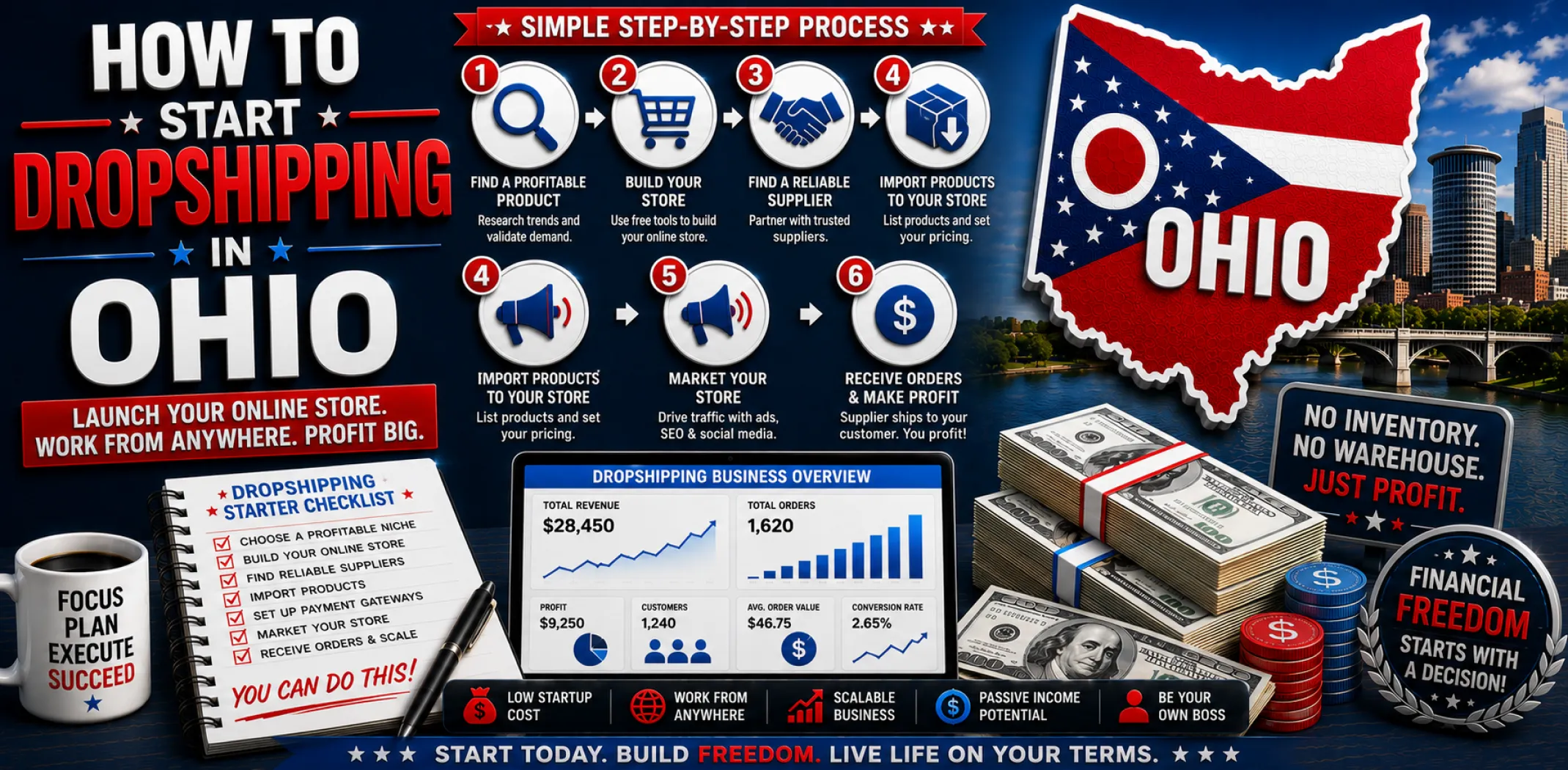
Every week, thousands of Ohio residents search for ways to start an online product business from home. The appeal is obvious – low startup costs, no office required, no boss, and the ability to earn from your phone while the rest of the household is asleep. If you have been researching online selling options for Ohio, you have probably realized quickly that not all models are created equal.
Some require sourcing physical products, managing supplier relationships, dealing with returns, and hoping your margins survive shipping costs. Others are faster, simpler, and better suited to someone starting from scratch in a state where the average household income is $71,389 and every dollar counts.
This guide cuts through the noise. It compares the real online selling models available to Ohio residents in 2026 – what each one actually requires, what it realistically earns, and which one gives you the best chance of building something real without a warehouse, a logistics degree, or a five-figure startup budget.
Quick Answer: Traditional physical-product online selling requires finding suppliers, managing inventory, handling returns, and surviving thin margins. Selling digital products online – guides, courses, checklists, and tools – eliminates all of that. No stock to hold, no shipping to coordinate, no logistics to manage. Ohio residents can launch a fully built digital products store through Sellvia’s free trial with 1,000 ready-made products included, and start selling the same day. This is the fastest, lowest-risk path to running an online store in Ohio in 2026.
Why online selling works in Ohio
Ohio is one of the most practical states in the country for building an online business. With 11.8 million residents, the 7th largest state population in the US, Ohio has a massive built-in audience that shops online daily.
Broadband access reaches 91.1% of Ohio residents according to BroadbandNow, meaning the infrastructure for running and growing an online store is in place for nearly every corner of the state – from Columbus and Cleveland to smaller cities like Zanesville, Chillicothe, and Defiance.
The economic case is just as strong. Ohio’s median household income of $71,389 sits 12% below the national average, which means a significant share of Ohio residents are actively looking for ways to supplement their income without taking on a second job with a fixed schedule.
Online selling from home checks every box that a second job does not – flexible hours, no commute, no manager, and the ability to scale income without trading more time for it.
Ohio also has a strong track record of ecommerce participation. US Census Bureau data shows consistent year-over-year growth in online retail sales nationally, and Ohio’s large, digitally connected population means Ohio residents are both buying and selling online in growing numbers.
For Ohio residents in smaller cities and rural areas where local employment options are limited, online selling from home is not a side strategy – it is often the most practical path available.
One more Ohio-specific advantage: the state charges just $99 to form an LLC, requires no annual report filing, and has no traditional corporate income tax. For someone starting an online business in Ohio, the barrier to formalizing is lower than in most states.
Online business models for Ohio residents – a real comparison
Before choosing how to build your online store, it helps to see the real picture side by side. Here is an honest comparison of the four main models Ohio residents consider when starting an online product business from home.
The physical product model carries the highest complexity and the most moving parts. Supplier vetting, product research, fulfillment setup, returns handling, and thin margins make it the hardest model for a first-time Ohio online seller to make work profitably.
Affiliate marketing and freelancing are both legitimate – but affiliate income takes months to build, and freelance income is capped by your available hours. The digital product store model removes the complexity of physical goods entirely and gives you a store that earns around the clock, not just when you are working.
That comparison is not a knock on any model. It is an honest look at what each one actually requires. For an Ohio resident starting from scratch, the model that lets you launch fastest with the lowest risk and the least prior knowledge is the one worth starting with – and for most Ohio residents, that is selling digital products online.
Tax considerations for online sellers in Ohio
Understanding your Ohio tax obligations before you start selling is one of the most practical things you can do. Here is what matters for Ohio online sellers.
Ohio income tax: Ohio taxes personal income on a graduated scale. The first $26,050 in taxable income is not taxed. Income from $26,051 to $100,000 is taxed at 2.75% plus $342. Income above $100,000 is taxed at 3.125% plus $2,394.
As a self-employed online seller, your store profits flow through to your personal return and are taxed at these rates. Many Ohio municipalities also charge a local income tax of 0.5% to 3% – check your city’s requirements, as Columbus, Cleveland, and Cincinnati all have their own local rates.
Ohio sales tax: Ohio’s base state sales tax rate is 5.75%, with an average combined state and local rate of 7.3%. Ohio online sellers must collect and remit sales tax if they exceed $100,000 in annual Ohio sales or complete 200 or more Ohio transactions in a year – this is called economic nexus.
If you sell through a marketplace facilitator like Amazon or Etsy, that platform collects and remits Ohio sales tax on your behalf. For digital products delivered electronically, Ohio’s sales tax rules differ from physical goods – consult the Ohio Department of Taxation at tax.ohio.gov or a qualified tax professional to confirm your obligations for your specific product type.
Commercial Activity Tax (CAT): Ohio’s CAT applies only to businesses with more than $6 million in annual gross receipts as of 2025. Most Ohio online sellers starting out will not come close to this threshold.
Key principle: As a self-employed Ohio online seller, you also owe federal self-employment tax of 15.3% on the first $160,200 in net earnings. Set aside 25–30% of your online income from the start to cover both federal and state obligations.
See your state tax breakdown at a glance
Simply enter your annual net profit, select your state, and the calculator will instantly generate a detailed tax breakdown while showing how your state’s tax burden compares to others.
How to register your online business in Ohio
Ohio makes business registration straightforward and affordable. Here is what you need to know.
Most Ohio online sellers start as a sole proprietor – no state filing required to begin operating. If you use your own legal name as your business name, you can start selling today with no registration cost. If you use a business name different from your own, a trade name registration with the Ohio Secretary of State costs $39.
Forming an LLC costs $99 by filing Articles of Organization with the Ohio Secretary of State. Online processing takes 1–2 business days. Ohio requires no annual report filing for LLCs, which means ongoing state compliance costs are essentially zero. An LLC creates legal separation between you and your business – generally worth the $99 investment once you are generating consistent income.
You can file at the Ohio Secretary of State Business Filings portal. You will also need a free federal EIN from IRS.gov – get it directly from the IRS in 10 minutes and never pay a third party for it.
Important note: If your online store generates taxable sales in Ohio, you may need to register for a vendor license with the Ohio Department of Taxation. The vendor license costs $25 and is required for businesses selling taxable goods or services in Ohio.
Step-by-step guide to starting an online product business in Ohio
Here is the practical path from zero to a live, selling online store in Ohio.
Step 1: Choose what to sell
For Ohio residents starting with no experience and limited budget, digital products are the lowest-friction starting point available. Guides, courses, checklists, and tools sell instantly after purchase, require no physical handling, and carry margins of 50–70% per sale. You do not need to source suppliers, negotiate pricing, or deal with returns.
Platforms like Sellvia pre-load your store with 1,000 ready-made digital products – you pick your niche, and the products are already there. If you want a broader overview of the landscape before deciding, our guide on how to start an online business in Ohio covers all the major models side by side.
Step 2: Register your business in Ohio
Start as a sole proprietor if you want to begin immediately with no cost. Register a trade name for $39 if you want a business name. Form an LLC for $99 when you are ready for legal protection. Get your free EIN from IRS.gov. Register for an Ohio vendor license at tax.ohio.gov if your products are taxable. None of these steps require a lawyer or an accountant – they are all self-service and can be completed online in an afternoon.
Step 3: Set up your store
For a digital products store, Sellvia builds the entire store for you during the free trial. You share your niche preferences, and the team sets up a fully functional store pre-loaded with 1,000 products – no coding, no design work, no tech knowledge required. The store is ready to take orders from day one. After the 14-day free trial, the plan is $39/month – roughly $1.30/day.
Step 4: Handle Ohio taxes
Set aside 25–30% of every sale from day one. Track your income in a simple spreadsheet or free accounting tool like Wave. If you expect to owe more than $1,000 in federal taxes for the year, make quarterly estimated payments to the IRS. Ohio has a similar estimated payment system for state taxes.
If you hit Ohio’s economic nexus threshold of $100,000 in annual sales or 200 transactions, register with the Ohio Department of Taxation and begin collecting sales tax. A local CPA familiar with Ohio small business taxes is worth consulting once your income becomes consistent.
Step 5: Start marketing
Marketing is not optional – it is the engine. For a digital products store, Sellvia’s built-in one-click advertising system lets you set a daily budget of $10–$50 and start reaching customers immediately. No marketing experience required. Many Ohio store owners report seeing their first orders on day one of activating ads.
Organic social media marketing through Facebook, Instagram, and TikTok costs nothing except time and can build a steady audience over weeks and months. The fastest results come from combining both: organic content to build trust, paid ads to drive immediate traffic.
Best niches for Ohio online sellers
Ohio’s demographic profile and economic landscape create some natural fits for digital product niches. Here are the strongest opportunities for Ohio online sellers in 2026.
Personal finance and budgeting
With a median household income 12% below the national average and a large population of working-class and middle-income families, Ohio has enormous demand for practical money management content.
Budgeting guides, debt payoff planners, savings trackers, and financial literacy courses sell consistently to Ohio’s core demographic. This niche has broad national appeal too, meaning your Ohio audience is just the starting point.
Home improvement and DIY
Ohio has a homeownership rate of 67.2% – well above the national average of 65.2%. That means millions of Ohio households are actively maintaining, improving, and renovating homes. Digital guides on home repair, renovation planning, energy efficiency, and seasonal maintenance sell well to this audience year-round.
Health, wellness, and fitness
Health content is one of the most consistent-selling digital product categories nationally, and Ohio’s population skews toward the age groups – 35 to 54 – most likely to invest in wellness guides, meal planning tools, and fitness programs. Weight loss guides, healthy eating planners, and stress management courses perform reliably across Ohio’s major and mid-sized cities alike.
Career development and side income
The same financial pressure that drives Ohio residents to search for online selling opportunities also drives strong demand for career advancement guides, resume templates, interview prep tools, and side income strategy guides. If you are reading this article, you are already in the target demographic for this niche – and so are millions of other Ohioans.
Parenting and family
Ohio has a large population of parents and caregivers, many of whom are managing tight budgets while raising children. Parenting guides, activity planners, homeschooling resources, and family budget tools are consistent sellers in this niche. Ohio’s Appalachian counties and smaller rural communities in particular have a high concentration of families who rely on practical, affordable guidance that they can access digitally.
Common challenges for Ohio online sellers
Building an online business in Ohio is achievable, but it is not without real obstacles. Here are the two most common challenges Ohio online sellers face and how to work through them.
Challenge 1: Slow early growth without paid marketing
Most Ohio online sellers who rely entirely on organic social media in the first 30–60 days grow more slowly than they expected. Organic reach on most platforms has declined significantly, and building an audience from zero takes consistent effort over weeks. The solution is not to panic – it is to plan for this from day one.
If budget allows, even $10–$20/day in targeted social ads from the start of your trial period dramatically shortens the time to a first sale. If budget does not allow, commit to posting daily across two or three platforms and engaging actively with comments and communities in your niche. Slow organic growth is not failure – it is the expected trajectory for a business without an ad budget.
Challenge 2: Balancing an online business with a full-time job
Most Ohio residents who start an online product business are already working – often more than one job. Finding 30–60 minutes per day to focus on marketing and store management can feel impossible after a 10-hour shift. The practical solution is to build a non-negotiable daily routine around your lowest-energy time – early morning before work, during a lunch break, or after the kids are in bed.
Treating those 30 minutes as a fixed appointment rather than optional effort is the single biggest behavioral difference between Ohio online sellers who build momentum and those who stall out after the first few weeks.
Resources for Ohio online sellers
Ohio has a strong support network for new online business owners. These resources are free and underused.
The SBA Ohio District Office in Columbus provides access to federal loan programs, business counseling, and free educational workshops for Ohio entrepreneurs at every stage.
Ohio’s Small Business Development Centers (SBDCs) operate at more than 30 locations across the state and offer free one-on-one consulting on business planning, marketing, and finance. Find your nearest center at ohiosbdc.org.
SCORE Ohio provides free mentoring from retired executives and experienced business owners. Chapters operate in Columbus, Cleveland, Cincinnati, Dayton, and other Ohio cities. Find a mentor at score.org/find-location.
The Ohio Department of Development at development.ohio.gov and the state’s business resource hub at businesshelp.ohio.gov list current state-level funding programs, incentives, and compliance guidance for Ohio business owners.
Why Sellvia is a game-changer for your online store 🚀
Sellvia isn’t just another ecommerce tool. We are a trusted name in the industry, recognized by Forbes and even ranked in Inc.’s list of the 5,000 fastest-growing companies in the U.S. So if you’re serious about starting as a solopreneur, this is a smart place to begin.
Starting an online business can feel overwhelming, but that’s exactly where Sellvia steps in. It takes care of the tricky parts, so you can focus on making sales and growing your brand. Let’s break down what makes it such a great choice.
Get a ready-to-go store hassle-free 🎯
Want to start selling but don’t know where to begin? No worries! Just share your ideas, and Sellvia’s team will build a free ecommerce website that’s fully set up and ready to take orders from day one. No coding, no stress – just a store that works right out of the box.
1,000 digital products ready to sell from day one 🎁
Not sure what to sell? Sellvia solves that instantly. Your store comes pre-loaded with 1,000 ready-made digital products – guides, courses, checklists, and tools – all created by Sellvia. No writing, no recording, no product creation needed. Just pick your niche, and the products are already there waiting for your first customer.
A massive catalog of digital products to sell 🏆
One of the biggest struggles in starting an online business is figuring out what to sell. Sellvia solves that completely. Your store comes pre-loaded with digital products – guides, courses, checklists, and tools – all created by Sellvia. You keep 50–70% of every sale. No inventory. No shipping. No logistics headaches.
Everything in one easy-to-use platform 🔥
Managing an online store shouldn’t be complicated. With Sellvia, you can handle orders, add new products, and even chat with customers – all from a simple and user-friendly platform. No need to mess with confusing tools or deal with unnecessary tech stuff. It’s all smooth sailing.
No upfront costs, just start selling 💰
A big reason people hesitate to start an online business is the cost. But here’s the good news: With Sellvia, you don’t need to invest in stock, storage, or shipping supplies. You can run your store with no upfront costs, keeping things low-risk while still making money.
Support that’s always got your back 🤝
Running a business comes with questions, but you’re never alone. Sellvia’s dedicated support team is available 24/7 to help with anything you need. Whether it’s a small question or a big challenge, they’ve got you covered.
Ohio residents who want to run an online store without the complexity of physical products have a smarter path available right now. Get your free store with 1,000 digital products and start building something real today.
How do I start an online store in Ohio?
Do I need a business license to sell online in Ohio?
Ohio does not require a statewide general business license for operating an online store. Operating as a sole proprietor under your legal name requires no state filing. If you use a different business name, a trade name registration costs 39 dollars. Forming an LLC costs 99 dollars and provides personal liability protection with no annual report fee. If your store sells taxable goods, you may need an Ohio vendor license from the Department of Taxation for 25 dollars. Always check your local city or county requirements, as Columbus, Cleveland, and Cincinnati each have their own additional licensing rules.
How much does it cost to start an online store in Ohio?
The cost to start an online store in Ohio depends on your model. Operating as a sole proprietor with free tools costs nothing upfront. Forming an LLC adds a one-time 99 dollar state filing fee. A fully built digital products store through Sellvia costs 39 dollars per month after a free 14-day trial – roughly 1 dollar and 30 cents per day – with no product creation, design, or development costs. A vendor license costs 25 dollars if required. Marketing through paid social ads can start at 10 dollars per day and is optional but recommended for faster results. Total startup costs for most Ohio online sellers fall between 0 and 200 dollars depending on the path they choose.
What do online sellers pay in taxes in Ohio?
Ohio online sellers owe state income tax at rates from 2.75 percent to 3.125 percent depending on their income level, with the first 26,050 dollars in taxable income exempt. Federal self-employment tax of 15.3 percent applies to net earnings. Ohio sales tax at a base rate of 5.75 percent must be collected from Ohio customers once an online seller exceeds 100,000 dollars in annual Ohio sales or 200 Ohio transactions. Many Ohio municipalities also charge a local income tax of 0.5 to 3 percent. Ohio does not have a traditional corporate income tax, and the Commercial Activity Tax applies only to businesses with more than 6 million dollars in annual gross receipts. Setting aside 25 to 30 percent of every sale from the start covers most Ohio online sellers comfortably.
What is the easiest online business to start in Ohio?
The easiest online business to start in Ohio in 2026 is a digital products store through a platform that handles the setup for you. Unlike physical product stores that require supplier relationships and logistics management, a digital products store comes pre-built with products already loaded – you focus entirely on marketing and sales. Sellvia builds the entire store during a free 14-day trial and includes 1,000 ready-made products with no creation work required. You keep 50 to 70 percent of every sale, there is no inventory to manage, and the store runs around the clock. For Ohio residents with no technical background and limited startup budget, this is the most realistic path to having a live, earning online store within days of starting.


