Every week, thousands of Oregon residents search for ways to start an online product business from home. If you landed here, you are probably one of them – tired of trading hours for dollars, looking for something you can build on your own schedule, and wondering whether running an online store is actually realistic for someone without a tech background or a lot of startup cash.
The honest answer is yes – but the model matters more than most people realize.
Traditional online selling models built around physical products require suppliers, logistics coordination, returns management, and razor-thin margins that leave little room for error. Oregon residents – especially those in smaller cities and rural areas where local job options are limited – often find that the complexity and upfront costs of physical product businesses make them harder to sustain than they appeared.
Quick Answer: Selling digital products online is a faster, lower-cost, and lower-risk path to online income for Oregon residents in 2026. Oregon has no state sales tax, which removes one of the biggest compliance burdens traditional online sellers face in other states. A digital product store requires no suppliers, no logistics, and no inventory – and platforms like Sellvia let you launch a complete store with 1,000 ready-made products in a free 14-day trial, no credit card required.
This guide covers why online selling works in Oregon, how the main business models compare honestly, what you need to know about Oregon taxes and registration, and a step-by-step path to your first sale.
Why online selling works in Oregon
Oregon has a combination of economic conditions that make it one of the more favorable states for running an online store from home. Understanding this context helps you see why online selling is not a long shot here – it is a realistic move for people at many different income levels and locations across the state.
Oregon’s population reached approximately 4.25 million in 2024, spread across a mix of urban centers like Portland, Eugene, and Salem, and a large rural interior. The median household income hit $83,011 in 2024, according to US Census data – slightly above the national median. That means both you and your potential customers are in a market with real spending power.
Internet access is strong statewide. About 88.4% of Oregon residents have access to wired or fixed wireless broadband, and 99.5% have access to wireless internet options. That connected population is your customer base – and your operating infrastructure.
As long as you have a phone or a laptop and a decent connection, you can run an online store from anywhere in Oregon, including areas where traditional employment options are thin.
The single biggest advantage Oregon offers online sellers is its tax structure. Oregon has no state sales tax – one of only five states in the country with that distinction. There are no marketplace facilitator laws and no economic nexus sales tax rules, because there is no sales tax to enforce.
For online sellers, this eliminates an entire layer of compliance that sellers in states like California, Washington, and Texas have to manage from day one. You will owe Oregon state income tax on your earnings, but you will not spend hours managing sales tax registrations, collection, or remittance.
Oregon also saw a 57.4% increase in new business formations in 2025, with approximately 540,000 active businesses registered statewide. The momentum around new business creation is real – and online businesses are a significant part of that growth.
Online business models for Oregon residents – a real comparison
Not all online selling models are the same. The table below gives you an honest side-by-side comparison of the four main options available to Oregon residents starting from scratch. Read through it carefully – the differences in complexity, cost, and earning potential are significant.
Physical product stores offer the widest product range but carry the most complexity and the lowest margins of the four models. Affiliate marketing is free to start but slow to generate real income. Freelancing earns well per hour but does not scale beyond your available time.
Digital product stores offer the best combination of low startup cost, fast setup, and high margin – particularly in Oregon where the lack of sales tax removes the main compliance burden physical sellers face.
The comparison speaks for itself: for Oregon residents with no prior experience and limited startup budget, a digital product store is the most practical starting point. If you want a deeper look at the full spectrum of models, the guide on how to start an online business in Oregon covers each one in more detail.
Tax considerations for online sellers in Oregon
Oregon’s tax picture is one of the best in the country for online sellers. Here is what you actually need to know – without the jargon.
No Oregon sales tax: Oregon does not impose a state sales tax. This means you do not collect sales tax from Oregon customers, you do not need to register for a sales tax permit, and there are no marketplace facilitator laws or economic nexus sales tax rules in the state.
This is a genuine and significant advantage over online sellers based in most other states, where sales tax compliance adds real administrative work and cost from day one.
Important note: If you sell to customers in other states – which is likely once your store is running – those states’ sales tax rules may apply once you exceed their sales thresholds. Most beginners do not hit those thresholds quickly, but it is worth monitoring as your sales grow. When in doubt, consult a tax professional or check the rules for each state directly.
Oregon state income tax: You will owe Oregon income tax on your net business earnings. Oregon uses a progressive income tax with rates from 4.75% to 9.9% for the 2025 tax year. Single filers pay 4.75% on the first $4,050 of taxable income, 6.75% up to $10,200, 8.75% up to $125,000, and 9.9% above $125,000. Most new online sellers starting out will fall in the 6.75%–8.75% range after deductions.
Estimated quarterly taxes: If you expect to owe more than $1,000 in Oregon income tax for the year, you are generally required to make quarterly estimated payments to the Oregon Department of Revenue. Track your income from the first sale and set aside roughly 25–30% of net profit to cover both Oregon state income tax and federal self-employment tax.
Key principle: Business expenses – your monthly platform plan, advertising costs, home office, phone, and internet – are deductible against your taxable income. Keep receipts for every business expense from day one.
How to register your online business in Oregon
Registration is simpler than most people expect, and in Oregon, it is also inexpensive.
Sole proprietorship: No formal state registration is required to operate as a sole proprietor in Oregon if you use your own legal name. You can start selling online today under your name with zero paperwork. If you want to use a business name, file an Assumed Business Name (DBA) with the Oregon Secretary of State for $50 – valid for two years.
LLC: Forming an LLC in Oregon costs $100 to file the Articles of Organization with the Secretary of State. Online filings are typically processed in 2–3 business days. There is a $100 annual report fee due each year on your LLC’s anniversary date.
Oregon does not charge a franchise tax on LLCs, which keeps recurring costs low. An LLC separates your personal finances from your business liabilities – worth considering once your store is generating consistent income.
You can register your business and search available business names at the Oregon Secretary of State Business Registry. The process is online and most applicants complete it in under an hour.
Step-by-step guide to starting an online product business in Oregon
Here is a practical sequence for getting from zero to your first sale. Every step is specific to Oregon’s registration and tax environment.
Step 1: Choose what to sell
This is the step that stops most people. Choosing a product niche feels overwhelming when you are starting from scratch. The fastest path past this obstacle is to use a platform that already provides products for you.
Sellvia’s free 14-day trial gives you a complete store pre-loaded with 1,000 digital products – guides, courses, checklists, and tools – organized by niche. You browse the catalog, pick a direction that resonates with you, and your products are already there. No supplier research, no product creation, no inventory decisions.
If you want to build your own product lineup from scratch instead, focus on niches with strong Oregon demand – outdoor recreation, homesteading, small business resources, and wellness are all areas with demonstrated buyer interest in this state.
Step 2: Register your business in Oregon
For most beginners, start as a sole proprietor under your own name – zero cost, zero paperwork, legal from day one. Once your store is generating $500–$1,000 per month consistently, consider filing an Oregon LLC for $100 to add liability protection and open a dedicated business bank account. Keep personal and business finances separate from the first sale regardless of your structure.
Step 3: Set up your store
A Sellvia free trial is the lowest-barrier complete store setup available for Oregon residents with no technical background. Your store is built by Sellvia’s team, loaded with products, and ready to take orders on day one. No coding, no design work, no platform learning curve beyond the basics. The free trial runs 14 days with no credit card required and includes a $40 advertising credit. After the trial, the monthly plan is $39.
If you prefer to build independently, Shopify and WooCommerce are the most widely used platforms – but both require you to source your own products, design your own store, and set up marketing from scratch. For a first-time Oregon online seller, that learning curve adds weeks or months before your first sale.
Step 4: Handle Oregon taxes
Set up a simple spreadsheet from day one to track every sale and every business expense. Oregon has no sales tax, so there is no collection or remittance needed for Oregon customers. You will owe Oregon income tax on net profit – typically in the 6.75%–8.75% range for new sellers – plus federal self-employment tax. Setting aside 25–30% of net profit each month keeps you covered at tax time.
If you expect to earn more than a few thousand dollars in your first year, consider making quarterly estimated payments to the Oregon Department of Revenue at oregon.gov/dor to avoid underpayment penalties.
Step 5: Start marketing
Marketing is where most first-time online sellers stall. Sellvia’s built-in one-click advertising system removes the biggest barrier – you set a daily budget between $10 and $50, activate with one click, and the system handles the targeting. Many Sellvia customers see their first orders on the day they activate ads, though results vary based on niche, budget, and consistency.
For free marketing, focus on one or two social platforms where your target audience is active – Instagram and TikTok work well for lifestyle and wellness niches; Facebook Groups and Pinterest work well for home, parenting, and practical skills niches common in Oregon’s demographics.
Best niches for Oregon online sellers
Oregon’s demographics and cultural identity create strong demand in specific niches. These are not generic national categories – they reflect what Oregon residents actually buy, search for, and care about.
Outdoor recreation and adventure
Oregon is one of the most outdoor-oriented states in the country. Hiking, camping, kayaking, mountain biking, and skiing are embedded in Oregon culture from the coast to the Cascades to the high desert.
Digital guides covering trip planning, gear selection, training plans, and safety skills have a large, engaged audience in this state. This niche works particularly well for sellers who want to tap into Oregon’s identity without needing any specialized credentials.
Homesteading, self-sufficiency, and rural living
A significant portion of Oregon’s population lives outside urban centers, and interest in homesteading, food preservation, off-grid living, and self-sufficiency has grown substantially in recent years. Digital guides covering these topics – canning, gardening, water systems, animal husbandry basics – address a real and underserved information need for rural Oregon residents and newcomers to rural life.
Small business and side income
Oregon’s 57.4% surge in new business formations in 2025 signals a population actively looking for ways to build their own income. Digital guides covering how to start a business, write a business plan, manage basic bookkeeping, or market a local service are in strong demand. This niche is particularly well-suited to digital product sellers because the audience is already motivated and actively searching for practical information.
Wellness, fitness, and mental health
Oregon consistently ranks among the most health-conscious states in the country. Digital products covering fitness programming, nutrition planning, stress management, and mental wellness tools have a broad and loyal audience statewide. Portland and Bend in particular have strong wellness cultures, but demand extends well into smaller Oregon communities as well.
Personal finance and debt management
With a median household income of $83,011, Oregon sits near but not far above the national median – and a meaningful share of Oregon households are managing tight budgets, student loans, or the financial pressures of high housing costs in cities like Portland and Bend.
Digital guides covering budgeting, debt payoff strategies, credit building, and financial planning for self-employed workers address a genuine pain point for a large segment of Oregon’s population.
Common challenges for Oregon online sellers
Online selling in Oregon is achievable, but it comes with specific friction points worth knowing about in advance.
Standing out in a crowded digital market
The same low barriers that make online selling accessible also mean there is significant competition in most niches. The sellers who stand out are not necessarily the ones with the biggest budgets – they are the ones who are most consistent and most specific.
Choosing a focused niche rather than trying to sell everything to everyone is the single most effective way to differentiate your Oregon store. A guide on “Pacific Northwest camping for beginners” reaches a more engaged buyer than a generic “outdoor recreation” catalog.
Rural broadband gaps
About one in ten Oregon residents lacks access to reliable wired broadband, and the gap is larger in rural counties like Harney, Lake, and Wheeler. Running an online store on an unreliable connection is frustrating but manageable if you plan around it.
Handle bandwidth-heavy tasks – uploading images, running ad dashboards – at a library or community college with faster service, and use your phone for day-to-day store management tasks, which are typically low-bandwidth. Oregon has active broadband expansion programs underway through the Oregon Broadband Office, so connectivity in many rural areas is improving.
Staying consistent past the first month
The most common reason Oregon online sellers do not reach their income goals is not lack of opportunity – it is stopping too early. The first 30 days rarely produce life-changing results.
The sellers who get to $50–$100 per day are almost universally the ones who showed up every day for 60–90 days, adjusted what was not working, and kept going. Building a simple weekly review habit – what sold, what ads performed, what content got engagement – keeps you moving in the right direction even when early results are slow.
Resources for Oregon online sellers
Oregon has a strong network of free resources for new online business owners. These are worth bookmarking before you start.
Oregon SBDC Network – Free one-on-one business advising through 19 centers hosted at community colleges across the state. Advisers can help with business planning, financial projections, and marketing strategy – all at no cost. During the 2023–2025 biennium, SBDC advisers helped Oregon businesses increase sales by over $71 million. Find your nearest center at oregonsbdc.org.
SCORE Oregon – Free mentoring from experienced business professionals, available in person in Portland, Eugene, and Salem, and virtually statewide. Visit score.org to connect with an Oregon mentor.
SBA Oregon District Office – The US Small Business Administration’s Oregon office provides free training, business counseling referrals, and access to federally backed financing. Visit sba.gov/offices/district/or/portland.
Business Oregon – The state’s economic development agency runs more than 80 programs for Oregon businesses, including rural business support, the Thriving Entrepreneurs Grant Program, and access to capital resources. Visit oregon.gov/biz.
Oregon Department of Revenue – For income tax guidance, estimated payment instructions, and business tax registration, visit oregon.gov/dor. The department publishes plain-language guides specifically for self-employed and small business filers.
Why Sellvia is a game-changer for your online store 🚀
Sellvia isn’t just another ecommerce tool. We are a trusted name in the industry, recognized by Forbes and even ranked in Inc.’s list of the 5,000 fastest-growing companies in the U.S. So if you’re serious about starting as a solopreneur, this is a smart place to begin.
Starting an online business can feel overwhelming, but that’s exactly where Sellvia steps in. It takes care of the tricky parts, so you can focus on making sales and growing your brand. Let’s break down what makes it such a great choice.
Get a ready-to-go store hassle-free 🎯
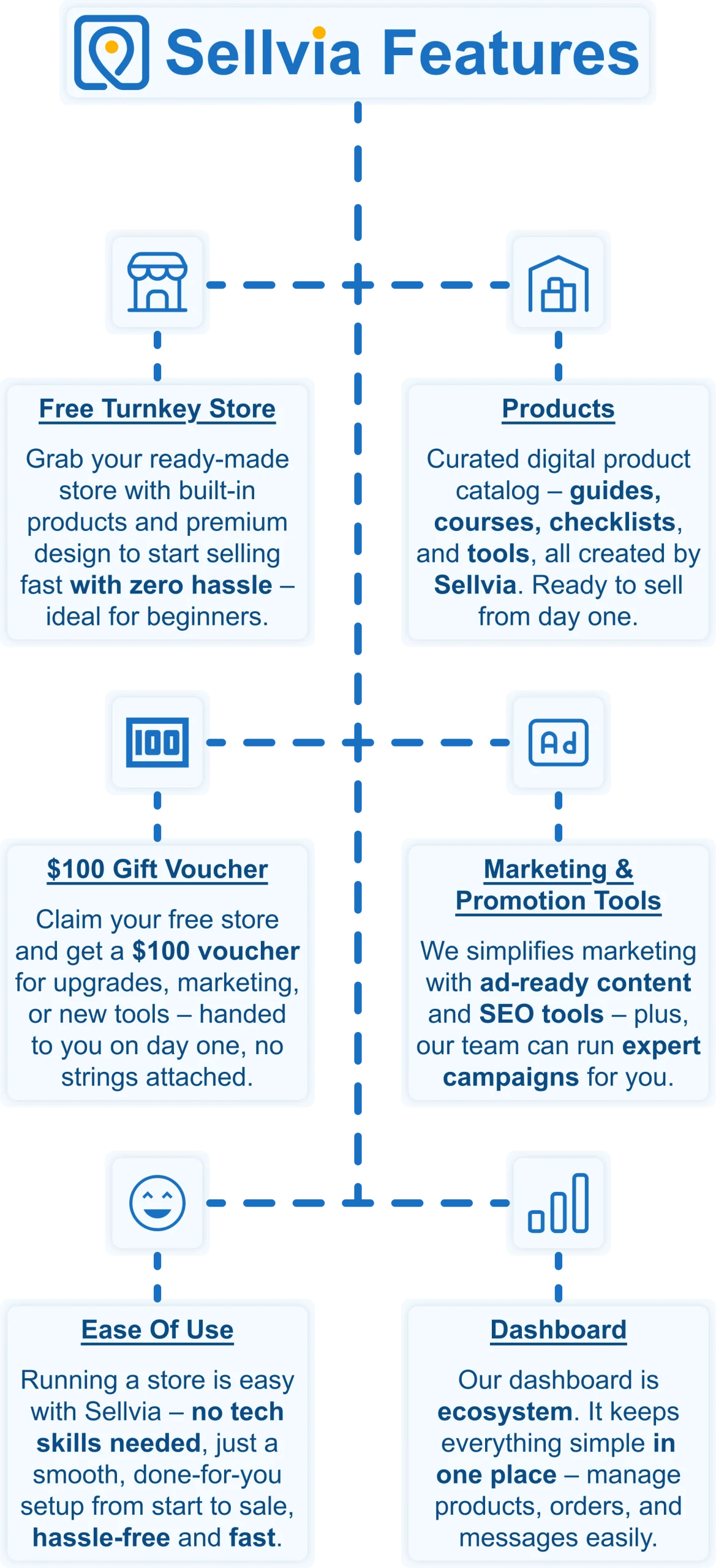
Want to start selling but don’t know where to begin? No worries! Just share your ideas, and Sellvia’s team will build a free ecommerce website that’s fully set up and ready to take orders from day one. No coding, no stress – just a store that works right out of the box.
1,000 digital products ready to sell from day one 🎁
Not sure what to sell? Sellvia solves that instantly. Your store comes pre-loaded with 1,000 ready-made digital products – guides, courses, checklists, and tools – all created by Sellvia. No writing, no recording, no product creation needed. Just pick your niche, and the products are already there waiting for your first customer.
A massive catalog of digital products to sell 🏆
One of the biggest struggles in starting an online business is figuring out what to sell. Sellvia solves that completely. Your store comes pre-loaded with digital products – guides, courses, checklists, and tools – all created by Sellvia. You keep 50–70% of every sale. No inventory. No shipping. No logistics headaches.
Everything in one easy-to-use platform 🔥
Managing an online store shouldn’t be complicated. With Sellvia, you can handle orders, add new products, and even chat with customers – all from a simple and user-friendly platform. No need to mess with confusing tools or deal with unnecessary tech stuff. It’s all smooth sailing.
No upfront costs, just start selling 💰
A big reason people hesitate to start an online business is the cost. But here’s the good news: With Sellvia, you don’t need to invest in stock, storage, or shipping supplies. You can run your store with no upfront costs, keeping things low-risk while still making money.
Support that’s always got your back 🤝
Running a business comes with questions, but you’re never alone. Sellvia’s dedicated support team is available 24/7 to help with anything you need. Whether it’s a small question or a big challenge, they’ve got you covered.
Oregon is one of the most tax-friendly states in the country for online sellers, and digital products are the model built for it. Get your free Oregon store with 1,000 digital products ready to sell.
How do I start an online store in Oregon?
Do I need a business license to sell online in Oregon?
Oregon does not have a single statewide business license requirement for online sellers. Operating as a sole proprietor under your own legal name requires no state registration fee. If you want to use a business name, file an Assumed Business Name with the Oregon Secretary of State for 50 dollars. An LLC costs 100 dollars to file online, with processing in 2 to 3 business days. Some cities and counties require a local business license, so check with your local government if you are operating from a specific location.
How much does it cost to start an online store in Oregon?
The minimum cost to start an online store in Oregon is very low. Selling as a sole proprietor under your own name has no mandatory registration fee. A DBA costs 50 dollars and an LLC costs 100 dollars. Sellvia offers a free 14-day trial with no credit card required, including a 40 dollar advertising credit. After the trial, the monthly plan is 39 dollars. The main ongoing cost beyond the platform is optional advertising spend, which can start as low as 10 dollars per day with Sellvia is built-in one-click ad system.
What do online sellers pay in taxes in Oregon?
Oregon online sellers do not pay any state sales tax because Oregon has no sales tax. There are no marketplace facilitator laws and no economic nexus sales tax rules in the state. Oregon does tax personal income at rates from 4.75% to 9.9% for the 2025 tax year, depending on earnings and filing status. Most new online sellers earning 20,000 to 60,000 dollars per year will owe tax in the 6.75% to 8.75% range after deductions. Setting aside 25 to 30 percent of net profit each month for state and federal taxes is a practical starting point for new Oregon online business owners.
What is the easiest online business to start in Oregon?
The easiest online business to start in Oregon for someone with no experience is a digital product store. It requires no product creation, no supplier relationships, no logistics management, and no sales tax compliance for Oregon customers. Sellvia provides a complete ready-made store with 1,000 digital products already loaded, built-in advertising tools, and 24 hour support. Oregon is particularly well suited to this model because its no-sales-tax environment removes the main administrative burden that makes physical product stores more complex. Most new sellers can launch a working store and activate their first ad campaign on the same day they sign up.


