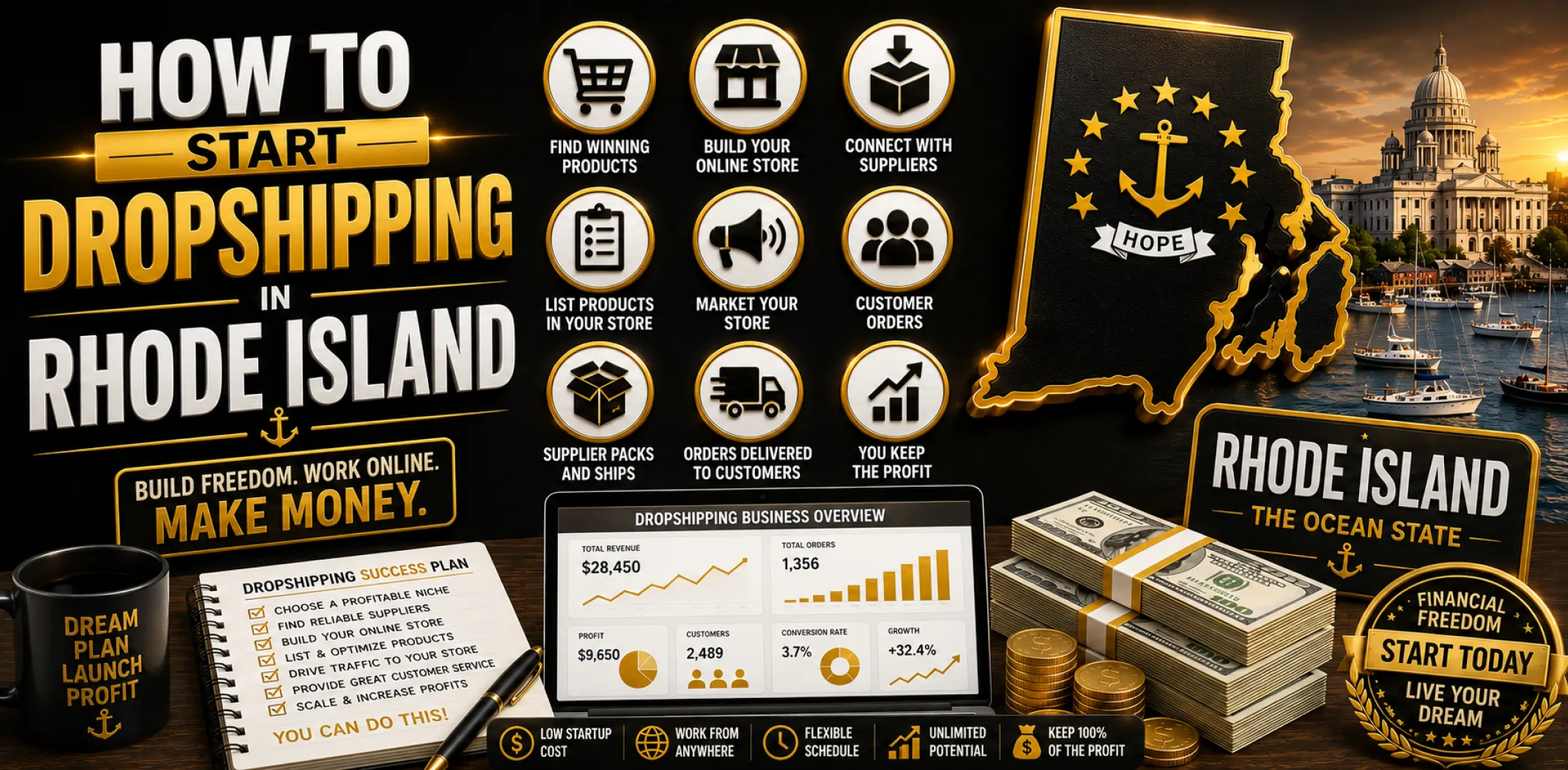
Every week, thousands of Rhode Island residents search for ways to start selling online from home. They want something real – a business that does not require a second job, a warehouse, or years of experience.
If you have been looking into starting an online product business, you have probably already run into how complicated the traditional physical-product model can be: finding reliable suppliers, managing inventory, handling returns, and dealing with shipping delays that frustrate customers and eat into margins.
There is a better path. And it is one that more Ocean State residents are finding every year.
Quick Answer: The most practical way to start an online product business in Rhode Island right now is to sell digital products – guides, courses, checklists, and tools that customers receive instantly after purchase. No supplier coordination, no logistics, no inventory. You keep 50–70% of every sale. This guide walks you through how it works, how it compares to other models, what Rhode Island taxes and registration actually require, and how to get started today.
Why online selling works in Rhode Island
Rhode Island is a small state with big online potential. With a population of approximately 1.1 million and a median household income of $87,796, the Ocean State sits slightly above the national median – but the cost of living, especially housing and property taxes, means that many Rhode Island families are looking for ways to supplement or replace traditional employment income.
The infrastructure for online selling is strong. According to US Census Bureau data, 78% of Rhode Island households subscribe to broadband internet, one of the higher adoption rates in New England. That connectivity is the foundation every online business runs on – and it means Rhode Island residents are already online, already buying, and already comfortable with digital transactions.
The state’s location in the Northeast corridor, with easy cultural and economic ties to Boston, Providence, and the broader New England market, gives Rhode Island sellers access to a dense, well-connected consumer base.
But when you run an online product business, your market is not Rhode Island – it is the entire country. A resident of Woonsocket or Westerly can sell to a customer in Phoenix or Portland just as easily as to someone in Providence.
Nationally, online retail now accounts for roughly a fifth of all retail sales, a share the US Small Business Administration projects will grow to 22.6% by 2027. Rhode Island sellers who build an online store today are getting in ahead of continued growth, not chasing a trend that has already peaked.
Online business models for Rhode Island residents – a real comparison
Not every online selling model is right for every person. Here is an honest comparison of the four most common options – what each one actually requires, and what it realistically pays.
The comparison above makes one thing clear: the physical product model and the digital product model have similar earning ceilings, but very different complexity levels.
Physical product stores require ongoing supplier management, customer service around shipping issues, and margin compression from fulfillment costs. A digital product store eliminates all of that – the products are delivered instantly, there is nothing to ship, and your margin stays in the 50–70% range on every sale.
For Rhode Island residents who want to run an online store from home without managing logistics, the digital product model is the more straightforward path. It is not easier in the sense of requiring no work – consistent promotion is essential – but it removes the layers of complexity that stop most people before they ever make their first sale.
Tax considerations for online sellers in Rhode Island
Taxes are one of the most common sources of confusion for new online sellers. Here is what Rhode Island actually requires – no jargon, no guesswork.
State income tax: Rhode Island uses a three-bracket progressive income tax system. The first $79,900 of taxable income is taxed at 3.75%. Income between $79,900 and $181,650 is taxed at 4.75%. Income above $181,650 is taxed at 5.99%.
As a self-employed online seller, you report your net business profit – revenue minus deductible expenses – on your Rhode Island personal income tax return. Most first- and second-year online sellers fall into the 3.75% or 4.75% bracket.
Sales tax: Rhode Island’s state sales tax rate is a flat 7%. There are no city or county sales taxes layered on top – what the state charges is the full amount. If you sell taxable goods to Rhode Island customers through your own online store, you are required to register for a sales tax permit ($10, renewed annually for $10) and collect sales tax once you meet the economic nexus threshold.
Economic nexus threshold: Rhode Island’s economic nexus threshold is $100,000 in gross sales to Rhode Island customers in the current or prior calendar year. If your sales to Rhode Island buyers stay below that level, you generally do not need to collect Rhode Island sales tax on those transactions. Most new online sellers are well below this threshold for their first year.
Digital products and sales tax: Rhode Island taxes certain digital goods, including vendor-hosted software (SaaS). The rules for other digital products – such as downloadable guides and courses – are more nuanced. Consult the Rhode Island Division of Taxation or a local accountant as your business grows to confirm your specific obligations.
Marketplace facilitator law: Rhode Island requires marketplace facilitators – large platforms like Amazon, Etsy, and Walmart Marketplace – to collect and remit sales tax on behalf of sellers who use their platforms, when the platform’s total Rhode Island sales exceed $100,000 or 200 transactions. If you sell through one of these large platforms, the platform handles the sales tax collection for you on those transactions.
Quarterly estimated taxes: If you expect to owe more than $250 in Rhode Island income tax for the year, you must make quarterly estimated payments to the Rhode Island Division of Taxation. Set aside 25–30% of your net profit from the start, and pay quarterly to avoid penalties at year-end.
See your state tax breakdown at a glance
Simply enter your annual net profit, select your state, and the calculator will instantly generate a detailed tax breakdown while showing how your state’s tax burden compares to others.
How to register your online business in Rhode Island
The registration steps for an online business in Rhode Island are straightforward. Here is what you actually need to do.
Sole proprietorship: If you operate under your own legal name, you do not need to file anything with the state to start selling. You report your business income on your personal Rhode Island tax return. If you use a business name different from your own legal name, you must file a fictitious name (DBA) registration with the Rhode Island Secretary of State for $50. No renewal required.
LLC (Limited Liability Company): An LLC protects your personal assets from business liabilities. To form one in Rhode Island, file Articles of Organization online at sos.ri.gov. The state filing fee is $150, and online processing typically takes 1–3 business days.
All Rhode Island LLCs must file an annual report between September 1 and November 1 each year ($50 fee) and pay a minimum annual tax of $400 to the Rhode Island Division of Taxation – regardless of income level.
Sales tax permit: If your sales trigger the economic nexus threshold, register for a Rhode Island sales tax permit through the Rhode Island Division of Taxation. The permit costs $10 and must be renewed annually.
Most new online sellers start as sole proprietors, skip the LLC until their income justifies the $400 annual minimum tax, and focus their first months on building the business rather than the paperwork.
Step-by-step guide to starting an online product business in Rhode Island
Here is the practical path from zero to first sale for Rhode Island residents who are ready to move.
Step 1: Choose what to sell
The most important decision you will make is what type of product business to run. Physical product stores require suppliers, inventory management, and logistics coordination – all of which add cost, complexity, and time before your first sale. Digital product stores eliminate those layers entirely.
A digital product store pre-loaded with 1,000 ready-made guides, courses, checklists, and tools gives you something to sell from day one – without creating anything yourself. You pick your niche, the products are already there, and you keep 50–70% of every sale. For most Rhode Island residents starting from scratch, this is the lowest-friction path to a first sale.
Step 2: Register your business in Rhode Island
If you are starting as a sole proprietor under your own name, there is nothing to file at this stage. If you want a business name or LLC protection, follow the registration steps in the section above. Most new sellers do not need an LLC on day one – you can add that structure once your income makes the $400 annual minimum tax worthwhile.
Step 3: Set up your store
Your store platform determines how quickly you reach your first sale. Building from scratch – sourcing products, designing pages, and setting up payment processing individually – can take weeks. A platform that provides your store, products, and promotional tools together gets you to launch in a day.
Sellvia’s free trial gives Rhode Island residents a fully built store pre-loaded with 1,000 digital products and a one-click ad system, with no credit card required to start. For a full breakdown of how online selling models compare, see our guide to how to start an online business in Rhode Island.
Step 4: Handle Rhode Island taxes
From your first sale, track every dollar of revenue and every legitimate business expense. Set aside 25–30% of your net profit for federal and state income taxes. If you sell to Rhode Island customers and approach the $100,000 annual nexus threshold, register for a Rhode Island sales tax permit and begin collecting the state’s 7% rate on applicable transactions.
Quarterly estimated tax payments are due to both the IRS and the Rhode Island Division of Taxation if your annual tax liability will exceed $250 at the state level. Missing these payments results in underpayment penalties – not a disaster, but avoidable with basic bookkeeping from the start.
Step 5: Start marketing
Paid advertising is the fastest path to first sales. A budget of $10–$50 per day on Facebook or Instagram, targeted to people already interested in your product niche, can generate orders on the same day you activate it. Many store owners using Sellvia’s built-in one-click ad system see their first orders within 24 hours of launching.
Organic methods – posting on social media, building a following, sharing helpful content – cost nothing but time. They are slower but sustainable. The most effective approach combines both: paid ads for fast traction, organic content for long-term growth without ongoing ad spend.
Best niches for Rhode Island online sellers
Niche selection matters – and the right niche for a Rhode Island seller takes into account who is buying, what they need, and where the Ocean State’s economy and culture create natural demand.
Personal finance and budgeting
With a poverty rate of nearly 11% and a significant portion of residents living paycheck to paycheck, practical personal finance content has consistent demand in Rhode Island and across the country. Budgeting guides, debt payoff planners, and savings trackers are among the most reliably purchased digital products online – and they require no credentials to sell, only a well-organized product that genuinely helps people.
Home-based business and side income
The same financial pressure that brought you to this article brings hundreds of thousands of others to search for ways to earn from home. Guides on starting a freelance business, building an online income, and managing the tax side of self-employment sell consistently across all 50 states.
Rhode Island’s above-average education level means buyers here are often looking for actionable, professional-quality content – not generic advice.
Health, wellness, and fitness
Rhode Island’s population skews slightly older – the state’s median age is around 40 – which creates demand for digital products in the health and wellness space: meal planning guides, exercise programs designed for home use, sleep improvement resources, and chronic condition management tools. These products have strong year-round demand and a wide audience across age groups.
Education and skill-building
Rhode Island has one of the higher concentrations of college and university students in New England, given the presence of Brown University, Rhode Island School of Design, and the University of Rhode Island. Study guides, productivity tools, career planning resources, and professional skill-building courses have consistent demand from students and young professionals in the region and nationally.
Parenting and family resources
Rhode Island’s child poverty rate of 16.3% reflects a large population of parents managing tight budgets while raising children. Practical parenting guides, educational activity packs, meal planning tools for families, and resources for managing household finances on a limited budget are all strong-selling digital product categories with audiences that are actively searching for solutions.
Common challenges for Rhode Island online sellers
Starting an online product business is not without obstacles. Here are the ones Rhode Island sellers most commonly face – and what to do about each.
Challenge 1: Rhode Island’s high cost of living creates pressure for fast results. The Ocean State consistently ranks among the most expensive in the Northeast, with property taxes that are among the highest in the country and housing costs that put real strain on family budgets. That financial pressure can make it tempting to give up on an online business before it has had time to gain traction.
The solution is to choose a model with the shortest possible time-to-first-sale. A digital product store with a built-in ad system can generate orders within 24 hours of launch – not because success is instant, but because the friction between starting and selling is lower than any other model available. Even one sale in the first week is meaningful proof that the model works.
Challenge 2: Building trust with buyers takes time. First-time online sellers often struggle with the question of why a stranger would buy from a brand-new store with no reviews.
The honest answer is that social proof takes time to build – but it can be accelerated. Platforms that provide professionally created products and a polished store design start you ahead of most first-time sellers. Every order you receive and fulfill well is a building block toward a reputation. Customer reviews, even just a handful, change how new buyers see you. Focus on getting those first 5–10 reviews as quickly as possible.
Challenge 3: Staying consistent when results are slow. Most online businesses take 60–90 days of consistent effort before income becomes predictable. That period is where most people quit – right before things start working.
The sellers who succeed are the ones who treat the first 90 days as a learning phase rather than a judgment on whether the business will work. Track what is performing, adjust what is not, and keep showing up. Rhode Island residents who have built anything – a career, a family, a home – already know what consistency looks like. This is no different.
Resources for Rhode Island online sellers
These free resources are available to any Rhode Island resident and can make a real difference in the early stages of building an online business.
Rhode Island Small Business Development Center (RISBDC): Free one-on-one counseling, workshops, and a “Start-Up Foundations” program covering everything from idea validation to launch. Based at the University of Rhode Island and available to anyone in the state. Visit web.uri.edu/risbdc.
SCORE Rhode Island: Free, confidential mentoring from experienced business professionals in your industry. In-person, phone, or online sessions – completely free. Access through sos.ri.gov.
SBA Rhode Island District Office: Free monthly workshops, business planning support, and SBA financing resources for Ocean State entrepreneurs. Find their schedule and contact information at sba.gov.
Rhode Island Secretary of State – Business Services: Online business registration, name searches, and annual report filing at sos.ri.gov. The Business Services Division is reachable at (401) 222-3040 for questions about registration requirements.
Rhode Island Division of Taxation: Sales tax registration, income tax guidance, and quarterly estimated tax payments at tax.ri.gov.
Why Sellvia is a game-changer for your online store 🚀
Sellvia isn’t just another ecommerce tool. We are a trusted name in the industry, recognized by Forbes and even ranked in Inc.’s list of the 5,000 fastest-growing companies in the U.S. So if you’re serious about starting as a solopreneur, this is a smart place to begin.
Starting an online business can feel overwhelming, but that’s exactly where Sellvia steps in. It takes care of the tricky parts, so you can focus on making sales and growing your brand. Let’s break down what makes it such a great choice.
Get a ready-to-go store hassle-free 🎯
Want to start selling but don’t know where to begin? No worries! Just share your ideas, and Sellvia’s team will build a free ecommerce website that’s fully set up and ready to take orders from day one. No coding, no stress – just a store that works right out of the box.
1,000 digital products ready to sell from day one 🎁
Not sure what to sell? Sellvia solves that instantly. Your store comes pre-loaded with 1,000 ready-made digital products – guides, courses, checklists, and tools – all created by Sellvia. No writing, no recording, no product creation needed. Just pick your niche, and the products are already there waiting for your first customer.
A massive catalog of digital products to sell 🏆
One of the biggest struggles in starting an online business is figuring out what to sell. Sellvia solves that completely. Your store comes pre-loaded with digital products – guides, courses, checklists, and tools – all created by Sellvia. You keep 50–70% of every sale. No inventory. No shipping. No logistics headaches.
Everything in one easy-to-use platform 🔥
Managing an online store shouldn’t be complicated. With Sellvia, you can handle orders, add new products, and even chat with customers – all from a simple and user-friendly platform. No need to mess with confusing tools or deal with unnecessary tech stuff. It’s all smooth sailing.
No upfront costs, just start selling 💰
A big reason people hesitate to start an online business is the cost. But here’s the good news: With Sellvia, you don’t need to invest in stock, storage, or shipping supplies. You can run your store with no upfront costs, keeping things low-risk while still making money.
Support that’s always got your back 🤝
Running a business comes with questions, but you’re never alone. Sellvia’s dedicated support team is available 24/7 to help with anything you need. Whether it’s a small question or a big challenge, they’ve got you covered.
Rhode Island residents who want to run an online product business from home do not need suppliers, logistics, or a warehouse to get started. Get your free store with 1,000 digital products ready to sell.
How do I start an online store in Rhode Island?
Do I need a business license to sell online in Rhode Island?
Rhode Island does not require a general statewide business license for most online sellers. Certain regulated industries such as healthcare, food, and financial services require specific professional licenses, but selling digital products online does not fall into those categories. If you sell under your own legal name as a sole proprietor, there is no registration required to begin. If you use a business name, you need to file a 50 dollar fictitious name registration with the Rhode Island Secretary of State. Forming an LLC costs 150 dollars plus a 50 dollar annual report fee and a 400 dollar minimum annual tax to the Division of Taxation each year.
How much does it cost to start an online store in Rhode Island?
The minimum cost to start an online store in Rhode Island depends on your business structure and platform choice. Operating as a sole proprietor under your own name costs nothing at the state level. An LLC costs 150 dollars to form, 50 dollars per year for the annual report, and 400 dollars per year in minimum taxes to Rhode Island regardless of income. Most full-featured store platforms charge a monthly fee after a free trial period – typically around 39 dollars per month. Payment processors take approximately 2.9% of each transaction. A new seller who chooses a free trial platform and operates as a sole proprietor can start for close to zero dollars in the first few weeks.
What do online sellers pay in taxes in Rhode Island?
Rhode Island online sellers pay state income tax on net business profit at rates ranging from 3.75% to 5.99% depending on income level. The state sales tax rate is 7% and applies to taxable sales made to Rhode Island customers, with no additional local taxes on top. Economic nexus is triggered when sales to Rhode Island customers exceed 100,000 dollars in a calendar year, at which point sellers must register for a sales tax permit and collect and remit the tax. Quarterly estimated tax payments are required if annual Rhode Island income tax liability will exceed 250 dollars. All registration and payment is handled through the Rhode Island Division of Taxation at tax.ri.gov.
What is the easiest online business to start in Rhode Island?
The easiest online business to start in Rhode Island for someone with no prior experience is a digital product store using a platform that provides the store already built and the products already included. This removes the need to create products, manage suppliers, handle shipping, or learn technical skills. The seller focuses entirely on promotion – sharing their store through social media, paid ads, or both. Many first-time store owners using this model see their first sales within the first week of launching. Earnings of 50 to 70 percent per sale, combined with a product catalog of 1,000 ready-made items, give new sellers a realistic path to consistent income with manageable startup costs.


