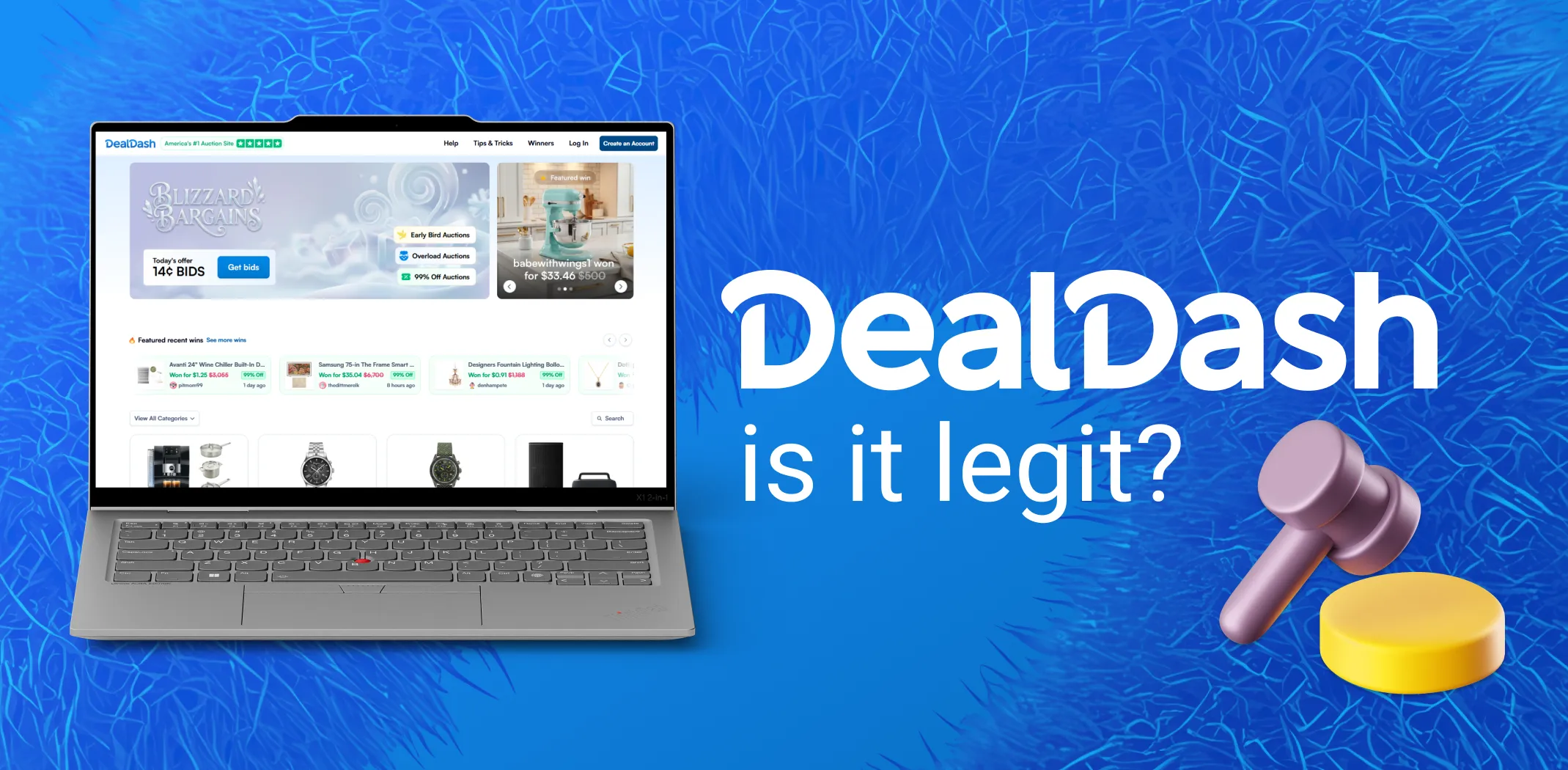
You have probably seen the commercials. Someone wins a brand-new television or a KitchenAid mixer for a few dollars, and it looks almost too good to be true. So you start asking the obvious question: is DealDash legit, or is it just a clever way to drain your wallet?
That skepticism is healthy. The site has been around since 2009, it ships real products, and it responds to complaints. But the way it makes money is worth understanding before you hand over your credit card details.
Quick Answer: DealDash is a real, operating company – not a scam. But its penny auction model is designed to make money from the majority of users who never win. Whether it is worth your time depends entirely on how much risk you are comfortable with.
This review breaks down exactly how the site works, the five biggest warning signs to watch for, the one feature that protects you, and what a smarter alternative looks like if your goal is actually earning money – not just saving it.
What is DealDash?
DealDash is a penny auction website. It was founded in 2009 by a Finnish entrepreneur named William Wolfram and is currently one of the most well-known platforms of its kind in the United States.
Unlike a normal online store, DealDash is not a place where you browse items and pay a set price. Instead, you buy bid credits in advance – usually between 12 and 60 cents each – and spend those credits to compete in live countdown auctions. Every bid raises the item price by one penny and resets a timer. The last person to bid when the clock hits zero wins the item.
Because every single bid costs real money regardless of who wins, the platform collects fees from all participants, not just the winner. That is the defining feature of a “pay-to-play” auction model, and it is what makes the site fundamentally different from eBay or Amazon.
DealDash has been in business for over 15 years, ships genuine products, and has undergone third-party audits. That is the good news. The rest of this article looks at the parts that are a little more complicated.
How much can you realistically save – or lose?
Before we get into the red flags, it helps to look at the actual numbers. Penny auctions are not a guaranteed savings method. Here is a realistic breakdown of what different types of users tend to experience.
A University of Chicago study that analyzed over 134,000 auctions found that just 2.2% of users were “power bidders” who won consistently. More than 55% of participants were budget bidders who lost small amounts repeatedly. For the average person, the site is closer to entertainment than savings.
One note on the “pennies” in the ads: The final auction price is only part of what a winner paid. If a laptop sells for $30.00, that means 3,000 bids were placed. At 15 cents each, the platform collected $450 in bid fees alone – before the winner even paid the sale price.
Is DealDash legit? The 5 red flags to know
The site is a legal, operating business. But “legit” and “a good deal for you” are two very different things. Here are the five warning signs that catch most first-time users off guard.
Red flag 1: The true cost is hidden in the ads
DealDash commercials show someone winning an item for a tiny amount. What they rarely show clearly is how much that winner spent on bids to get there. A 2017 complaint filed with state attorneys general by consumer advocacy organization Truth in Advertising pointed out that the ads consistently omitted total bid costs from the final price shown to viewers.
After a class-action lawsuit was filed and later voluntarily dismissed in 2018, the company updated its disclosures. You can now find small-print notes explaining bid totals in their advertising. But most casual viewers never read that fine print.
Red flag 2: House brands with inflated price tags
A large portion of items on the platform come from luxury-sounding brands you have never heard of – names like Bolvaint, Kamikoto, and Wilson and Miller. Legal and business filings have revealed that these are house brands owned by a company closely tied to DealDash’s founder.
The problem is price anchoring. A set of Kamikoto knives might be listed at an MSRP of 1,200 dollars. Winning them for 80 dollars feels incredible. But because these brands are not sold in mainstream retail stores, there is no external market to verify whether that price tag is real. Critics argue it exists mainly to make the BIN option – and every winning bid – look more valuable than it is.
Important: Before bidding on any unfamiliar brand, search for it on Amazon or Google. If it has no independent retail presence, treat the listed price with caution.
Red flag 3: The “perpetual sale” on bid packs
If you visit the site on almost any given day, bid packs will be listed as “on sale.” The standard price is shown at 60 cents per bid, with the sale price sitting around 12 to 20 cents. The catch is that the full 60-cent price is rarely if ever what people actually pay. The sale is essentially permanent, which means it is not a sale at all – it is a price anchoring tactic designed to create urgency.
Red flag 4: Automated bidding can drain your balance fast
DealDash offers a built-in tool called BidBuddy. You tell it how many bids to use, and it automatically places bids at the last second on your behalf. Many users have this running at once, which means auctions can stretch on for hours. Each person involved keeps burning through their bid credits in an automated war of attrition.
For a new user without a strategy, this can feel like bidding against a machine – because in a sense, you are. Your human timing cannot compete with an automated tool, and every second you stay in the auction costs you money whether you win or not.
Red flag 5: Surprise charges at sign-up
One of the most common complaints logged at the Better Business Bureau involves users who signed up for DealDash and were immediately charged 30 to 40 dollars for an initial bid pack without fully realizing they were making a purchase. This pattern comes up repeatedly across hundreds of reviews.
To be fair, DealDash typically resolves these complaints quickly and refunds the charge. They maintain an A+ rating at the BBB largely because of their responsive customer service and a 90-day money-back guarantee on first purchases. But the confusion happens consistently enough that it is worth slowing down and reading every screen carefully before entering your card details.
The one feature that protects you: Buy It Now
The strongest argument in DealDash’s favor is the Buy It Now feature, often called BIN. Here is how it works: if you enter an auction, spend bids, and lose, you can choose to purchase the item at its listed retail price. When you do that, DealDash refunds every bid you spent in that auction back to your account.
This turns a potential total loss into a regular retail transaction. It is the reason the company has survived legal scrutiny – the BIN option means the platform can argue it is a retailer, not a gambling site. And it is a genuine protection if you use it correctly.
There are two important catches. First, the retail prices on the site are sometimes higher than what you would pay at Amazon or Walmart, so you may not be getting a great deal even when you use BIN. Second, you need to actually have the cash available to cover the full retail price. If you have already spent your available budget on bid packs and cannot afford the item, you lose your bids with no refund.
Key principle: Only bid on an item you are genuinely willing and able to buy at full price. If you cannot afford the retail cost, do not start bidding.
Is DealDash rigged?
A common concern from first-time users is that they seem to be bidding against bots. Someone always outbids you at the last second, over and over. It feels automated, and that makes it feel rigged.
The reality is a little more nuanced. In 2020, DealDash commissioned a third-party audit by an independent accounting firm to examine whether “shill bots” or company employees were bidding to inflate prices. The audit found no evidence of either. The competitor outbidding you at the last second is almost certainly a real person using BidBuddy – the platform’s own automated bidding tool.
So the game is not technically rigged, but the playing field is not level either. Experienced users with large bid balances and tuned automation strategies have a structural advantage over someone trying the site for the first time.
Legal history: What the lawsuits actually tell us
In 2017, a class-action lawsuit called Pstikyan v. DealDash was filed in Minnesota. The plaintiffs claimed the site operated as an illegal lottery and used deceptive advertising by hiding the true cost of winning from viewers.
The lawsuit was voluntarily dismissed with prejudice in 2018, meaning the specific claims could not be refiled. While settlement details were kept private, the company updated its advertising disclosures after the case closed. Fine-print explanations of total bid costs now appear in their commercials.
The takeaway here is not that the company is clean of controversy – it is that they have responded to legal and regulatory pressure by adjusting their practices. They have been operating openly for over 15 years, which is a meaningful sign of operational legitimacy even if the business model remains controversial.
How to stay safe if you decide to try it
If you still want to give the site a shot after reading all of this, here is a practical checklist that can protect you from the most common mistakes.
Only bid on BIN-eligible items. Never enter an auction unless you have the cash to buy the item at full retail price. That is the only way to guarantee you never walk away with a total loss.
Verify the retail price independently. Before bidding on any brand you have not heard of – especially Bolvaint, Kamikoto, or similar house brands – search for the item on Amazon or Google. If you cannot find it sold elsewhere, the listed MSRP may be inflated.
Set a hard bid limit before you start. Decide exactly how many bids you are willing to spend and stop when you hit that number. The sunk-cost feeling is real, and the site is designed to keep you in just one more bid longer.
Jump in early on auctions with a no-jumper rule. Some auctions lock out new bidders once the price hits 5 dollars. If you want to participate, enter before that threshold or you will be locked out entirely.
Use the first-purchase money-back guarantee. Your first bid pack is covered by a 90-day guarantee. If you try it and it is not for you, contact support and ask for a refund before the window closes.
Final thoughts: Is DealDash legit or worth your time?
Here is the honest answer. DealDash is a legitimate company. It ships real products, operates within the law, responds to customer complaints, and has been independently audited. You are not going to get scammed in the identity-theft sense.
But the platform is not designed to save you money consistently. It is designed to make money for the house, primarily through the bid fees paid by everyone who loses. Research shows over 55% of users are budget bidders who spend repeatedly without winning. A small group of power users – roughly 2% – captures most of the value.
If you have a fun budget, understand the rules, and treat it like entertainment, DealDash can be an interesting way to spend an evening. But if you are looking for a reliable way to stretch a tight budget or build any kind of financial stability, a competitive auction model is the wrong tool for the job.
Why this works in 2026: The people who consistently come out ahead in environments like this are the ones selling – not the ones buying. Building your own income source puts you on the other side of that equation.
Why Sellvia is a game-changer for your online store 🚀
Sellvia isn’t just another ecommerce tool. We are a trusted name in the industry, recognized by Forbes and even ranked in Inc.’s list of the 5,000 fastest-growing companies in the U.S. So if you’re serious about starting as a solopreneur, this is a smart place to begin.
Starting an online business can feel overwhelming, but that’s exactly where Sellvia steps in. It takes care of the tricky parts, so you can focus on making sales and growing your brand. Let’s break down what makes it such a great choice.
Get a ready-to-go store hassle-free 🎯
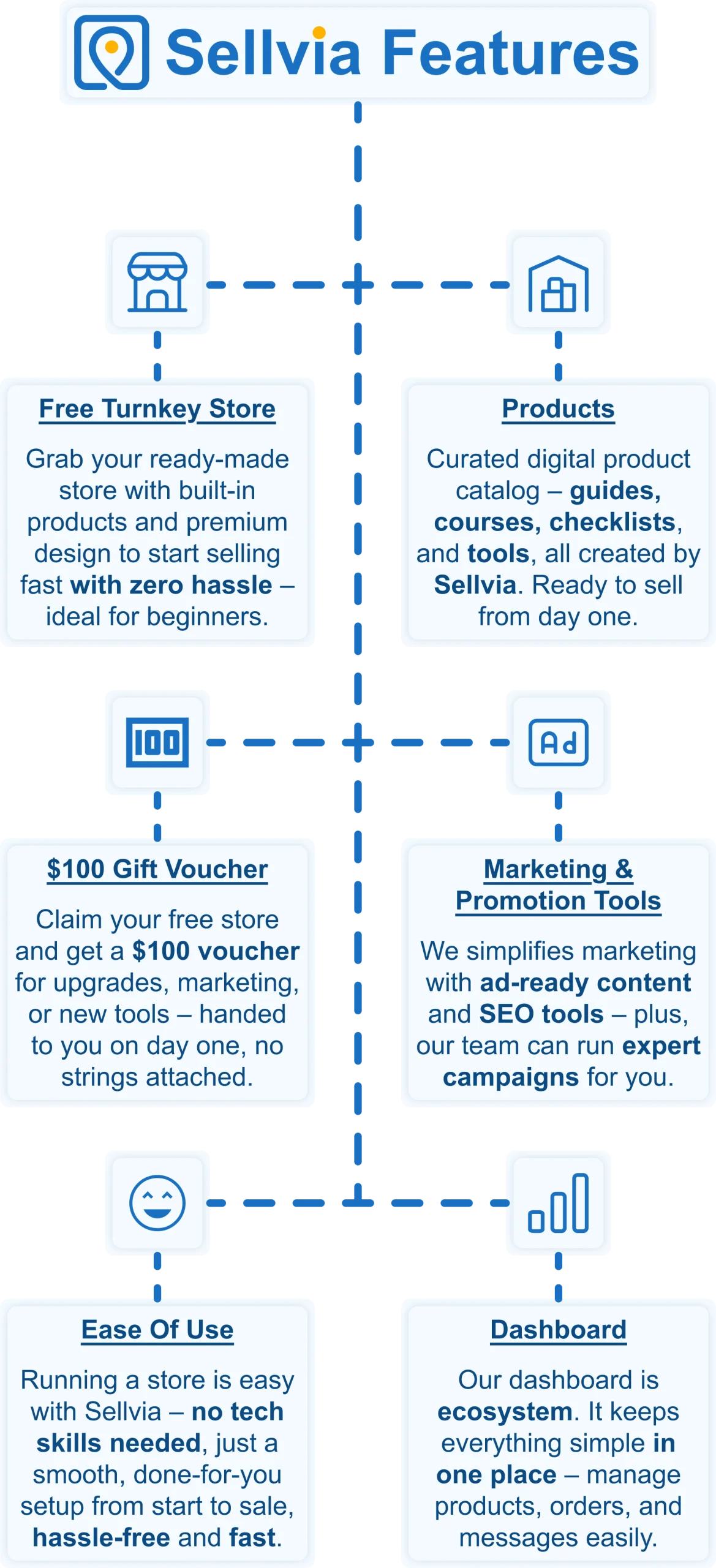
Want to start selling but don’t know where to begin? No worries! Just share your ideas, and Sellvia’s team will build a free ecommerce website that’s fully set up and ready to take orders from day one. No coding, no stress – just a store that works right out of the box.
A $100 gift voucher to grow your business faster 🎁
Starting a business takes momentum – and Sellvia gives you a head start. When you claim your free store today, you also get a $100 gift voucher to put toward growing your business. Use it to upgrade your store, boost your marketing, or unlock new tools. It is a real dollar value, handed to you on day one, with no catch and no hoops to jump through.
A massive catalog of digital products to sell 🏆
One of the biggest struggles in starting an online business is figuring out what to sell. Sellvia solves that completely. Your store comes pre-loaded with digital products – guides, courses, checklists, and tools – all created by Sellvia. You keep 50–70% of every sale. No inventory. No shipping. No logistics headaches.
Everything in one easy-to-use platform 🔥
Managing an online store shouldn’t be complicated. With Sellvia, you can handle orders, add new products, and even chat with customers – all from a simple and user-friendly platform. No need to mess with confusing tools or deal with unnecessary tech stuff. It’s all smooth sailing.
No upfront costs, just start selling 💰
A big reason people hesitate to start an online business is the cost. But here’s the good news: With Sellvia, you don’t need to invest in stock, storage, or shipping supplies. You can run your store with no upfront costs, keeping things low-risk while still making money.
Support that’s always got your back 🤝
Running a business comes with questions, but you’re never alone. Sellvia’s dedicated support team is available 24/7 to help with anything you need. Whether it’s a small question or a big challenge, they’ve got you covered.
If penny auctions have taught you anything, it is that the real money goes to the people running the game – not playing it. Claim your free Sellvia store today and start building income on your own terms.
Is DealDash legit or a scam?
How does DealDash make money?
DealDash makes money primarily through bid fees rather than the final sale price of items. Every time a user places a bid, they spend one bid credit regardless of whether they win the auction. If a product sells for 25 dollars, that means 2,500 bids were placed. At 15 cents each, the platform collects 375 dollars in bid fees plus the sale price. This all-pay auction structure means the company profits from everyone who participates, not just the winner.
What is the Buy It Now feature on DealDash?
The Buy It Now feature, also called BIN, allows a losing bidder to purchase the item at its listed retail price. When a user uses BIN, DealDash refunds all the bids that person spent in that specific auction back to their account. This turns a loss into a regular retail purchase and is the main legal defense the company uses to distinguish itself from gambling. The catch is that the listed retail prices are sometimes higher than Amazon or Walmart, and users must have the cash available to cover the full price to get their bids back.
Can you actually win on DealDash?
Yes, people do win on DealDash, but consistent winning is rare for average users. A University of Chicago study that analyzed more than 134,000 auctions found that roughly 2 percent of users were power bidders who won frequently, while over 55 percent were budget bidders who lost regularly. Winning requires either significant experience, large bid balances, and strategic use of automated tools, or a combination of timing and luck. Casual users who try the site a few times are statistically more likely to spend money without a win.
Does it cost money to bid on DealDash?
Yes, bidding on DealDash always costs money. Users must purchase bid credits in advance before they can participate in any auction. Each bid placed uses one credit and that credit is spent permanently, whether the user wins or loses. Credits typically cost between 12 and 60 cents each depending on current promotions. In addition, new users have reported being charged 30 to 40 dollars for an initial bid pack at sign-up, sometimes without fully realizing they were making a purchase at that moment.