You clicked an ad, found something you liked, and then noticed the URL said “myshopify.com.” Now you’re asking: is Shopify legit? That is a completely fair question. Nobody wants to hand over their card details to a site they are not sure about.
Here is the short answer: Shopify itself is a real, established company used by millions of sellers worldwide. But because anyone can open a Shopify store, some individual stores are more trustworthy than others. Knowing the difference is what this guide is all about.
Quick Answer: Yes, Shopify is a legitimate platform trusted by millions of sellers. The company is publicly traded, PCI compliant, and has strong fraud protection built in. The key is knowing how to check the individual store you are buying from – not just the platform itself.
Whether you are shopping on a Shopify store or thinking about starting your own online business, this guide covers everything you need to know. We will walk through how the platform works, what red flags to watch for, and how people are using online stores to build real income in 2026.
What is Shopify?
Shopify is a platform that lets people build and run their own online stores without needing any coding skills. Think of it like renting a fully equipped digital storefront. You get the tools, the checkout system, and the hosting – and you fill the shelves with your own products.
Launched in 2006, Shopify has grown into one of the biggest names in online selling. Over 4 million businesses use it worldwide – from small handmade goods shops to well-known brands. That scale says a lot: the platform works, and serious sellers trust it.
For shoppers, though, the important thing to understand is this: every Shopify store is independent. Each seller manages their own products, pricing, and customer service. Shopify provides the infrastructure – not the brand. That is why some stores feel polished and professional while others might look a little rough around the edges.
Why this works in 2026: Shopify’s low barrier to entry has created a massive ecosystem of independent sellers. That is great for variety – but it also means shopping smart matters more than ever.
Is Shopify legit as a platform?
When people ask “is Shopify legit?” what they are really asking is whether they can trust what is behind the “Buy Now” button. And that is a smart question – because there is a real difference between Shopify the platform and the individual stores built on it.
Shopify itself is completely legitimate. It is a publicly traded company headquartered in Ottawa, Canada. It is regulated, widely reviewed, and used by millions of verified merchants. The platform handles secure payments, provides hosting, and follows strict online safety standards.
But here is where it gets nuanced: anyone can open a Shopify store. That freedom is great for entrepreneurs – it lowers the barrier to starting a business – but it also means not every store plays fair. Some may sell poor-quality products. Others may take your payment and disappear.
So when you wonder whether Shopify is legit, the better question is: how do I tell if a specific Shopify store is trustworthy? The sections below walk you through exactly that.
Important note: Shopify the company is not responsible for the actions of every individual store on its platform – just as Amazon is not responsible for every third-party seller. Always evaluate the store, not just the platform.
How much can store owners realistically earn?
One reason people ask “is Shopify legit?” is because they are also considering starting their own online store – not just shopping on one. So let us look at what real income looks like across different types of online businesses.
Every income figure above depends on effort, consistency, and how well you engage your audience. Most beginners see their first meaningful results within 60–90 days. Treat any online business as a real income source that requires real work – not a shortcut.
One note on the earning figures: The ranges above reflect realistic outcomes for active store owners. Results vary based on the time you put in, the niche you choose, and how consistently you show up.
Shopify’s safety and security measures
One of the biggest reasons Shopify is trusted by so many sellers – and shoppers – is the safety net it provides. While the platform cannot control every individual seller’s behavior, it does have strong security features built directly into the system.
Payment security and SSL
Shopify is fully PCI compliant, which means it meets the strict security standards required to handle credit card information. Every store on the platform automatically receives an SSL certificate – that small padlock icon you see in your browser bar. That padlock encrypts your payment details, making it far harder for anyone to intercept them.
If you visit a Shopify store and see “https://” at the start of the URL along with the padlock, your connection is encrypted. If either is missing, treat that as a warning sign and do not enter payment details.
Fraud detection tools
Shopify has automated fraud detection built into its system. If a transaction looks suspicious – say, an unusually large order from a brand-new account – the platform flags it for review. Sellers do not have full control over this; it is a platform-level protection designed to look out for buyers.
This does not mean every transaction is reviewed manually. But it does mean there is an active system working in the background to catch irregular activity before it becomes a problem.
Chargeback and buyer support
If a Shopify store fails to deliver a product or misrepresents what you are buying, you have options. You can contact Shopify support directly to report the store. You can also initiate a chargeback through your bank or credit card provider, which adds another layer of protection that most smaller or self-hosted websites do not offer.
Using a credit card or PayPal when shopping on any online store – not just Shopify – gives you recourse if something goes wrong. Direct bank transfers or unusual payment methods offer far less protection, so avoid them.
Common Shopify scams and how to spot them
Even though Shopify itself is secure, not every store on the platform follows the rules. Knowing what bad actors look like – and how to catch them early – is the best protection you have.
Fake or misleading products
Some stores advertise branded or premium items at prices that seem impossibly low. If a pair of sneakers that normally sells for $150 is listed at $25, that is a red flag. The product either does not exist, is counterfeit, or is dramatically different from what is pictured.
Important: If a price seems too good to be true, it almost always is. Cross-check the product price on the brand’s official site before buying from an unfamiliar store.
Stores that vanish after payment
Some stores take your payment and then go quiet. No tracking number. No response to emails. No product. These stores often appear suddenly, run ads heavily for a short period, and disappear before complaints pile up.
Checking a store’s reviews outside the platform itself – on Trustpilot, Reddit, or Google – is one of the most effective ways to catch this kind of operation before you hand over your money. If a store has no external reviews at all, proceed carefully.
Phishing and information-harvesting stores
Some stores look polished but are built specifically to collect personal information rather than sell anything. Warning signs include copied product images, a generic “About Us” page with no real company details, and an email address that does not match the store’s domain.
Legitimate stores have real contact information, a working email tied to their domain, and policies that are easy to find. If any of those are missing, close the tab.
Tips for shopping safely on Shopify stores
Knowing that Shopify is legit is one thing. Knowing how to shop safely on any individual Shopify store is another. These are the checks worth doing before you buy.
Check contact information
A legitimate store lists a working email address, and many include a phone number or physical address. If the only way to reach the seller is a contact form with no other details, that is worth noting. Real businesses want to be reachable – they depend on repeat customers and word of mouth.
Read the return and refund policy
Trustworthy stores are transparent about what happens if you are not happy with your purchase. If a store has no return policy – or one that is vague and hard to find – that is a warning sign. Look for a clearly written policy that explains timelines, conditions, and how to start a return.
Look up reviews outside the platform
On-site reviews can be manipulated. Before buying from an unfamiliar store, search the store name plus the word “reviews” or “scam” on Google. Check Trustpilot and Reddit for real customer experiences. A few negative reviews are normal – a flood of them, or zero reviews anywhere outside the site, is not.
Use a secure payment method
Always pay with a credit card or PayPal when shopping online. Both offer built-in buyer protections that let you dispute a charge if a product never arrives or is completely different from what was advertised. Debit cards offer less protection, and direct bank transfers offer almost none.
Trust your instincts
If a site feels off – the design looks copied, the prices are suspiciously low, or the checkout redirects to an unusual page – trust that feeling and move on. A few minutes of research before buying can save hours of frustration after.
Key principle: Your job as a buyer is to evaluate the store, not just the platform. Shopify keeps the infrastructure safe – you decide whether the seller deserves your trust.
Shopify vs other platforms: how do they compare?
It helps to see Shopify in context. How does it stack up against other well-known platforms when it comes to safety, trust, and ease of use – whether you are shopping or selling?
Shopify and Amazon both offer strong platform-level security. The key difference is that Amazon manages a marketplace while Shopify powers independent stores. For buyers, Amazon’s A-to-Z Guarantee offers slightly more direct protection. For sellers, Shopify gives you more control over your own brand and customer relationships.
Is Shopify legit for sellers? What you need to know before starting
If you are thinking about starting your own online store – not just shopping – the legitimacy question takes on a different shape. Shopify is a real, functional platform for building a store. But knowing what you are getting into matters before you commit.
What it costs to run a Shopify store
Shopify’s basic plan starts at around $39/month, and that does not include payment processing fees, the cost of a domain name, or apps you may need to run your store properly. If you want to sell physical products, you also have to factor in the cost of sourcing those products, storing them, and fulfilling orders.
For someone just starting out – especially someone on a tight budget – those upfront costs add up fast. And there is no guarantee of income in the early months while you are still finding your footing.
The learning curve is real
Setting up a Shopify store from scratch takes time. You need to choose a theme, configure your products, set up payment processing, write product descriptions, and handle customer service. If you have never run an online business before, there is a genuine learning curve – and mistakes in the early stages can cost you money.
That is not a reason to avoid starting. It is a reason to go in with clear expectations. Many successful store owners took 60–90 days before they started seeing consistent results.
What kind of store owner does Shopify suit?
Shopify works best for people who already have a product to sell, a clear niche in mind, and some comfort with managing tech tools. If you are starting completely from scratch with no product, no audience, and limited time, the ramp-up period can be longer and harder than expected.
Earning potential: $500–$3,000/month for active Shopify sellers managing physical products, after 3–6 months of consistent effort.
Final thoughts: what to do with this information
If you came here wondering “is Shopify legit?” – the answer is yes. The platform is real, secure, and trusted by millions of sellers and shoppers worldwide. The risks that exist are at the individual store level, not the platform level. And with the right checks, you can shop on Shopify with confidence.
But if you have been reading this and thinking “I want to be on the other side of this” – the seller, not the buyer – then you are already asking the right question. Online stores are a real way to build income. The question is which platform gives you the best shot at getting started without wasting months on setup or spending money before you make any.
Which path fits you?
If you are a complete beginner with no product and no tech background, you need a platform that handles the hard parts for you. Spending weeks learning Shopify before seeing your first sale is discouraging – and unnecessary.
If you want to run an online store part-time and test whether it works for you before going all in, starting with a ready-built store and digital products is a far lower-risk way to find out.
If you already have experience with online selling and want to scale, the built-in advertising system that Sellvia provides – where ads are managed for you at $10–$50 a day – can remove the bottleneck that stops most stores from growing.
Whatever stage you are at, the opportunity to earn income online is real. It takes effort. It takes consistency. But in 2026, the tools available to regular people with no experience and no big budget are better than they have ever been.
Why Sellvia is a game-changer for your online store 🚀
Sellvia isn’t just another ecommerce tool. We are a trusted name in the industry, recognized by Forbes and even ranked in Inc.’s list of the 5,000 fastest-growing companies in the U.S. So if you’re serious about starting as a solopreneur, this is a smart place to begin.
Starting an online business can feel overwhelming, but that’s exactly where Sellvia steps in. It takes care of the tricky parts, so you can focus on making sales and growing your brand. Let’s break down what makes it such a great choice.
Get a ready-to-go store hassle-free 🎯
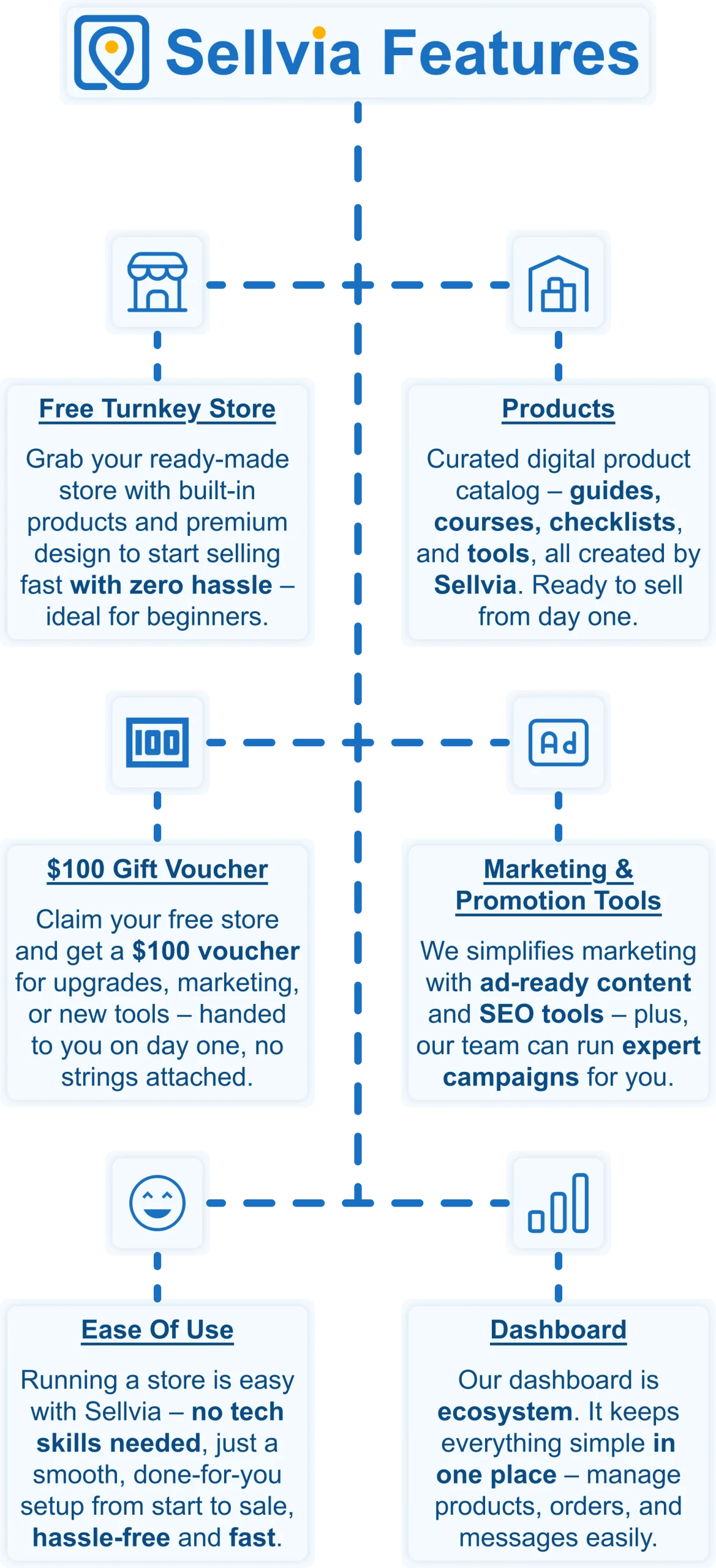
Want to start selling but don’t know where to begin? No worries! Just share your ideas, and Sellvia’s team will build a free ecommerce website that’s fully set up and ready to take orders from day one. No coding, no stress – just a store that works right out of the box.
A $100 gift voucher to grow your business faster 🎁
Starting a business takes momentum – and Sellvia gives you a head start. When you claim your free store today, you also get a $100 gift voucher to put toward growing your business. Use it to upgrade your store, boost your marketing, or unlock new tools. It is a real dollar value, handed to you on day one, with no catch and no hoops to jump through.
A massive catalog of digital products to sell 🏆
One of the biggest struggles in starting an online business is figuring out what to sell. Sellvia solves that completely. Your store comes pre-loaded with digital products – guides, courses, checklists, and tools – all created by Sellvia. You keep 50–70% of every sale. No inventory. No shipping. No logistics headaches.
Everything in one easy-to-use platform 🔥
Managing an online store shouldn’t be complicated. With Sellvia, you can handle orders, add new products, and even chat with customers – all from a simple and user-friendly platform. No need to mess with confusing tools or deal with unnecessary tech stuff. It’s all smooth sailing.
No upfront costs, just start selling 💰
A big reason people hesitate to start an online business is the cost. But here’s the good news: With Sellvia, you don’t need to invest in stock, storage, or shipping supplies. You can run your store with no upfront costs, keeping things low-risk while still making money.
Support that’s always got your back 🤝
Running a business comes with questions, but you’re never alone. Sellvia’s dedicated support team is available 24/7 to help with anything you need. Whether it’s a small question or a big challenge, they’ve got you covered.
Now that you know Shopify is a legit platform, the next step is deciding whether you want to shop on it – or build income from your own store. Claim your free Sellvia store today and start earning 50–70% on every digital product you sell.
Is it safe to purchase from Shopify?
How do I know if a Shopify store is legitimate?
You can check several things to tell if a Shopify store is trustworthy. Look for a clearly listed email address and, ideally, a physical address or phone number. Read the return and refund policy – legitimate sellers are transparent about this. Search for the store name on Trustpilot, Reddit, or Google to find reviews that were not written on the store itself. If prices seem unusually low or the design looks copied from another site, those are red flags worth taking seriously.
Will Shopify help me if I get scammed by a store?
Shopify does not guarantee refunds directly, but it does offer support if a store is acting dishonestly. You can report a store to Shopify and the platform may take action against sellers who violate its terms. More importantly, if you paid by credit card or PayPal, you can initiate a chargeback or dispute with your payment provider. This is one of the main reasons using a credit card when shopping online is strongly recommended. Most disputes involving non-delivery or misrepresented products are resolved in favor of the buyer when reported promptly.
Is Shopify legit for starting an online business?
Shopify is a legitimate platform for starting an online business. It is used by millions of sellers worldwide, ranging from solo entrepreneurs to large brands. However, starting a Shopify store from scratch requires time, money, and a product to sell. The monthly plan starts at around 39 dollars and does not include sourcing costs, apps, or transaction fees. Most new store owners take 60 to 90 days before seeing consistent results.
What is the biggest problem people face with Shopify stores?
The most common difficulty people face with individual Shopify stores is inconsistent quality between sellers. Because anyone can open a store on the platform, buyer experiences can vary significantly. Some stores deliver exactly what they promise while others have slow shipping, poor product quality, or limited customer support. The solution is to research any unfamiliar store before buying – check external reviews, verify contact details, and confirm that a clear return policy exists before completing your purchase.