You have a camera. Or at least a phone with a decent one. And somewhere in the back of your mind, you have been wondering: can I actually make money selling photos?
The short answer is yes. Photographers at every skill level earn real income from their images every year. In 2026, the demand for authentic, everyday photos has never been stronger.
Quick Answer: You can make money selling photos online through stock agencies, print sales, freelance work, and microstock platforms. Most people start earning within their first 30–60 days after building a solid portfolio.
But let us be real. Building a photography income does not happen overnight. This guide breaks down exactly what works, what to expect, and which method fits where you are right now.
Whether you have a professional camera or just your smartphone, there is a path here for you. Read on to find the right one for where you are now.
What does selling photos online actually mean?
When people talk about making money selling photos, they usually mean one of two things: licensing your images to businesses and individuals, or selling physical or digital prints directly to buyers.
Licensing is the most common route. You upload your photos to a platform like Shutterstock or Adobe Stock. When someone downloads your image for their website, ad, or project, you earn a royalty. It is like renting your photo – you keep the copyright and it keeps earning for you.
Selling prints works differently. You sell a physical or digital copy of your photo directly to a buyer. They own that copy. You set the price and keep the profit.
Both paths work. Licensing builds up slowly but can earn consistently over time. Print sales need more active marketing but give you more control over pricing and presentation.
Important note: Selling photos does not require a professional background or expensive gear. What matters is producing images that are technically sound and that buyers actually need.
The right platform depends on your skill level, how much time you have, and what type of photos you already take. The next section will help you set realistic income expectations before you choose.
How much can you realistically earn selling photos?
The honest answer: it varies a lot. Most beginners earn $20–$100 in their first month from stock platforms. With a large, well-keyworded portfolio, consistent sellers can reach $500–$2,000/month. Full-time professionals can earn significantly more – but that takes years of consistent effort.
Here is a breakdown by method to help you set realistic expectations:
These ranges reflect real-world results – not best-case scenarios. Most beginners sit at the lower end for the first 3–6 months while building their portfolio and learning which images actually sell.
One note on the earning ranges: Reaching the upper end requires hundreds of images on multiple platforms, consistent uploads, and months of trial and error. A realistic first goal: $50–$200/month in your first 90 days.
The good news is that even modest income streams add up. A few hundred dollars a month from stock photos plus a weekend freelance shoot can make a real difference in your monthly budget.
No matter which method you pick, the most important step is to start. Pick one approach, commit to it for 90 days, and track what works.
5 proven ways to make money selling photos
Here is a detailed look at each method. Each one works – the key is choosing what fits your skills, schedule, and current goals.
1. Stock photography: build a portfolio that earns for you
Stock photography is the most popular way to sell photos online. You upload images to an agency, they review them, and when someone licenses your photo for their website, ad, or project, you earn a royalty.
The appeal: once your images are approved, they can keep earning without you doing anything additional. One strong photo can be downloaded hundreds of times over the years.
The reality: royalties per download are low – usually $0.25–$2.00 per image on high-volume platforms. To earn meaningfully, you need volume. Most successful stock photographers have 500–2,000+ images in their portfolio.
Shutterstock
Shutterstock is one of the largest stock agencies in the world. Royalties start at around 15% and increase based on your total lifetime earnings on the platform. It is competitive, but the volume of buyers means even niche images can sell regularly.
Adobe Stock
Adobe Stock integrates directly with Adobe Creative Cloud, which means millions of designers see your images in the apps they already use daily. Royalties are around 33% – higher than many competitors. If your work has a polished, design-ready aesthetic, this is a strong platform to prioritize.
Getty Images and iStock
Getty is the premium tier of stock photography. Acceptance standards are strict, but royalties are considerably higher than average. iStock, which is Getty’s self-serve platform, is slightly more accessible for beginners while still offering above-average payouts. If your photography is technically excellent and commercially strong, it is worth applying to both.
Earning potential: $50–$500/month on stock platforms after building a portfolio of 200+ strong images.
2. Print sales: sell directly to people who love your work
Selling prints means offering your photos as wall art, canvases, framed prints, or items like mugs and phone cases. This path gives you more control over pricing and branding, and profit margins can be significantly higher than stock royalties.
Etsy
Etsy is a natural fit for photographers who want to sell photos online. Millions of shoppers browse Etsy specifically looking for unique, artistic items. You can sell digital downloads – buyers print themselves – or physical prints through a print-on-demand partner. Setting up a shop is straightforward and costs very little to start.
Print-on-demand services
Platforms like Printful and Redbubble let you upload your photos and sell them on dozens of products without managing any logistics. When someone orders, the platform handles production and gets it to the customer. You earn the markup between your price and the base cost. Overhead is essentially zero – you just need to drive traffic.
Earning potential: $100–$1,000/month, depending on how much you invest in marketing and how well your work connects with buyers.
3. Freelance photography: get paid directly for your skills
Freelance photography means finding clients who pay you directly to shoot for them – weddings, portraits, events, product listings, real estate, food. This is the highest-earning method but also the most demanding in terms of time and hustle.
Portrait and event photography
Family portraits, headshots, and weddings are consistent markets in almost every city. Local marketing works well – a Google Business profile, a few posts on Facebook and Instagram, and word of mouth can fill your calendar. Wedding photographers charge $1,500–$5,000 per event. Portrait sessions typically run $150–$400.
Product photography for businesses
Every online seller needs product photos. Small brands and Etsy sellers need clean, professional shots and most of them do not own a decent camera. You can charge $50–$150 per product or offer day-rate packages. This niche is underserved in most small and mid-sized markets, which means less competition for you.
Earning potential: $500–$3,000/month for part-time freelancers; significantly more for full-time.
4. Microstock photography: low barrier, lower pay
Microstock agencies license images at much lower prices than traditional stock agencies – and pay you accordingly. Royalties can be as low as $0.10–$0.25 per download. The upside: requirements are less strict, making it easier for beginners to get accepted and start building a library.
Platforms like Dreamstime, 123RF, and Bigstock fall into this category. Think of microstock as a good learning tool and a way to build confidence while you develop your portfolio. Do not rely on it as a primary income source.
Earning potential: $10–$100/month. Best treated as supplemental income alongside a main hustle.
5. Niche photography: specialize and stand out
Niche photography means focusing on a specific type of imagery that is in demand but less saturated. Think drone and aerial photography, underwater shots, macro close-ups, or hyper-local images of your city or region. Buyers often pay premium rates for content that is genuinely hard to find.
The investment is higher upfront – drone licenses, specialized equipment, specific training – but the pay-off can be significant. Local real estate agencies, tourism boards, and environmental organizations all pay well for specialized imagery they cannot easily source elsewhere.
Why this works in 2026: AI image tools have flooded stock sites with generic content. Authentic, hard-to-replicate niche photos are more valuable than ever because they cannot be generated by software.
Earning potential: $200–$2,000/month depending on your specialty and how actively you market it.
As AI continues to transform creative industries, photographers who specialize in authentic, real-world imagery have a growing competitive advantage. That window is wide open right now.
Tips to maximize your earnings from selling photos
No matter which method you choose, these habits separate photographers who earn consistently from those who give up after a few months.
Focus on what buyers actually need
The photos that sell are not always the ones you like best. High-demand categories include business and technology, lifestyle and diversity, food and health, and home interiors. Before uploading a batch, check what is trending on the platform and align your shoots with those themes.
Use keywords strategically
On stock platforms, discoverability is everything. A beautiful photo with poor keywords earns nothing. Research what terms buyers use when searching for images similar to yours. Study the keyword lists on top-selling images in your niche and model your approach on what is already working.
Build volume consistently
Stock photography is a numbers game. Ten images will not pay your bills. But 1,000 well-keyworded, commercially relevant images can generate consistent monthly income. Commit to uploading regularly – even 5 to 10 new photos per week adds up to a serious portfolio within a year.
Diversify across platforms
Do not limit your images to a single platform. Spreading across Shutterstock, Adobe Stock, and Alamy at minimum means different buyer pools see your work without proportionally more effort on your end.
Keep improving your craft
The difference between a photo that earns $0.25 and one that earns $5.00 is usually technical quality and commercial appeal. Study lighting, composition, and post-processing. Small improvements compound into meaningful income gains over time – whether you are selling photos on stock sites or shooting freelance.
Which method is right for you?
Not every path suits every person. Here is a quick guide based on where you are right now.
Complete beginner
Start with microstock and Shutterstock at the same time. The goal is to learn what sells, build upload habits, and get real feedback from the market. A modern smartphone camera is enough to start building your first 100 uploads. Do not invest in expensive equipment yet – let the market tell you what to buy next.
Part-time photographer
If you already shoot regularly, focus on Shutterstock, Adobe Stock, and Etsy print sales together. These three can realistically generate $200–$600/month within 3–6 months of consistent effort. Add freelance gigs on weekends to accelerate your income while the stock portfolio grows in the background.
Advanced / full-time goal
If you want photography to replace your full income, freelance work is where the real money is. Combine it with a strong stock library and a specialized niche focus. Freelance gives you immediate cash flow; stock gives you a growing income asset over time. Together, $3,000–$5,000/month within 12–18 months is realistic for dedicated, consistent photographers.
A faster path to online income worth knowing about
Making money selling photos is legitimate – and it can grow into something meaningful. But it is also slow to start. Most photographers see their first real returns after 60–90 days of consistent uploads, and building a full income from photography alone typically takes years.
If you need to supplement or replace your income sooner rather than later, there is a faster and more accessible route worth knowing about.
Sellvia is a platform that gives you a ready-made online business – pre-loaded with digital products to sell, a built-in advertising system, and no technical skills required. Over 1,500,000 stores have launched on Sellvia, and the community has earned over $1.5 billion combined. Most people who activate their built-in ads start receiving orders the same day.
You do not have to choose one or the other. Many people use Sellvia to generate faster income while they build their photography portfolio on the side. Both can grow at the same time.
Why Sellvia is a game-changer for your online store 🚀
Sellvia isn’t just another ecommerce tool. We are a trusted name in the industry, recognized by Forbes and even ranked in Inc.’s list of the 5,000 fastest-growing companies in the U.S. So if you’re serious about starting as a solopreneur, this is a smart place to begin.
Starting an online business can feel overwhelming, but that’s exactly where Sellvia steps in. It takes care of the tricky parts, so you can focus on making sales and growing your brand. Let’s break down what makes it such a great choice.
Get a ready-to-go store hassle-free 🎯
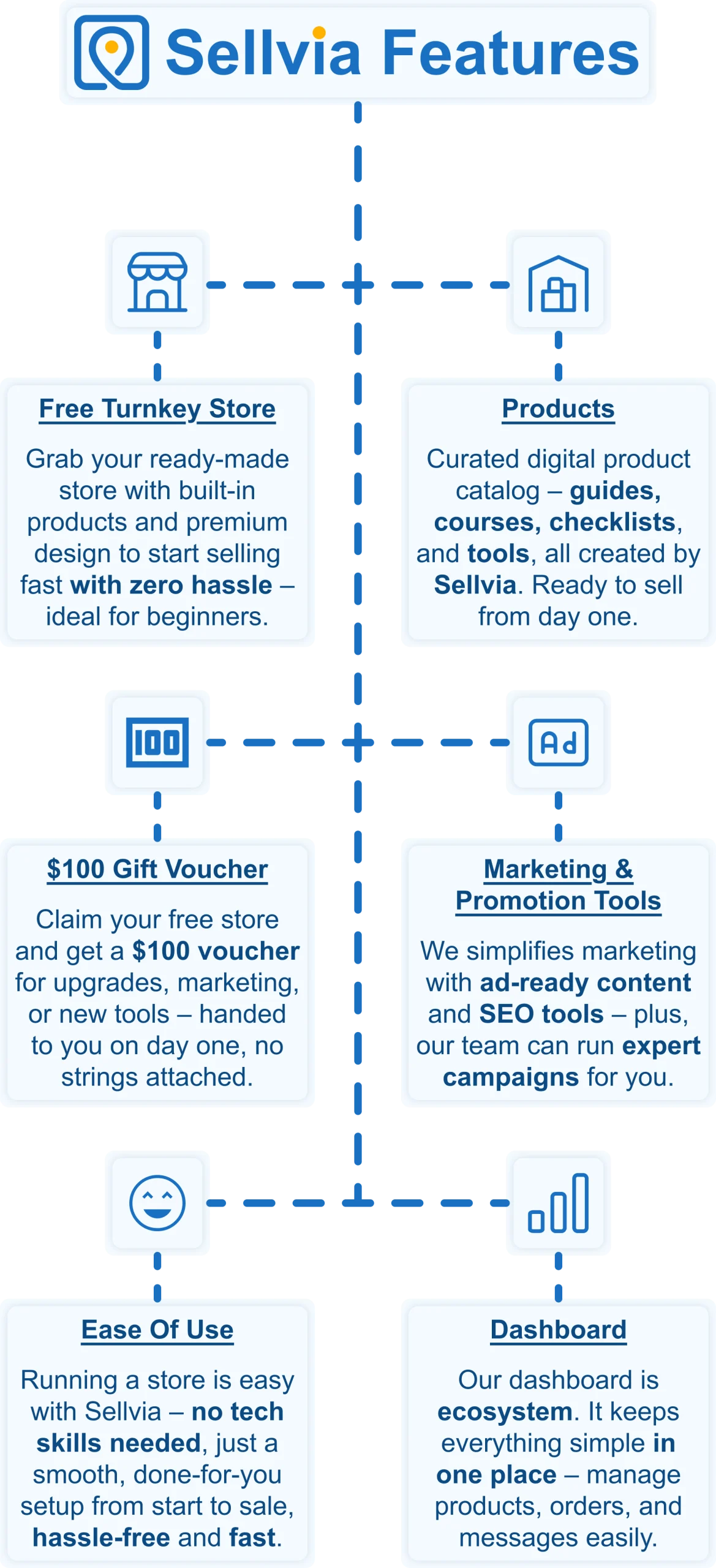
Want to start selling but don’t know where to begin? No worries! Just share your ideas, and Sellvia’s team will build a free ecommerce website that’s fully set up and ready to take orders from day one. No coding, no stress – just a store that works right out of the box.
A $100 gift voucher to grow your business faster 🎁
Starting a business takes momentum – and Sellvia gives you a head start. When you claim your free store today, you also get a $100 gift voucher to put toward growing your business. Use it to upgrade your store, boost your marketing, or unlock new tools. It is a real dollar value, handed to you on day one, with no catch and no hoops to jump through.
A massive catalog of digital products to sell 🏆
One of the biggest struggles in starting an online business is figuring out what to sell. Sellvia solves that completely. Your store comes pre-loaded with digital products – guides, courses, checklists, and tools – all created by Sellvia. You keep 50–70% of every sale. No inventory. No shipping. No logistics headaches.
Everything in one easy-to-use platform 🔥
Managing an online store shouldn’t be complicated. With Sellvia, you can handle orders, add new products, and even chat with customers – all from a simple and user-friendly platform. No need to mess with confusing tools or deal with unnecessary tech stuff. It’s all smooth sailing.
No upfront costs, just start selling 💰
A big reason people hesitate to start an online business is the cost. But here’s the good news: With Sellvia, you don’t need to invest in stock, storage, or shipping supplies. You can run your store with no upfront costs, keeping things low-risk while still making money.
Support that’s always got your back 🤝
Running a business comes with questions, but you’re never alone. Sellvia’s dedicated support team is available 24/7 to help with anything you need. Whether it’s a small question or a big challenge, they’ve got you covered.
Photography is one way to build income online – but you can build a full business without a camera. Start your free Sellvia store today and see your first sales in days, not months.