
If you want to make money typing, you are not alone. Millions of people search for this every year – and in 2026, the opportunities are real. Typing-based work includes transcription, data entry, writing, captioning, and more. Some of these jobs pay $10 an hour. Others pay $30 or more. And a small number of people use typing skills as the foundation for building something much bigger online.
Quick Answer: Yes, you can make money typing from home. Entry-level work like data entry pays around $10–$15 per hour. Specialized roles like legal transcription can reach $25–$40 per hour. The key is picking the right method and building consistency early.
This guide walks you through five proven typing jobs, what each one pays, how to get started, and which option fits where you are right now.
One more thing before we dive in. If you are also thinking about starting a business – not just a typing gig – stick around through the end of this article. There is one option worth knowing about that does not require any typing skills at all, yet can earn far more per hour.
What does it mean to make money typing?
Typing-based work covers any job where your primary output is written text produced by keyboard. That includes transcription (turning audio into text), data entry (inputting information into systems), captioning (writing text for videos), content writing, and remote customer support over chat or email.
What they all have in common: you do not need an office, a degree, or expensive equipment. A reliable computer, a decent internet connection, and good accuracy are usually all you need to start.
In 2026, remote work has made these jobs more accessible than ever. Businesses that once hired in-person office staff for data entry and transcription now hire remote workers globally. That is good news if you are looking to earn from home.
Why this works in 2026: The shift to remote-first hiring means more typing jobs are available online than at any point in history – and most do not require prior experience to start.
How much can you realistically earn?
Here is an honest look at what typing jobs typically pay. These figures reflect real-world rates from platforms like Rev, Upwork, and Clickworker in 2026. Individual results will vary based on your speed, accuracy, and specialization.
These numbers represent average ranges. Entry-level data entry is relatively easy to get but has a low ceiling. Freelance writing takes longer to build a client base but can pay three to five times more per hour once you are established. Legal and medical transcription pays well but often requires specialized training before platforms will hire you.
One note on typing jobs: Most platforms pay per audio minute or per word – not per hour. Your real hourly rate depends heavily on how fast and accurate you are. A beginner transcriptionist may earn only $6–$8 per effective hour while learning the ropes.
The honest answer is that most people who make money typing start part-time while keeping another income source. Building up to a consistent $300–$600 per month takes most people 60–90 days of regular effort. Replacing a full-time income solely through typing is possible but rare – it typically requires specializing in a high-paying niche like legal work, or building a writing portfolio that commands premium rates.
Five ways to make money typing from home in 2026
Each method below has different requirements, different pay rates, and different amounts of competition. Choose based on your current skills and how quickly you need to start earning.
Transcription
Transcription is the most popular entry point for people who want to make money typing. You listen to an audio or video recording and type out exactly what is said. Clients include podcasters, researchers, legal firms, and healthcare providers.
General transcription
General transcription covers interviews, podcasts, meetings, and academic recordings. Platforms like Rev, TranscribeMe, and GoTranscript hire regularly with no degree required. Rev pays around $0.45–$0.75 per audio minute, which works out to roughly $9–$15 per effective hour for most beginners. TranscribeMe pays slightly less per minute but offers more consistent work volume.
Getting started is straightforward. Create a free account on one of the platforms, pass a short skills test, and you can begin accepting jobs the same day. The test checks your accuracy and formatting – most people pass on the second or third attempt.
Earning potential: $10–$20/hr for general work; $25–$40/hr for legal and medical once certified.
Legal and medical transcription
These specializations pay significantly more but require training. Legal transcriptionists work with depositions, court hearings, and legal briefs. Medical transcriptionists handle physician dictation and patient records. Both fields pay $25–$40 per hour for experienced workers. If you are willing to invest 3–6 months in an online certification course, this path offers one of the highest hourly rates available in typing work.
Captioning
Captioning is closely related to transcription but focuses specifically on video. You sync text to on-screen content, making videos accessible for viewers who are deaf or hard of hearing. Platforms like Rev, Vitac, and Captionmax hire freelance captioners regularly.
The process involves receiving a video file, typing the dialogue with accurate timing, and formatting captions to meet accessibility standards. Pay rates are similar to transcription – $0.45–$0.75 per video minute on most platforms. Good captioners can process roughly one hour of video every 3–4 hours of work.
Important note: Captioning requires learning timing software. Most platforms provide free training resources, but expect a 2–3 week learning curve before your speed improves.
Data entry
Data entry is the simplest form of typing work and the easiest to get without experience. Tasks typically involve inputting customer information, product details, survey results, or spreadsheet data. Pay is lower than transcription – usually $10–$15 per hour – but the work is predictable and abundant.
Platforms like Clickworker, Amazon Mechanical Turk, and Lionbridge hire data entry workers continuously. For larger, ongoing contracts, check Upwork and Fiverr. The key to earning more in data entry is speed and reliability. Clients who find a trustworthy data entry worker will send repeat work without a second thought.
Earning potential: $10–$15/hr for basic entry work; up to $20/hr for specialized database or form processing roles.
Freelance writing and editing
If you enjoy writing, this is the highest-ceiling method for people who want to make money typing. Freelance writers create blog posts, website copy, product descriptions, marketing emails, and more. Pay ranges from $0.03–$0.10 per word for beginners to $0.20–$0.50 per word for experienced specialists.
Platforms like Upwork, Fiverr, and ProBlogger Job Board are the best starting points. To get your first clients, focus on a specific niche – tech, health, finance, or ecommerce – rather than offering to write about everything. A niche focus lets you build a portfolio faster and charge more quickly.
Editing is a related option with less competition. Many businesses need editors who can polish rough drafts before publication. Platforms like Reedsy and PaperTrue hire freelance editors at rates of $20–$50 per hour for experienced workers.
Earning potential: $20–$60/hr for established freelance writers; $15–$25/hr for beginners building their first portfolio.
Remote chat and email customer support
Many companies hire remote customer support agents to handle inquiries by text – no phone calls required. You respond to questions over live chat or email, troubleshoot issues, and process requests. Typing speed and clarity matter a lot here.
Liveops, Alorica, and Teleperformance are among the larger companies that hire remote support agents regularly. Typical pay is $12–$18 per hour. Some positions are part-time, others full-time with benefits. Since many support systems are proprietary, most companies will train you before you go live.
Earning potential: $12–$18/hr with a regular schedule; senior agents can earn $20+/hr at larger companies.
Tools and habits that help you earn more
Whether you choose transcription, data entry, or writing, a few practical habits separate people who earn consistently from those who do not.
Start with your setup. A quality keyboard makes a real difference over long sessions. For transcription and captioning, a good headset is essential – mishearing even a few words per minute kills your accuracy rate and slows you down. Tools like Grammarly help writers catch errors before submitting, which protects your reputation with clients.
Practice your typing speed with free tools like Typing.com or TypingClub. Most transcription platforms expect at least 60–70 words per minute (WPM) for beginners. Writers and data entry workers benefit from reaching 80–100 WPM, which has a direct impact on hourly earnings since most typing work is measured by output volume rather than time spent.
Specialize early. Writers who pick a niche earn more faster. Transcriptionists who get certified in legal or medical work double their rate. Data entry workers who learn CRM tools like Salesforce or HubSpot can charge premium rates for database projects. Generalists get work, but specialists keep clients.
Track everything. Know which platform pays you the most per hour. Know which clients rehire you. Know your average daily output. The typists who grow their income treat it like a small business – because it is.
What to watch out for before you start
Not every typing job listing is legitimate. Scam postings are common, especially for data entry and transcription, because these are high-demand categories that attract inexperienced job seekers.
The most common red flag: a company asks you to pay a fee before you can access jobs. Legitimate platforms like Rev, Clickworker, and Upwork never charge workers upfront. If a listing requires payment to “unlock” work or access a job board, do not proceed.
Watch out for platforms that ask you to complete dozens of tasks before you can withdraw anything. Some lower-quality microtask sites have payout thresholds that are nearly impossible to reach. Read reviews on Reddit and Trustpilot before registering on any new platform. Real users will tell you exactly what the experience is like.
Key principle: Legitimate typing platforms pay you for work completed – they never require payment from you to access jobs.
Also be cautious with writing or transcription requests that seem designed to collect personal data, copy proprietary content, or produce fake reviews. These tasks may seem harmless but can expose you to legal and reputational risk. Stick to platforms with documented payment histories and real company information.
Which method is right for you?
Not every method fits every situation. Here is a simple breakdown to help you match your circumstances to the right starting point.
Complete beginner
If you have never done any online work before and want to earn quickly, start with data entry or general transcription. Both accept beginners, have short onboarding times, and can produce a first paycheck within two to three weeks. Set a realistic expectation of $200–$400 in your first month. Use that time to also test your typing speed and decide whether you want to specialize.
Part-time earner
If you already have a job and want a consistent side income of $300–$600 per month, transcription or remote chat support is a strong fit. Both offer flexible scheduling and predictable pay. Aim for 10–15 hours of work per week to start. After 60 days, evaluate which platform is generating the most reliable income and double down there.
Full-time goal
If your goal is to replace a 9-to-5 with fully remote income, freelance writing is the highest-potential path. It takes longer – typically 6–12 months to reach $3,000–$5,000 per month – but it is achievable with the right niche and consistent output. Legal transcription certification is another solid path if you are willing to invest 3–6 months in training first.
Not just looking for a job – looking to build something
If your real goal is financial freedom rather than just another job you do from home, typing work alone has a ceiling. Most typing jobs still trade your time for money – the same fundamental limit as any hourly wage. The people who break through that ceiling typically build a business alongside their typing income, not instead of it.
There is one more option worth knowing about
Most typing jobs pay you for what you produce. Transcribe a file, get paid. Write an article, get paid. Chat with a customer, get paid. That is real, useful income – but it is still hourly work with a real-world cap.
If you are already researching ways to make money online, there is another path worth understanding. Some people who start with typing jobs eventually build an online store that earns income not tied directly to hours worked. Digital product sales are one example – a well-built store can generate sales without requiring you to produce anything new for each transaction.
That is exactly the model Sellvia is built on. And it is worth knowing about before you commit all your time to typing alone.
Why Sellvia is a game-changer for your online store 🚀
Sellvia isn’t just another ecommerce tool. We are a trusted name in the industry, recognized by Forbes and even ranked in Inc.’s list of the 5,000 fastest-growing companies in the U.S. So if you’re serious about starting as a solopreneur, this is a smart place to begin.
Starting an online business can feel overwhelming, but that’s exactly where Sellvia steps in. It takes care of the tricky parts, so you can focus on making sales and growing your brand. Let’s break down what makes it such a great choice.
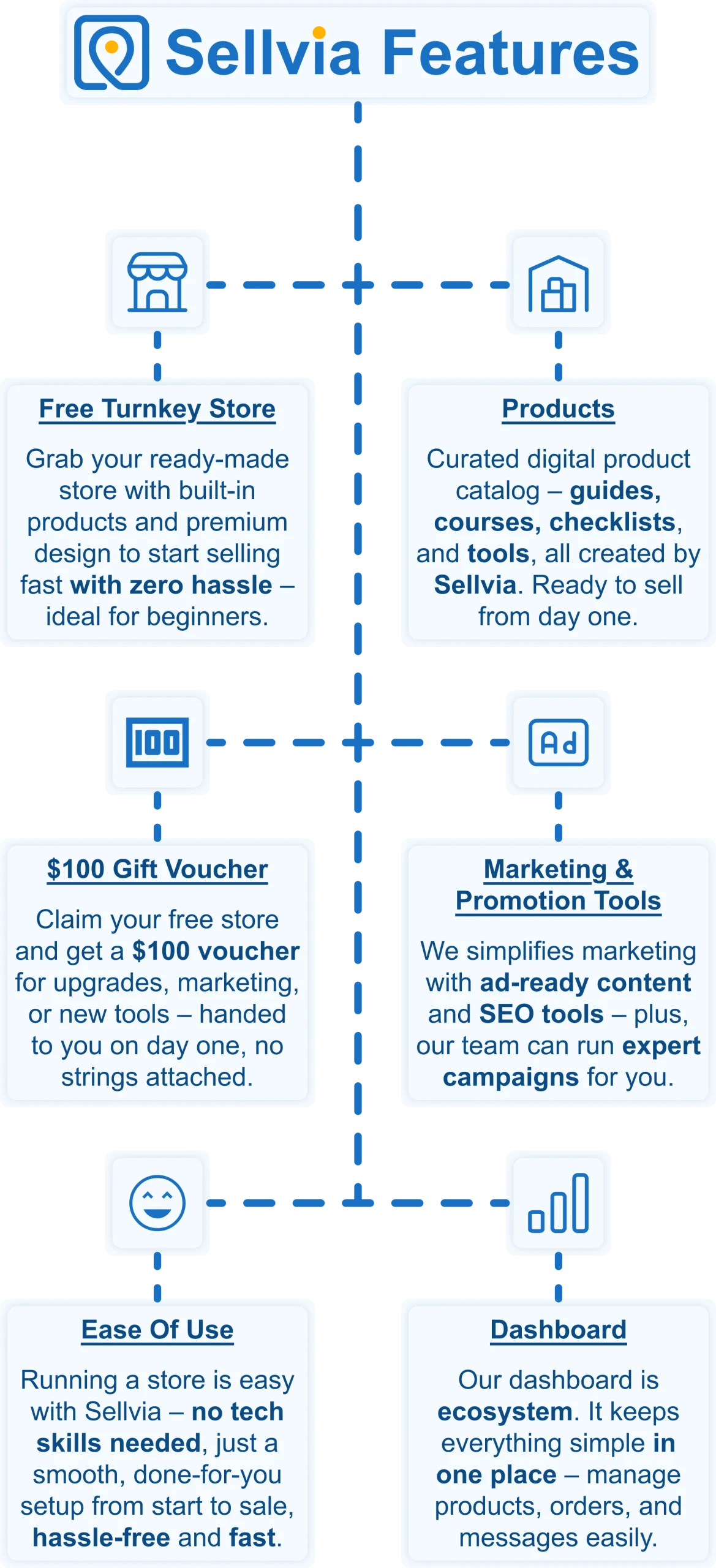
Get a ready-to-go store hassle-free 🎯
Want to start selling but don’t know where to begin? No worries! Just share your ideas, and Sellvia’s team will build a free ecommerce website that’s fully set up and ready to take orders from day one. No coding, no stress – just a store that works right out of the box.
A $100 gift voucher to grow your business faster 🎁
Starting a business takes momentum – and Sellvia gives you a head start. When you claim your free store today, you also get a $100 gift voucher to put toward growing your business. Use it to upgrade your store, boost your marketing, or unlock new tools. It is a real dollar value, handed to you on day one, with no catch and no hoops to jump through.
A massive catalog of digital products to sell 🏆
One of the biggest struggles in starting an online business is figuring out what to sell. Sellvia solves that completely. Your store comes pre-loaded with digital products – guides, courses, checklists, and tools – all created by Sellvia. You keep 50–70% of every sale. No inventory. No shipping. No logistics headaches.
Everything in one easy-to-use platform 🔥
Managing an online store shouldn’t be complicated. With Sellvia, you can handle orders, add new products, and even chat with customers – all from a simple and user-friendly platform. No need to mess with confusing tools or deal with unnecessary tech stuff. It’s all smooth sailing.
No upfront costs, just start selling 💰
A big reason people hesitate to start an online business is the cost. But here’s the good news: With Sellvia, you don’t need to invest in stock, storage, or shipping supplies. You can run your store with no upfront costs, keeping things low-risk while still making money.
Support that’s always got your back 🤝
Running a business comes with questions, but you’re never alone. Sellvia’s dedicated support team is available 24/7 to help with anything you need. Whether it’s a small question or a big challenge, they’ve got you covered.
Typing jobs earn by the hour, but your Sellvia store earns by the sale – and there is no limit to how many sales you can make in a day. Claim your free store and $100 voucher and start building income that grows.