Every day, millions of people click on ads – and someone earns money every time they do. Pay per click advertising is one of the most popular ways to drive traffic and generate income online, and in 2026 it is bigger than ever. Whether you want to run ads for your own online store or master PPC as a skill you can sell, the basics are more accessible than you might think.
Quick Answer: To make money with pay per click advertising, you create targeted ads on platforms like Google or Facebook, pay only when someone clicks, and earn when those clicks turn into sales. Beginners can start with budgets as low as $10–$25 per day, and experienced advertisers can generate hundreds or thousands in monthly income once their campaigns are dialed in.
This guide covers exactly how PPC works, how much you can realistically earn, and how to get started even if you have never run a single ad. If you are looking for a faster route to earning online – one where the advertising is already set up for you – we will cover that option too.
What is pay per click advertising?
Pay per click – commonly called PPC – is an online advertising model where you only pay when someone actually clicks on your ad. Instead of paying a flat fee to display an ad to thousands of people, you pay based on the actions people take. The biggest platforms for PPC include Google Ads, Facebook and Instagram Ads, and Microsoft (Bing) Ads.
Businesses of all sizes use PPC to get their offers in front of people who are already looking for what they sell. A local gym can show ads to people searching “gym near me.” An online store selling digital guides can target people searching “how to start an online business.” The advertiser only pays when an interested person clicks through.
How PPC works step by step
You start by creating an ad – a headline, a short description, and a link. You choose keywords (the search terms you want your ad to appear for) or target audiences based on interests and behavior. You set a bid, which is the maximum you are willing to pay per click. The platform then runs an auction: the most relevant, highest-quality ads at competitive bids get shown. When someone clicks, you pay your bid amount – nothing more.
Every platform gives you detailed analytics showing how many people saw your ad, how many clicked, what they did after clicking, and how much you spent. This data is what lets you keep improving over time until your campaigns become reliably profitable.
Why this works in 2026: Digital advertising spending exceeded $740 billion globally in 2025, and it keeps climbing. Small businesses and solo entrepreneurs are competing head-to-head with major brands – which means the skills to run smart, efficient PPC campaigns are more valuable than ever.
How much can you realistically earn with pay per click?
Income from PPC advertising depends on your niche, your product, your budget, and how well you optimize your campaigns. Here is a realistic breakdown of what different approaches typically look like.
These figures reflect realistic outcomes for people running PPC campaigns to drive sales for their own online business. Results vary based on niche, daily budget, and how much time you invest in testing and optimization.
One of the most common beginner mistakes is expecting fast profits without accounting for the cost of learning. PPC works when your ad spend stays lower than the revenue it generates – and figuring out that math takes time. Most advertisers spend 30–90 days testing before their campaigns become reliably profitable. That is normal. Budget for it.
Earning potential: $30–$150/day from an optimized PPC-driven online business after 60–90 days of consistent effort, testing, and reinvesting into what works.
How to make money with pay per click advertising
Getting started with PPC is accessible – but it requires a clear plan. Here is a practical breakdown of the platforms to consider and the steps you need to follow to give your campaigns the best chance of success.
Step 1 – Choose the right platform
Not every PPC platform is suited to every business. Choosing the right one from the start saves time, money, and frustration.
Google Ads
Google Ads is the largest PPC platform in the world. It shows your ads to people actively searching for what you offer through Google Search, YouTube, and the Google Display Network. If someone is already looking for “best digital guides for beginners” or “how to start earning online,” your ad can appear right at the top of their results. Google Ads is powerful for products with clear search demand, but competition in popular niches can push click costs higher – sometimes $2–$10 per click or more.
Facebook and Instagram ads
Meta’s ad platform covers both Facebook and Instagram, reaching billions of people based on their interests, behaviors, and demographics. Instead of waiting for someone to search, you show your ad to people who are most likely to want what you offer. This approach works especially well for visually engaging products, lifestyle content, and anything with an emotional angle. Cost per click tends to be lower than Google – often $0.50–$2.00 – but you typically need more testing to find what resonates.
Microsoft (Bing) Ads
Bing Ads reach over one billion people globally through Bing, Yahoo, and other Microsoft-powered search engines. Because fewer advertisers compete on this platform, clicks often cost 20–30% less than on Google. The Bing audience skews slightly older and higher-income on average, which can work in your favor depending on what you’re selling. If you’re looking to stretch your ad budget further, Bing is worth including in your strategy.
Step 2 – Build your campaign foundation
Picking a platform is just the beginning. The real results come from how you build and run your campaigns every single day.
Set clear goals before you spend anything
Before you create a single ad, decide what success looks like. Are you trying to drive store visits? Get email sign-ups? Sell a digital product? Your goal determines everything that follows – from the keywords you target to the page you send people to. Without a clear goal, you cannot measure whether your campaign is actually working.
Do your keyword research carefully
Keyword research is where PPC campaigns are often won or lost. Free tools like Google Keyword Planner show you how many people search for any given term each month and how competitive that term is. Look for keywords with solid search volume and manageable competition. Long-tail keywords – phrases of three words or more – tend to cost less per click and attract people who are closer to making a purchase decision.
Important note: A keyword with 50,000 monthly searches sounds exciting, but if it costs $8 per click and your product sells for $30, the math doesn’t work. Always think about profitability, not just volume.
Write ads that earn the click
A great PPC ad does two things well: it grabs attention and sets accurate expectations. Keep your headline tightly relevant to the keyword someone searched for. Include a specific benefit or number – “50% profit on every sale” beats “great opportunity” every time. Always end with a clear call to action. “Start free today,” “See how it works,” and “Get your guide now” consistently outperform vague phrases like “Learn more.”
Set your budget and watch your numbers daily
Start with a daily budget you can comfortably afford while you’re learning – $10–$25 per day is a reasonable starting point for most beginners. Once your ads are live, check your data every day or two. Watch your click-through rate (the percentage of people who click after seeing your ad) and your conversion rate (how many of those clicks result in a sale). Pause what isn’t working, and put more budget toward what is.
Important: Never launch a campaign and walk away. A PPC campaign left unmonitored for a week can burn through hundreds of dollars with nothing to show for it. Attention is not optional – it is what separates profitable advertisers from ones who give up.
Tips to get more from your pay per click campaigns
Once your campaigns are live, these strategies will help you earn more without simply spending more.
Test multiple ad versions
Never assume your first ad is your best one. Write two or three versions with different headlines, offers, or calls to action – then let them run side by side for a week or two. This is called A/B testing. The data will show you which version gets more clicks and more conversions. Small wording changes can sometimes double your click-through rate. The best campaigns are built through dozens of small improvements, not one perfect ad.
Use negative keywords to protect your budget
Negative keywords tell your ad platform which searches you do not want your ads to appear for. If you sell premium digital courses, you might add “free” as a negative keyword so you stop paying for clicks from people who will never buy. If you sell guides for adults, you might exclude terms associated with student or academic searches. Negative keywords are one of the most overlooked tools in PPC – and they can dramatically cut your wasted ad spend.
Make your landing pages earn their keep
Your ad gets the click – but your landing page closes the sale. Make sure the page people arrive on exactly matches what your ad promised. If your ad said “get a free checklist,” the landing page needs to deliver that checklist immediately and clearly. A slow, confusing, or mismatched page will lose customers even when your ads are excellent. Test different headlines, images, and button text on your landing pages the same way you test your ads.
Add retargeting to your strategy
Retargeting lets you show ads specifically to people who already visited your page but didn’t buy. These visitors have already shown interest, which means they are far more likely to convert the second time around. Most PPC platforms make retargeting easy to set up, and it often delivers a much better return on ad spend than cold traffic campaigns. It is one of the most efficient ways to get more value out of every dollar you spend on advertising.
Track the numbers that actually matter
The advertisers who make the most money with PPC are the ones who watch their numbers closely – especially cost per acquisition (how much you spend in ads to get one customer). If your cost per acquisition is lower than your profit per sale, your campaign is working. If it is higher, something needs to change. Set up conversion tracking from day one, review it regularly, and make data-driven decisions rather than guessing.
Which approach is right for you?
Pay per click advertising looks different depending on your goals, your experience, and how much time you can commit. Here is a simple breakdown to help you find where you fit.
Complete beginner
If you have never run an ad before, start small and focus on learning rather than profits. Pick one platform – Google Ads or Facebook Ads – and set a budget of $10–$15 per day. Focus on one product and one audience. Your first 30 days are about collecting data, not making money. Budget $300–$500 for the learning phase, and treat it as tuition for one of the most valuable digital skills you can develop.
Part-time earner
If you already have an online presence or a product to sell and want to use PPC to grow your income, you can move faster. Start with $25–$50 per day, test two or three ad variations at once, and scale the winners. With consistent effort, part-time advertisers running well-optimized campaigns can earn an extra $500–$1,500 per month after about 60 days of testing and refinement.
Full-time income goal
Replacing a full-time income through PPC requires a solid product, a well-tested campaign, and a daily budget of at least $50–$100. It is absolutely achievable – many online business owners earn $3,000–$8,000 per month from well-optimized PPC-driven stores – but it takes 3–6 months of consistent work, testing, and reinvesting profits back into advertising. The payoff is real, but so is the commitment it requires.
Common pay per click mistakes to avoid
Even experienced advertisers fall into these traps. Knowing them in advance can save you real money and real frustration.
- Skipping analytics. Running ads without tracking performance is like guessing. Review your data every few days at minimum – click-through rates, conversion rates, and cost per acquisition should all be on your radar from day one.
- Setting campaigns and forgetting them. PPC is not a set-it-and-forget-it system. Platforms change, competition shifts, and ads get stale. Successful advertisers check in regularly and keep making small improvements.
- Ignoring mobile users. More than 60% of search traffic now comes from mobile devices. If your ads or landing pages are not mobile-friendly, you are losing the majority of potential customers before they even see your offer.
- Targeting too broadly. A wide audience sounds appealing, but it means you pay for clicks from people who were never going to buy. Narrow your targeting, especially in the early weeks of a campaign, and expand gradually as you gather data.
- Not testing enough. One ad is never enough. Test headlines, images, offers, and calls to action continuously. The best-performing campaigns are the result of dozens of small improvements over time – not one perfect ad written at the start.
- Sending traffic to a homepage. Your homepage is designed to introduce your brand – not to convert an ad click. Always send PPC traffic to a dedicated landing page that matches your ad message exactly.
A smarter way to start earning online
Pay per click advertising is genuinely powerful. But it comes with a real learning curve – you need a product to sell, a platform to advertise on, an understanding of keywords and bidding, the budget to absorb early losses, and the patience to keep optimizing week after week. For most beginners, that is a lot to manage all at once.
That is exactly why platforms like Sellvia exist. Instead of building everything from scratch, you get a ready-made online business with digital products already loaded and a built-in advertising system that handles the targeting, the creatives, and the optimization for you. You set your daily budget – as low as $10 – and the system does the rest. Most Sellvia customers who activate ads start seeing orders on the very same day.
It is not a shortcut past hard work – growing any online business takes real effort. But it removes the biggest barrier most people face: the steep technical learning curve that stops beginners from ever getting started in the first place.
Why Sellvia is a game-changer for your online store 🚀
Sellvia isn’t just another ecommerce tool. We are a trusted name in the industry, recognized by Forbes and even ranked in Inc.’s list of the 5,000 fastest-growing companies in the U.S. So if you’re serious about starting as a solopreneur, this is a smart place to begin.
Starting an online business can feel overwhelming, but that’s exactly where Sellvia steps in. It takes care of the tricky parts, so you can focus on making sales and growing your brand. Let’s break down what makes it such a great choice.
Get a ready-to-go store hassle-free 🎯
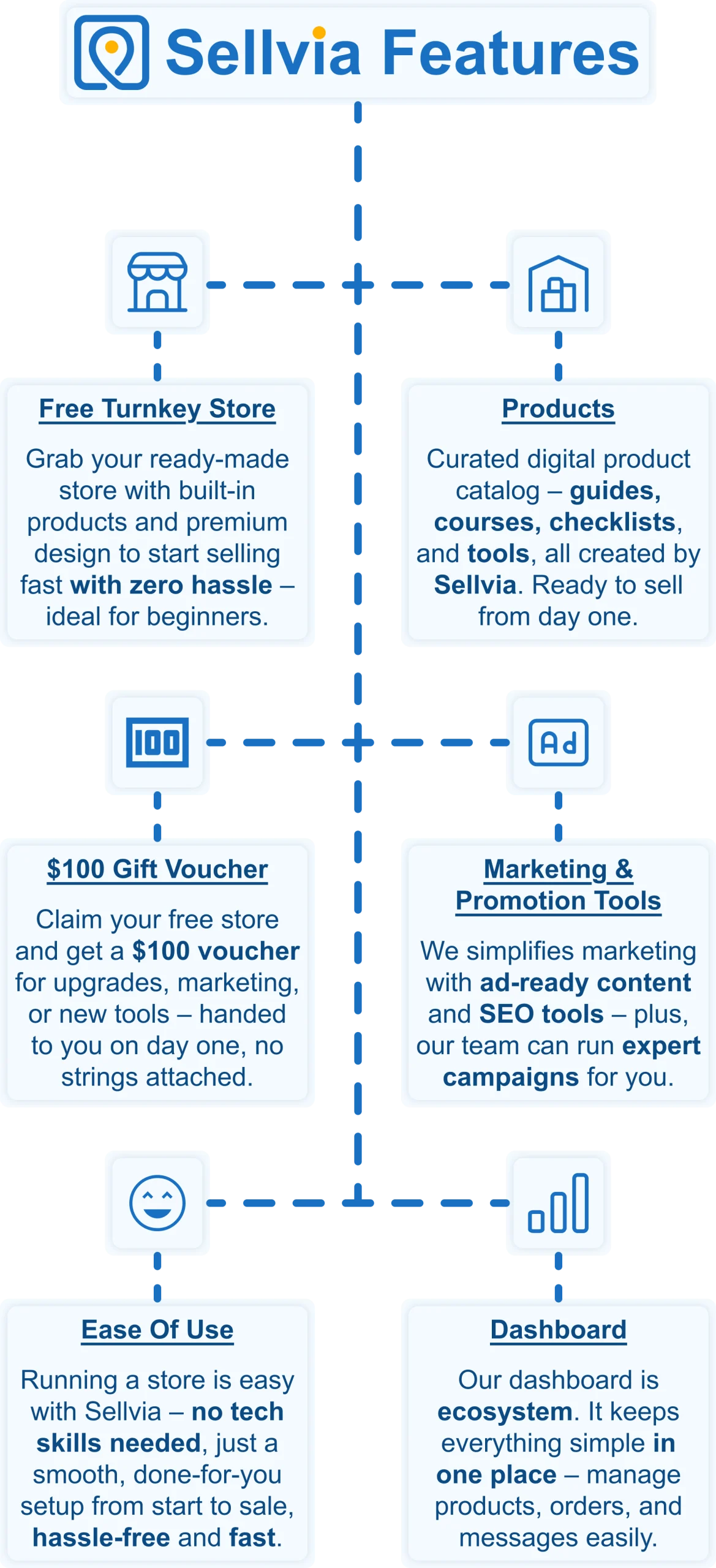
Want to start selling but don’t know where to begin? No worries! Just share your ideas, and Sellvia’s team will build a free ecommerce website that’s fully set up and ready to take orders from day one. No coding, no stress – just a store that works right out of the box.
A $100 gift voucher to grow your business faster 🎁
Starting a business takes momentum – and Sellvia gives you a head start. When you claim your free store today, you also get a $100 gift voucher to put toward growing your business. Use it to upgrade your store, boost your marketing, or unlock new tools. It is a real dollar value, handed to you on day one, with no catch and no hoops to jump through.
A massive catalog of digital products to sell 🏆
One of the biggest struggles in starting an online business is figuring out what to sell. Sellvia solves that completely. Your store comes pre-loaded with digital products – guides, courses, checklists, and tools – all created by Sellvia. You keep 50–70% of every sale. No inventory. No shipping. No logistics headaches.
Everything in one easy-to-use platform 🔥
Managing an online store shouldn’t be complicated. With Sellvia, you can handle orders, add new products, and even chat with customers – all from a simple and user-friendly platform. No need to mess with confusing tools or deal with unnecessary tech stuff. It’s all smooth sailing.
No upfront costs, just start selling 💰
A big reason people hesitate to start an online business is the cost. But here’s the good news: With Sellvia, you don’t need to invest in stock, storage, or shipping supplies. You can run your store with no upfront costs, keeping things low-risk while still making money.
Support that’s always got your back 🤝
Running a business comes with questions, but you’re never alone. Sellvia’s dedicated support team is available 24/7 to help with anything you need. Whether it’s a small question or a big challenge, they’ve got you covered.
Pay per click advertising can drive real income online – and Sellvia makes that even easier by handling the advertising side for you. Claim your free store today and start earning with a business that is already set up and ready to go.