If you love putting words on paper, here is some good news. You really can make money writing letters — and in 2026, businesses, individuals, and creative clients are paying more for skilled letter writers than ever before.
Quick answer: Letter writers earn anywhere from $10 to $200 per letter depending on the type and complexity of the work. Most part-time writers bring in $300 to $1,500 per month. Experienced specialists in business proposals, sales copy, or ghostwritten correspondence can earn $2,000 or more.
This guide breaks down every realistic way to get paid for writing letters in 2026 — who is hiring, what they actually pay, where to find clients, and what it genuinely takes to turn this into a reliable income stream.
The good news is that you do not need a journalism degree or years of professional experience to get started. Clear communication, a feel for tone, and a willingness to deliver what clients need — that is what the market is paying for. Whether you want a quick side hustle or something more scalable, there is a letter-writing method that fits your situation.
What is making money writing letters?
At its core, making money writing letters means using your communication skills to produce written correspondence that someone else needs but does not want to — or does not know how to — write themselves. This has always been a service people pay for, but the rise of freelance platforms and online marketplaces has made it far easier to find consistent, well-paying work in 2026.
Businesses need letters to win clients, retain customers, and communicate professionally. Individuals need letters to express emotions, navigate professional situations, or mark important moments in life. Neither group always has the time or the right words — and that is where a skilled letter writer becomes genuinely valuable.
The category is broader than most people realize. It covers everything from formal business proposals and cover letters to handwritten personal notes and emotionally charged romantic correspondence. Some writers focus on one type and charge premium rates. Others offer a wider range of services and build a steady client base on freelance platforms. Both approaches work — the right one depends on your strengths and how quickly you want to grow.
Important note: Letter writing is not a set-it-and-forget-it income source. You earn when you write. That distinction matters a lot when comparing it to other online income paths — and it is worth keeping in mind as you explore what is possible.
Letter writing can genuinely bring in real money — especially when you find the right niche and market yourself consistently. But before diving into the methods, it helps to understand what the earnings actually look like across different types of work.
How much can you realistically earn writing letters?
Setting honest expectations upfront saves a lot of frustration later. Earnings from writing letters for money vary significantly based on your niche, your level of experience, and how consistently you show up and market your services.
Entry-level writers on Fiverr often start at $10 to $20 per letter while building their reviews. The ceiling is considerably higher for writers who specialize — particularly in business correspondence and sales copy, where experienced writers routinely charge $100 to $500 or more per project. For most people starting out, expect to earn $300 to $800 in your first full month of consistent effort, growing from there as you build a portfolio and client base.
One note on ceiling figures: The top-end estimates you will see in other guides typically reflect experienced copywriters who have built a strong reputation over several years. Give yourself 60 to 90 days to reach reliable monthly income from letter writing — it takes time to get reviews and referrals working in your favor.
Ways to make money writing letters
There are several proven methods for getting paid to write letters in 2026. Some are better suited for beginners, while others reward writers who have put in the time to develop their craft. Here is a breakdown of the most reliable options available right now.
Business and professional letters
This is the most straightforward entry point for new letter writers. Businesses constantly need written correspondence — and many simply do not have the in-house staff to handle all of it.
Cover letters and job applications
Job seekers are one of the most consistent markets for letter writing services. A well-crafted cover letter can be the difference between landing an interview and being passed over entirely — and most applicants know this. On platforms like Fiverr, writers charging $20 to $80 for a professionally written cover letter are among the most consistently reviewed gigs in the writing category. Bundling cover letters with resumes and LinkedIn profiles can push that to $100 to $200 per package.
Earning potential: $20–$80 per cover letter, with bundles reaching $100–$200 per client.
Sales and fundraising letters
Small businesses, nonprofits, and startups regularly need compelling letters to attract customers, partners, or donors. If you can write in a way that moves people to take action — donate, sign up, or make a purchase — you are operating in a narrow and well-paid niche. Fundraising letters for nonprofits can pay $100 to $300 per project, especially if your writing has a strong storytelling element. Sales letters for small business marketing campaigns can go even higher.
Earning potential: $75–$300 per project, with higher rates for performance-tied arrangements.
Customer service and formal correspondence
Businesses dealing with complaints, disputes, or formal communications sometimes hire outside writers to draft their responses. This work is less creative than other types of letter writing, but it is consistent — particularly for small and medium-sized businesses without a dedicated communications team. Upwork is a reliable platform for finding this type of recurring work, often as part of a longer-term retainer arrangement.
Earning potential: $25–$75 per letter, or $15–$30 per hour for ongoing client relationships.
Personal and creative letters
Not every client is a business. A large and underserved market exists for personal correspondence — people who need to say something important but cannot find the right words on their own.
Love and romantic letters
This is one of the most emotionally driven niches in freelance writing. People pay for love letters for anniversaries, marriage proposals, long-distance relationships, and difficult reconciliations. On platforms like Etsy, personalized romantic letters are a consistently popular product — and sellers with strong reviews can charge $20 to $60 per letter. Rush orders and premium packages can push that figure higher.
Earning potential: $20–$60 per letter, scaling higher with strong reviews and bundled packages.
Sympathy and special occasion letters
Grief, gratitude, and milestone moments are situations where people often feel at a complete loss for words. Sympathy letters, heartfelt thank-you notes, retirement tributes, and letters to aging parents are all services people genuinely pay for. This niche requires empathy and sensitivity more than technical writing ability — and the emotional value clients receive is real and significant.
Earning potential: $15–$50 per letter depending on length and level of personalization.
Handwritten letters for businesses and events
Luxury brands, boutique hotels, and wedding planners sometimes hire writers specifically to create handwritten notes for clients or event guests. Handwriting has become a premium service in an era of digital communication — and if you have good penmanship, this is a niche where you can charge a real premium. Wedding invitation writing and personalized guest correspondence are particularly popular in this space, with some service providers earning hundreds of dollars per event package.
Earning potential: $2–$5 per note at scale, or $30–$75 for custom letter packages.
Ghostwriting professional correspondence
Ghostwriting means writing on behalf of someone else — they send it under their name, you get paid. In the letter-writing world, this includes resignation letters, letters of recommendation, formal complaints, and sensitive professional correspondence. This type of work pays well because it requires discretion, strong customization, and the ability to capture another person’s voice accurately.
The best platforms for finding ghostwriting gigs are Upwork and PeoplePerHour, where clients regularly post requests for confidential correspondence. Experienced ghostwriters in this category can charge $50 to $150 per letter or more, depending on complexity and required turnaround time. Establishing trust with a small number of repeat clients is the fastest way to build consistent income in this niche.
Earning potential: $50–$200 per project, with higher rates for legal or sensitive professional correspondence.
Across all of these categories, the common thread is clear: there is genuine and growing demand for letter writing in 2026. People are willing to pay for correspondence that saves them time, expresses something they cannot put into words, or helps them make a better impression.
How to find letter-writing jobs
Knowing what types of letters to write is only half the equation. You also need to know where to find clients who are ready to pay. Here are the most reliable sources of work for letter writers right now.
Freelance platforms are the fastest starting point for new writers. Upwork, Fiverr, Freelancer, and PeoplePerHour all have active demand for letter writing. Fiverr works well for one-off creative and personal letters. Upwork is better for professional correspondence where clients want a longer-term relationship. Create a focused profile, upload at least 3 writing samples, and apply consistently in your first 30 days to build early reviews and momentum.
Etsy and Gumroad are underrated options for personal letter services. Etsy in particular has a strong market for handwritten, romantic, and emotionally personalized letters. Set up a listing, upload sample previews, and let the built-in search bring buyers to you. Sellers with 10 or more reviews in this niche routinely charge $25 to $60 per letter with consistent order volume.
Direct outreach is the method most beginners overlook — and often one of the most effective. Small businesses, real estate agents, nonprofits, and startups frequently need correspondence help but do not actively search freelance platforms for it. A short, confident email introducing your services can open doors that no algorithm will. Start with local businesses, then expand from there.
Social media and online communities are worth building alongside your freelance presence. LinkedIn is the most direct network for business correspondence clients. Facebook groups for small business owners and entrepreneurs regularly surface clients who need professional writing help. Even Reddit communities in relevant niches can generate referrals if you contribute genuinely and mention your services when appropriate.
Combining two or three of these channels — rather than relying on a single platform — is the most effective way to create consistent work from the beginning. Most successful letter writers use a freelance platform for volume and direct outreach for higher-paying projects.
Tips to maximize your earnings from letter writing
Getting your first few clients is one milestone. Scaling from a handful of gigs per month to a consistent income stream is another. These tips can help you get there faster — and avoid the mistakes most new letter writers make early on.
Specialize in one niche
Trying to write every type of letter will slow your growth. The letter writers who earn the most are known for something specific — sales letters, cover letters, or romantic correspondence. Specializing lets you build real expertise, charge higher rates, and market yourself more clearly to the right clients. Pick the niche that matches your strengths and commit to it for at least 60 days before expanding.
Build a portfolio from day one
A portfolio is your most important asset as a letter writer. Even before you have paid clients, write 3 to 5 strong sample letters in your chosen niche and publish them as a PDF or a profile on a platform like Contently. Real samples beat any amount of description when a potential client is deciding who to hire — and having them ready from the start can cut your ramp-up time significantly.
Offer add-on services
The fastest way to increase income per client is to bundle related services. Cover letter writers can add resume editing. Romantic letter writers can offer anniversary packages with multiple letters. Business correspondence writers can set up monthly retainers for clients who need ongoing help. Add-ons make every client more valuable without requiring you to find entirely new ones.
Set rates that reflect your value
New writers often undercharge out of fear. Starting lower while you build your first 10 to 15 reviews makes sense — but raise your rates once you have a track record. Research what experienced writers in your niche are charging and price yourself accordingly. Clients who genuinely value quality writing will accept fair pricing. Those who push back at reasonable rates are usually not the clients worth keeping.
Protect yourself with clear agreements
Revision requests and scope creep are the most common frustrations for freelance letter writers. Avoid both by setting clear expectations upfront: how many revisions are included, what the turnaround time is, and when payment is due. A clearly worded Fiverr gig description or a basic written agreement for direct clients can save hours of difficult back-and-forth later.
Key principle: Treat every client interaction professionally from the start — even the smallest gigs. Repeat business and word-of-mouth referrals will become your most reliable income source once you get past the first few months.
Is letter writing a reliable path to full-time income?
Honestly — for most people, writing letters for money is a solid side income, not a straightforward path to replacing a full-time paycheck. The ceiling is real: you can only write so many letters per day, and your earnings are tied directly to your hours. The market for premium letter writing is also narrower than many guides suggest.
That does not mean it is not worth doing. If you enjoy writing and want to bring in an extra $300 to $1,000 per month, letter writing is one of the most accessible freelance options available — with a low barrier to entry and genuine demand. But if your goal is financial freedom or building something that grows beyond the hours you have available, you will need a model that does not cap out when you step away from your keyboard.
Many people who start with letter writing eventually look for income sources that are not one-to-one with their time. That is where having your own online store changes the picture entirely. With Sellvia, you get a complete ready-to-go store pre-loaded with digital products and a built-in advertising system — so you can pursue letter writing as a creative outlet while your store builds income alongside it.
More than 1,500,000 stores have been launched through Sellvia, with store owners collectively earning over $1.5 billion. The platform is recognized by Forbes and ranked among Inc.’s 5,000 fastest-growing companies in the U.S. — which means it is a serious platform, not just another side-hustle tool.
Why Sellvia is a game-changer for your online store 🚀
Sellvia isn’t just another ecommerce tool. We are a trusted name in the industry, recognized by Forbes and even ranked in Inc.’s list of the 5,000 fastest-growing companies in the U.S. So if you’re serious about starting as a solopreneur, this is a smart place to begin.
Starting an online business can feel overwhelming, but that’s exactly where Sellvia steps in. It takes care of the tricky parts, so you can focus on making sales and growing your brand. Let’s break down what makes it such a great choice.
Get a ready-to-go store hassle-free 🎯
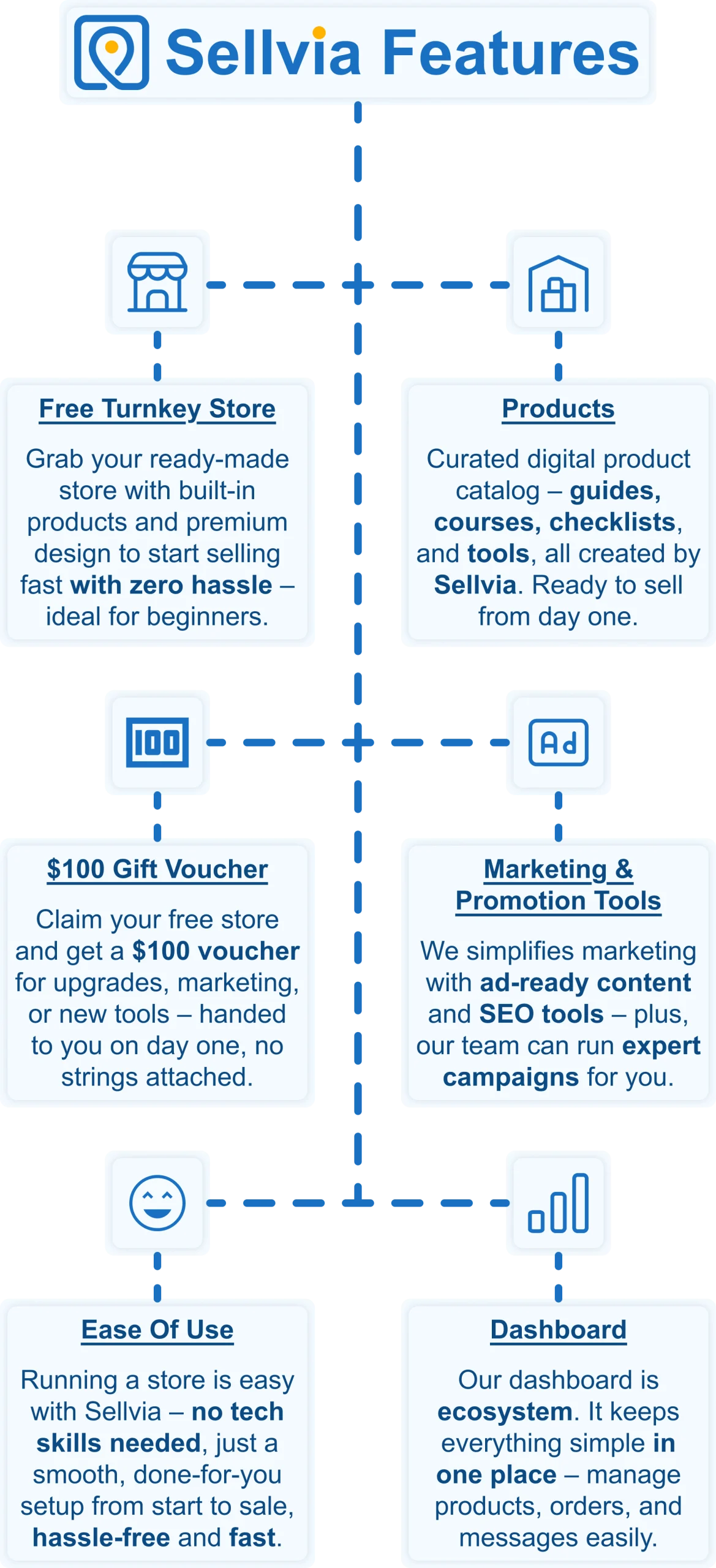
Want to start selling but don’t know where to begin? No worries! Just share your ideas, and Sellvia’s team will build a free ecommerce website that’s fully set up and ready to take orders from day one. No coding, no stress – just a store that works right out of the box.
A $100 gift voucher to grow your business faster 🎁
Starting a business takes momentum – and Sellvia gives you a head start. When you claim your free store today, you also get a $100 gift voucher to put toward growing your business. Use it to upgrade your store, boost your marketing, or unlock new tools. It is a real dollar value, handed to you on day one, with no catch and no hoops to jump through.
A massive catalog of digital products to sell 🏆
One of the biggest struggles in starting an online business is figuring out what to sell. Sellvia solves that completely. Your store comes pre-loaded with digital products – guides, courses, checklists, and tools – all created by Sellvia. You keep 50–70% of every sale. No inventory. No shipping. No logistics headaches.
Everything in one easy-to-use platform 🔥
Managing an online store shouldn’t be complicated. With Sellvia, you can handle orders, add new products, and even chat with customers – all from a simple and user-friendly platform. No need to mess with confusing tools or deal with unnecessary tech stuff. It’s all smooth sailing.
No upfront costs, just start selling 💰
A big reason people hesitate to start an online business is the cost. But here’s the good news: With Sellvia, you don’t need to invest in stock, storage, or shipping supplies. You can run your store with no upfront costs, keeping things low-risk while still making money.
Support that’s always got your back 🤝
Running a business comes with questions, but you’re never alone. Sellvia’s dedicated support team is available 24/7 to help with anything you need. Whether it’s a small question or a big challenge, they’ve got you covered.
If you are ready to go beyond earning one letter at a time, Sellvia gives you a full online business – built, loaded with digital products, and ready to launch today. Claim your free store and your $100 gift voucher right now.