Most businesses that struggle to grow share one common problem — they have no written marketing plan. They post on social media when inspiration strikes, run ads without a clear goal, and wonder why nothing sticks. A solid marketing plan example gives you a framework so every action connects to a real outcome.
This guide walks you through what a marketing plan actually looks like in practice, breaks down each section with real examples by business type, and shows you how to build one from scratch — even with zero marketing background.
Quick answer: A marketing plan is a written document that defines your target audience, your goals, your channels, and your budget. A good marketing plan example shows you how those pieces fit together in a real business context — so you can adapt the structure to your own situation.
What is a marketing plan?
A marketing plan is a strategic document that outlines how a business intends to reach its target customers and turn them into buyers. It covers everything from audience research and channel selection to budget allocation and performance tracking. Without one, marketing tends to be reactive — driven by trends or guesswork rather than clear business goals.
A marketing plan is not the same as a marketing strategy, though the two are closely related. Your strategy is the big-picture direction — for example, “we want to own the budget fitness niche online.” Your plan is the operational document that turns that direction into specific actions, timelines, and measurable targets.
In 2026, the need for a written plan is greater than ever. The number of channels available to small businesses — search, social, email, video, influencer, paid — has expanded significantly. Without a plan, it is easy to spread your budget too thin and see weak results everywhere. A focused marketing plan keeps you deliberate and on track.
How much does good marketing actually cost?
One of the first questions people ask when building a marketing plan is how much they need to spend. The honest answer is that it depends heavily on your channel mix and your timeline. Here is a realistic breakdown by approach:
Most people starting out land in the first or second row. A well-structured plan helps you get the most from whatever budget you have by focusing your spend on the channels most likely to convert your specific audience.
One note on budget figures: these ranges reflect typical small business and online store scenarios. Starting lean and scaling what works is almost always the smarter move — especially in your first 90 days.
Marketing plan examples: what each type looks like in practice
Before building your own plan, it helps to see what a real marketing plan example looks like across different business types. The structure is similar across the board — but the channels, priorities, and budget shift depending on what you sell and who you sell to.
Marketing plan example: online store selling digital products
Business overview
An online store selling digital guides and productivity tools targeting first-time online business owners aged 25–45 in the US.
Goals
Generate 200 monthly sales within 90 days of launch. Achieve a positive return on ad spend by month two through a combination of built-in advertising and organic content.
Target audience
People working from home or looking to replace a day job income. Comfortable buying online but new to running their own business. Motivated by financial freedom and flexibility rather than corporate career growth.
Channels
- Built-in advertising system (ads managed for you — no setup required)
- Instagram and Facebook organic content (real results, personal stories, product demos)
- Email welcome sequence for new customers
Budget
$10–$50 per day on ads through the built-in system. Zero cost on store setup — the store is provided free. A $40 ad coupon is included to help cover the first days of advertising.
KPIs
Daily orders, cost per sale, email open rate, monthly revenue.
Earning potential: $30–$150/day with consistent ad spend and a well-matched audience — results vary based on niche, effort, and how quickly you optimize.
Marketing plan example: small service business
Business overview
A freelance graphic designer targeting early-stage startups and small businesses that need branding work.
Goals
Land 4 new clients per month at an average project value of $800. Build a referral pipeline within 6 months.
Target audience
Founders and solopreneurs aged 28–45, active on LinkedIn and in startup communities on Reddit and Slack.
Channels
- LinkedIn content and direct outreach
- Portfolio website optimized for niche search terms
- Referral program offering a discount for introductions
Budget
$150/month — LinkedIn Premium subscription plus basic SEO tools.
KPIs
Number of qualified leads per month, proposal-to-close rate, referral count.
Earning potential: $2,000–$5,000/month with a steady client base — highly dependent on niche, portfolio strength, and referral volume.
Marketing plan example: digital content creator
Business overview
A creator selling productivity guides and templates targeting remote workers and students aged 18–34.
Goals
Reach $2,000/month in digital product sales within 120 days. Grow an email list to 3,000 subscribers.
Target audience
Remote workers and university students who follow productivity accounts on TikTok and YouTube. Looking for tools that save time and reduce stress.
Channels
- TikTok and YouTube Shorts showing product walkthroughs
- Storefront optimized for search (Gumroad or Etsy)
- Weekly newsletter with free tips to drive product interest
Budget
$80/month — email platform and basic design tools.
KPIs
Monthly revenue, email list growth rate, content views, conversion rate from traffic to sales page.
Earning potential: $500–$3,000/month depending on content consistency, audience size, and product-market fit.
Marketing plan example: local service business
Business overview
A coffee shop in a mid-sized city targeting remote workers and students looking for a reliable workspace during the week.
Goals
Increase weekday foot traffic by 25% within 60 days. Build a loyalty program with 500 active members in 3 months.
Target audience
Remote workers and students aged 20–38 within a 3-mile radius who use Google Maps and Instagram to discover local spots.
Channels
- Google Business Profile optimization and review generation
- Instagram Stories showing the workspace, drinks, and daily specials
- Local SEO targeting “coffee shop with wifi near me” type searches
Budget
$200/month — social scheduling tool, local ad spend, and loyalty app.
KPIs
Google Maps views and actions, Instagram reach, loyalty sign-ups, average daily transactions.
Earning potential: Highly location-dependent — a well-executed local marketing plan can add $1,000–$4,000/month in incremental revenue for a small venue.
Important note: Local businesses are limited by geography. An online store has no such ceiling — your customers can be anywhere in the US from day one.
How to write your own marketing plan step by step
Now that you have seen several real marketing plan examples, here is how to build your own from scratch. Each step below maps directly to the examples above — so you can reference them as you fill in your own details.
Step 1 — define your business and offer clearly
Start with a one-paragraph description of what your business does, what problem it solves, and who it is for. This is not a mission statement — it is a plain, honest description that grounds everything that follows. If you cannot describe your offer clearly in three sentences, your marketing will struggle to land with anyone.
Important note: Be specific about your niche from the start. “I sell products online” is too vague to build a meaningful plan around. “I sell digital productivity guides to remote workers in the US” gives you a foundation to work from.
Step 2 — set SMART goals
Every strong marketing plan uses SMART goals — Specific, Measurable, Achievable, Relevant, and Time-bound. Vague goals like “grow our audience” are not actionable. A SMART version would be: “Grow our Instagram following from 400 to 1,500 engaged followers by the end of Q2 by posting 5 times per week and running one collaboration per month.”
Set 2–3 goals maximum per quarter. More than that and you dilute your focus. Each goal should map to a real business outcome — revenue, leads, conversions, or retention.
Step 3 — research and define your target audience
Your marketing plan example is only useful if it is built around a real audience profile. At a minimum, define your audience by age range, location, income level, and the main problem your product or service solves for them. Then go deeper: where do they spend time online? What content do they consume? What objections do they typically have before buying?
Free research tools that work well here include Reddit (search for conversations in relevant subreddits), Facebook Groups, Google Trends, and the review sections of competitor listings. Real customer language from these sources is far more valuable than demographic data alone.
Step 4 — choose your marketing channels
The biggest mistake small businesses make in this step is trying to be everywhere at once. Pick 2–3 channels based on where your specific audience already spends time — not based on what is trendy. For most online businesses in 2026, a combination of one organic social channel, one paid channel, and email covers the essentials without spreading resources too thin.
Match your channel choice to your content strengths as well. If you are comfortable on camera, short-form video on TikTok or Instagram Reels is a natural fit. If you prefer writing, a blog paired with an email newsletter is a more sustainable long-term channel mix.
Step 5 — build your content and campaign calendar
A marketing plan without a calendar is just a wish list. Once you have your channels, map out your content themes and campaign cadence for the next 30–90 days. A simple spreadsheet with columns for date, channel, content type, topic, and goal is enough to start.
Plan your content in weekly batches rather than day by day. This gives you enough breathing room to stay consistent without burning out. Batch-create content for one or two channels at a time rather than jumping between all of them simultaneously.
Step 6 — set your budget and allocate spend
Even a zero-budget plan needs a budget section — because your time has a cost. List every tool, platform, ad spend, and contractor cost involved in executing your plan. Then prioritize ruthlessly. If a tool does not directly contribute to a stated goal, cut it for now.
A practical rule of thumb for early-stage online businesses: allocate roughly 60–70% of your marketing budget to paid acquisition and 30–40% to retention through email and content. Adjust based on your results every 30 days.
Step 7 — track, measure, and adjust
The final section of any marketing plan example worth following is measurement. Define your key performance indicators (KPIs) before you launch any campaign — not after. Knowing what success looks like in advance prevents you from moving the goalposts when results come in.
Review your KPIs monthly at minimum. If a channel consistently underperforms after 60 days of genuine effort, reallocate that budget or time to your strongest performer. A marketing plan is a living document — it should evolve with your data, not sit untouched in a folder.
Common marketing plan mistakes to avoid
Even with a solid marketing plan example in hand, there are a few mistakes that consistently trip up first-time online business owners.
Targeting everyone
The more specific your audience definition, the more effective your marketing. “Everyone who might like this product” is not a target audience — it is a way to waste budget. Narrow your focus until it feels uncomfortable, then narrow it a little more. You can always expand later once you have proven the core audience converts.
Skipping the research phase
Jumping straight to content creation without understanding your audience is one of the most common and costly mistakes. Spend at least a week before launch reading competitor reviews, exploring relevant communities, and looking at what content already performs well in your niche. This research should shape your messaging — not just confirm what you already think.
Setting goals without tracking systems
A goal without a tracking system is just an intention. Before you set any marketing goal, confirm you have the tools in place to measure it. Google Analytics 4 is free and covers the essentials for most online stores. Pair it with your email platform’s built-in reporting and you have a solid baseline measurement setup at no cost.
Treating the plan as a one-time document
Your first marketing plan will not be perfect — and that is fine. The goal is to start with a structured approach, gather real data, and iterate. Businesses that revisit and update their plan every 30–60 days consistently outperform those that write one document and never touch it again.
How to choose your approach based on your situation
Not every marketing plan example applies equally to every reader. Here is how to match your approach to where you actually are right now.
Complete beginner
If you are building your first marketing plan, start with a single-channel focus. Pick the one channel where your audience is most active and commit to it for 60 days before adding anything else. Use a simple one-page plan: audience, goal, channel, content calendar, budget, and one KPI. Keep it short enough to actually follow.
If you want to skip the setup entirely and start earning sooner, Sellvia handles the store, the products, and the advertising for you. Most beginners who activate ads see their first orders within 24 hours.
Intermediate — part-time business
If you have some experience but are juggling a day job, prioritize channels with the highest return per hour of effort. Email marketing typically wins here — a well-maintained list of even 500 engaged subscribers can outperform a social following of 10,000 passive ones. Add a second channel only when your primary channel is producing consistent results.
Advanced — full-time growth goal
If you are treating this as a full-time business, your marketing plan should include a multichannel approach with dedicated budget for paid acquisition, a content engine, and a structured email sequence. At this stage, tracking which channel is driving which revenue becomes essential — not just which one is generating the most traffic.
At the advanced level, the businesses that grow fastest are the ones with the least friction between a customer seeing an ad and completing a purchase. A ready-made store with built-in ads removes that friction entirely.
Why Sellvia is a game-changer for your online store 🚀
Sellvia isn’t just another ecommerce tool. We are a trusted name in the industry, recognized by Forbes and even ranked in Inc.’s list of the 5,000 fastest-growing companies in the U.S. So if you’re serious about starting as a solopreneur, this is a smart place to begin.
Starting an online business can feel overwhelming, but that’s exactly where Sellvia steps in. It takes care of the tricky parts, so you can focus on making sales and growing your brand. Let’s break down what makes it such a great choice.
Get a ready-to-go store hassle-free 🎯
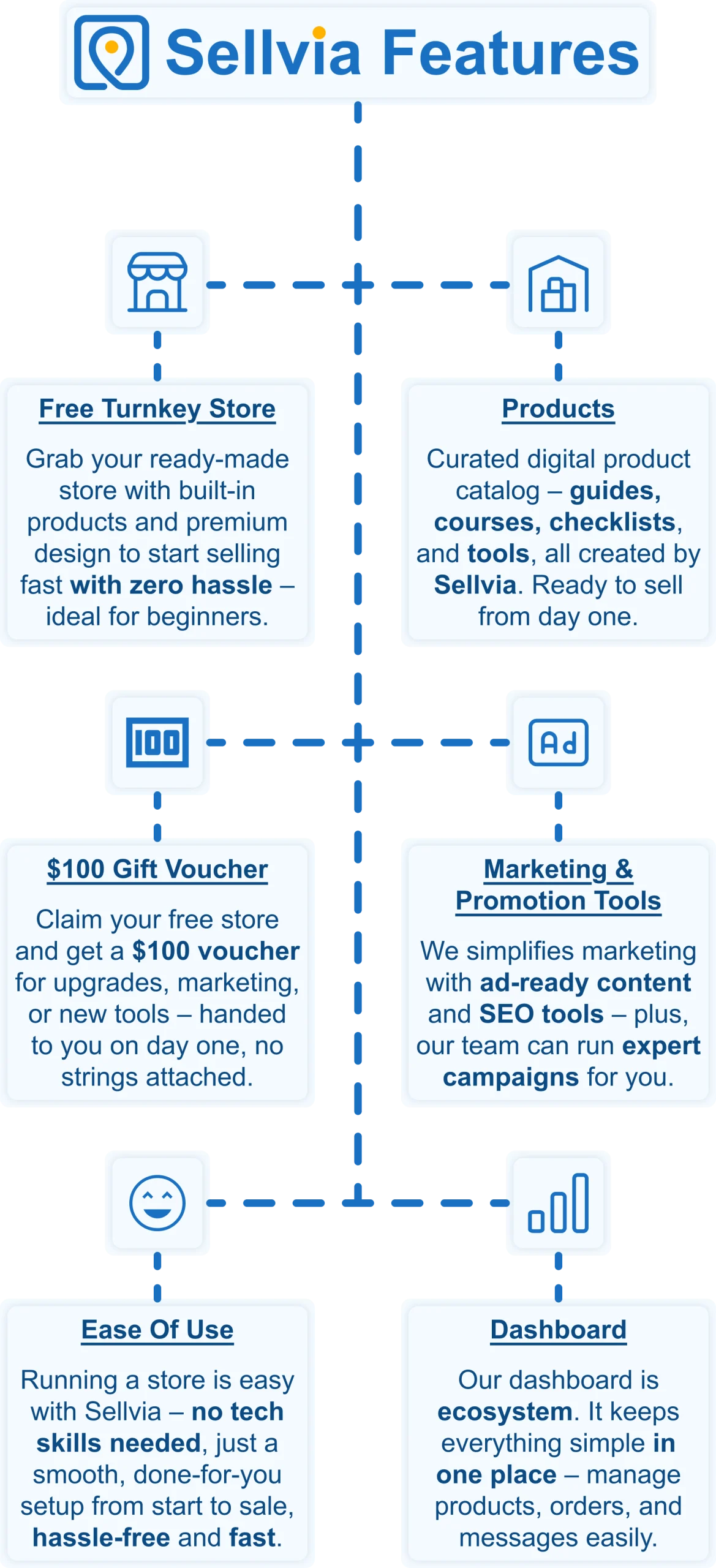
Want to start selling but don’t know where to begin? No worries! Just share your ideas, and Sellvia’s team will build a free ecommerce website that’s fully set up and ready to take orders from day one. No coding, no stress – just a store that works right out of the box.
A $100 gift voucher to grow your business faster 🎁
Starting a business takes momentum – and Sellvia gives you a head start. When you claim your free store today, you also get a $100 gift voucher to put toward growing your business. Use it to upgrade your store, boost your marketing, or unlock new tools. It is a real dollar value, handed to you on day one, with no catch and no hoops to jump through.
A massive catalog of digital products to sell 🏆
One of the biggest struggles in starting an online business is figuring out what to sell. Sellvia solves that completely. Your store comes pre-loaded with digital products – guides, courses, checklists, and tools – all created by Sellvia. You keep 50–70% of every sale. No inventory. No shipping. No logistics headaches.
Everything in one easy-to-use platform 🔥
Managing an online store shouldn’t be complicated. With Sellvia, you can handle orders, add new products, and even chat with customers – all from a simple and user-friendly platform. No need to mess with confusing tools or deal with unnecessary tech stuff. It’s all smooth sailing.
No upfront costs, just start selling 💰
A big reason people hesitate to start an online business is the cost. But here’s the good news: With Sellvia, you don’t need to invest in stock, storage, or shipping supplies. You can run your store with no upfront costs, keeping things low-risk while still making money.
Support that’s always got your back 🤝
Running a business comes with questions, but you’re never alone. Sellvia’s dedicated support team is available 24/7 to help with anything you need. Whether it’s a small question or a big challenge, they’ve got you covered.
Every marketing plan example in this guide requires a product worth promoting and a store ready to receive traffic — Sellvia gives you both from day one. Claim your free store and start putting your marketing plan into action today.