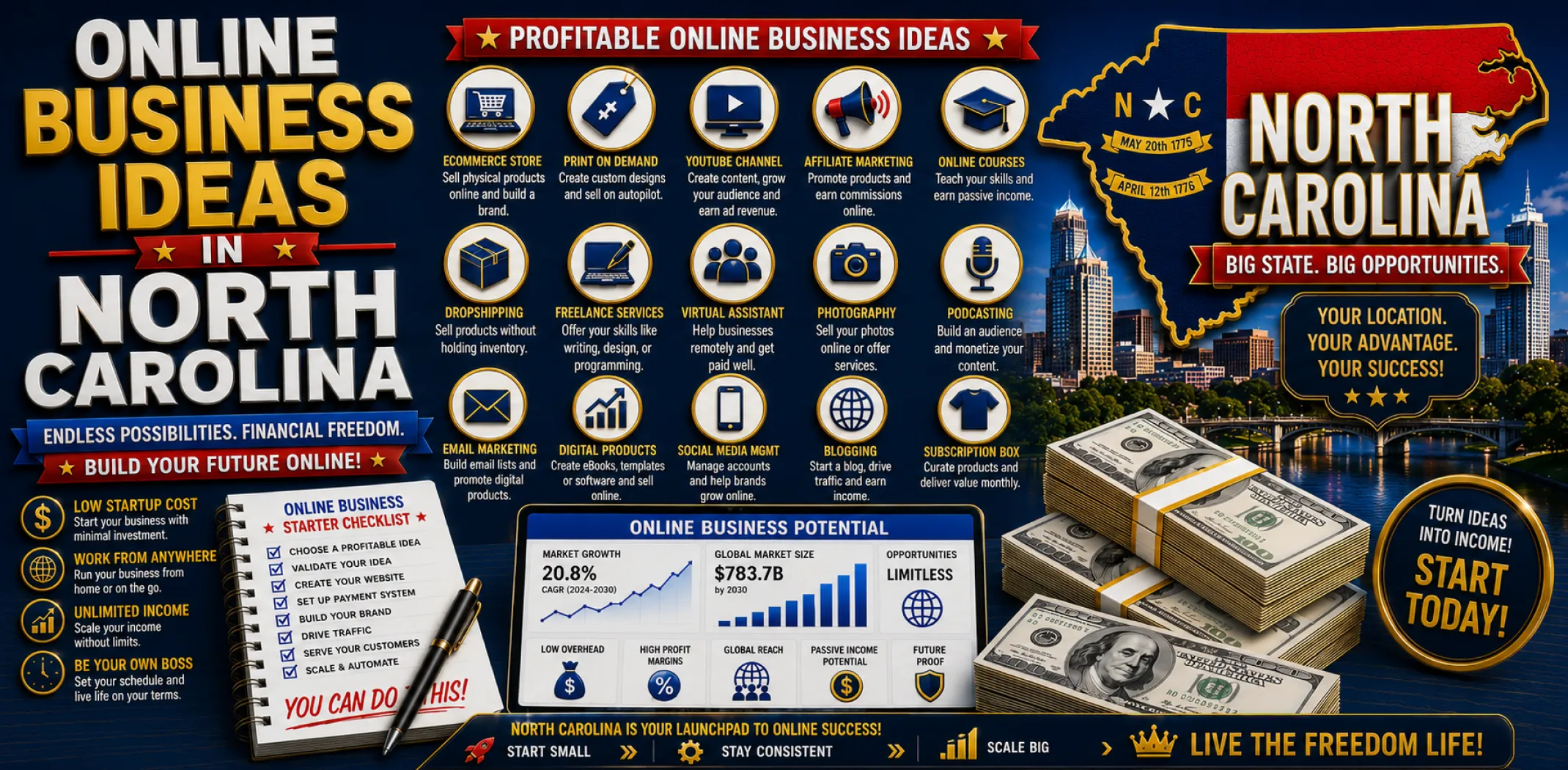
If you are searching for online business ideas in North Carolina, you are probably not looking for a comprehensive academic overview of ecommerce trends. You are looking for something real – an idea that fits your life, your schedule, and your starting point.
Maybe you have been working the same job for years and want something that is yours. Maybe a layoff or a health issue forced the question. Maybe you just want to know what is actually working for people in this state right now.
North Carolina has more than 10.7 million residents, a growing digital economy, and a job market that pays a median household income of $74,000 – roughly 9% below the national median. That gap is real, and a lot of North Carolina families feel it. The people who close it are increasingly doing so through online income streams, not second jobs at the same employer.
Quick Answer: The best online business idea in North Carolina for someone with no prior experience is a digital product store – a fully built store pre-loaded with products to sell, requiring no inventory, no technical skills, and no product creation. Platforms like Sellvia provide this with a free 14-day trial and no credit card required. For people with existing skills, freelancing and online tutoring offer the fastest path to a first dollar.
This guide walks through eight real online business ideas for North Carolina residents, with honest earning ranges, who each idea suits best, and a clear starting point for each. No hype, no vague promises – just a practical map of what is available.
What makes a good online business idea in North Carolina?
Not every online business idea is equally practical for a North Carolina resident starting from scratch. Before diving into the options, it is worth establishing what separates a good idea from a great one for this specific state and audience.
A good online business idea for a North Carolina beginner has four qualities. First, low startup cost – ideally under $100 to get to a first sale, with no large upfront investment.
Second, flexibility – the ability to work around an existing job, family obligations, or caregiving responsibilities.
Third, no requirement for specialized credentials or degrees – the idea should be accessible to someone who finished high school or has a general work background. Fourth, a realistic path to income within 90 days – not guaranteed, but genuinely possible with consistent effort.
North Carolina’s specific context adds a few more considerations. Rural areas – particularly in the western mountains and eastern coastal plain – have limited local job markets, which makes online income more important and not just more convenient.
Smartphone penetration is high even where home broadband is inconsistent, so any idea that can be managed from a phone has a wider potential audience in the state. And North Carolina’s flat income tax rate of 4.25% for 2025 (dropping to 3.99% in 2026) means online business profits are taxed at a reasonable rate compared to many other states.
Best online business ideas for North Carolina residents
Here are eight online business ideas that are genuinely accessible to North Carolina residents in 2026, ordered from the lowest barrier to entry to the highest.
1. Digital product store
What it is: A digital product store sells downloadable items – guides, courses, checklists, planners, tools – that customers receive instantly after purchase. There is nothing to manufacture, ship, or restock. Every sale is fulfilled automatically.
Who it suits: Anyone with no prior business experience, limited startup capital, or limited time. Especially well-suited to North Carolina residents in rural areas where local job options are scarce, parents or caregivers who need flexible hours, and people who have been burned by complex business models before.
Why it works in North Carolina: With a population of 10.7 million and growing internet adoption across the state, the potential customer base for practical digital products – home improvement guides, budgeting tools, health and wellness resources, parenting support – is substantial. You are not selling to North Carolina alone. Your store reaches buyers nationwide from day one.
Platforms like Sellvia build the entire store for you and pre-load it with 1,000 ready-made products. You keep 50–70% of every sale. The free 14-day trial requires no credit card. After the trial, the monthly plan is $39.
Earning potential: $30–$200/day with consistent marketing effort over 60–90 days, though results vary based on ad spend, niche, and consistency.
2. Freelancing
What it is: Selling a skill – writing, graphic design, bookkeeping, social media management, data entry, virtual assistance, video editing – directly to businesses or individuals through platforms like Upwork or Fiverr.
Who it suits: North Carolina residents who already have a marketable skill and want the fastest possible path to their first online dollar. Freelancing requires no product creation, no store setup, and no upfront investment beyond a free platform profile.
Why it works in North Carolina: Charlotte, Raleigh, and the Research Triangle generate consistent demand for remote freelancers across creative, administrative, and technical fields. Rural North Carolina residents can access these same clients without relocating. The barrier is simply packaging your existing skill into a service offer.
Earning potential: $15–$75/hour depending on skill and experience. Income is directly tied to hours worked – scaling requires raising rates or working more, which limits long-term growth without building a team.
3. Content creation
What it is: Building an audience on YouTube, TikTok, Instagram, or a blog, then monetizing through ad revenue, brand sponsorships, and affiliate commissions.
Who it suits: North Carolina residents who are comfortable on camera or enjoy writing, have a specific passion or niche they can speak to consistently, and are willing to invest 12–18 months before seeing meaningful income.
Why it works in North Carolina: North Carolina has natural content material across outdoor recreation (Blue Ridge Parkway, Outer Banks, hiking, kayaking), food culture (Eastern NC barbecue, mountain foraging, coastal seafood), and the state’s distinct blend of urban and rural life. Creators with a genuine North Carolina angle have built real audiences on the strength of local content that national creators cannot replicate.
Earning potential: $100–$3,000+/month once established, but typically 12–18 months before monetization begins. Best treated as a long-term play alongside a faster-return primary income stream.
4. Affiliate marketing
What it is: Promoting other companies’ products through a unique link and earning a commission each time someone purchases through it. Common platforms include Amazon Associates, ShareASale, and individual brand affiliate programs.
Who it suits: North Carolina residents who already have an audience – a social following, an email list, or an established blog – and want to monetize it without creating their own products. Affiliate marketing works poorly as a standalone starting point for complete beginners.
Why it works in North Carolina: Outdoor gear, local travel, food and drink, and home improvement are all strong affiliate niches with natural North Carolina relevance. A blogger covering Appalachian Trail hiking in NC, for example, can generate consistent affiliate revenue from gear recommendations to an engaged audience.
Earning potential: $50–$500/month for most beginners in year one. Higher with a large established audience.
5. Online coaching or consulting
What it is: Offering structured guidance – in fitness, career development, financial planning, parenting, business, or any field where you have genuine expertise – to individuals or small groups via video call.
Who it suits: North Carolina residents with professional experience or a specific area of deep knowledge who can package that expertise into a repeatable program. Coaching requires confidence and the ability to communicate clearly – it does not require a certification in most niches.
Why it works in North Carolina: The state’s diverse population – from Research Triangle professionals to rural families – creates demand for coaches across nearly every niche. Virtual delivery means you can serve clients statewide and nationally without ever leaving home.
Earning potential: $500–$5,000+/month at scale. Most coaches take 6–12 months to build a sustainable client base from scratch.
6. Online tutoring
What it is: Teaching students one-on-one or in small groups in a specific subject – math, reading, science, test preparation, foreign languages – via video call. Platforms like Wyzant and Tutor.com connect tutors with students and handle payment processing.
Who it suits: North Carolina residents with strong subject knowledge and a patient, communicative style. No teaching degree is required on most platforms – subject competency and good reviews build your profile over time.
Why it works in North Carolina: North Carolina has more than 1.5 million public school students and a significant college population across UNC system campuses, private universities, and community colleges. Demand for tutoring in math, reading, and standardized test prep is consistent and year-round.
Earning potential: $20–$60/hour depending on subject and experience. Like freelancing, income is time-limited.
7. Print-on-demand
What it is: Designing products – t-shirts, mugs, phone cases, tote bags – that are printed and shipped by a third-party provider only when a customer orders. Platforms like Printful and Redbubble handle fulfillment. You only need to create the designs.
Who it suits: North Carolina residents with a design sensibility or a strong niche idea – local pride apparel, sports-adjacent designs, hobby communities, regional humor. No inventory, no upfront product cost, but designs must resonate with a specific audience to generate consistent sales.
Why it works in North Carolina: North Carolina has strong regional identity – college sports loyalty runs deep, the mountains and coast inspire visual design, and local pride merchandise has a genuine market. A well-executed NC-themed design line can find a loyal customer base.
Earning potential: $100–$800/month for a focused niche store with consistent design output. Margins are lower than digital products – typically 20–40% after platform fees.
8. Virtual assistant work
What it is: Providing administrative, organizational, or technical support to small business owners and entrepreneurs remotely. Tasks typically include email management, calendar scheduling, research, data entry, social media posting, and customer communication.
Who it suits: North Carolina residents with strong organizational skills and attention to detail. No specialized degree required – reliability, communication, and follow-through are the core competencies that matter most to clients.
Why it works in North Carolina: Small business owners across the state – particularly the growing number of solo entrepreneurs and consultants in the Charlotte and Raleigh metros – consistently outsource administrative tasks to remote virtual assistants. It is a service with stable, recurring demand.
Earning potential: $15–$40/hour to start, rising to $50–$75/hour for specialized VAs with expertise in specific tools or industries.
How to choose the right online business idea in North Carolina
Eight options is useful – but it is also paralyzing if you do not have a framework for choosing. Here is a simple guide by reader profile to narrow it down.
No experience, limited time
If you are starting from zero – no existing audience, no specific skill to sell, limited hours in the week – the digital product store is the right choice. It is the only model on this list where the product creation, store setup, and technical infrastructure are already handled for you. You show up to market and sell. Everything else is built.
Sellvia’s free trial is the practical starting point. You can be live with a real store and real products within 24 to 48 hours of signing up, without writing a single word of product content or building a single page of your store. After 14 days, you decide whether to continue at $39/month.
Why this works in 2026: The market for digital products – practical guides and tools people can download and use immediately – continues to grow as consumers become more comfortable buying information online. North Carolina’s 10.7 million residents are part of that trend.
Some skills, part-time goal
If you have a marketable skill – writing, design, bookkeeping, teaching, project management – and your goal is a reliable part-time income of $500–$2,000/month alongside your current job, freelancing or online tutoring are strong fits. Both can generate income within weeks of setting up a profile, and both can be managed in the hours around a full-time schedule.
The practical limitation is the ceiling. Freelancing and tutoring income scales with your hours, not with your audience or product catalog. Once you hit the limit of your available time, income plateaus. Many North Carolina residents start with freelancing for fast cash and layer in a digital product store for scalable income alongside it.
Ready to go full-time
If your goal is replacing a full-time income of $3,000–$5,000+/month, no single model on this list gets you there quickly without significant effort. The realistic path is starting with the fastest-return model (digital product store or freelancing), building to $1,000–$2,000/month consistently, then reinvesting a portion of revenue into advertising and scale.
Content creation, coaching, and affiliate marketing all have high earning ceilings – but they require the most time investment before meaningful income appears. They work best as the second or third layer of an income strategy, not the first.
How to get started with your online business idea in North Carolina
Once you have chosen a direction, the steps are simpler than most people expect. Here is what the first week looks like for a North Carolina resident starting a digital product store – the most practical starting point for beginners.
Day 1: Sign up for Sellvia’s free trial. No credit card required. Your store is built for you – you do not design it, code it, or stock it. By end of day, you have a live store with 1,000 digital products ready to sell.
Days 2–3: Explore your store. Understand the product categories. Choose the niche or product type you want to lead with in your marketing. Set up the built-in one-click advertising system with a starting budget of $10–$30/day if you want fast results.
Days 4–7: Start marketing. Post about your store on social media. Activate ads if you have set them up. Tell people in your network what you are doing. The first sale is the most important psychological milestone – it proves the model works and gives you data to build on.
For the registration and tax side of things, you do not need to do anything formal in week one. Start as a sole proprietor, keep records of your income and expenses, and revisit the structure question once you are generating consistent revenue. The guide on how to start an online business in North Carolina covers registration and tax in full detail when you are ready for that step.
See your state tax breakdown at a glance
Simply enter your annual net profit, select your state, and the calculator will instantly generate a detailed tax breakdown while showing how your state’s tax burden compares to others.
Why Sellvia is a game-changer for your online store 🚀
Sellvia isn’t just another ecommerce tool. We are a trusted name in the industry, recognized by Forbes and even ranked in Inc.’s list of the 5,000 fastest-growing companies in the U.S. So if you’re serious about starting as a solopreneur, this is a smart place to begin.
Starting an online business can feel overwhelming, but that’s exactly where Sellvia steps in. It takes care of the tricky parts, so you can focus on making sales and growing your brand. Let’s break down what makes it such a great choice.
Get a ready-to-go store hassle-free 🎯
Want to start selling but don’t know where to begin? No worries! Just share your ideas, and Sellvia’s team will build a free ecommerce website that’s fully set up and ready to take orders from day one. No coding, no stress – just a store that works right out of the box.
1,000 digital products ready to sell from day one 🎁
Not sure what to sell? Sellvia solves that instantly. Your store comes pre-loaded with 1,000 ready-made digital products – guides, courses, checklists, and tools – all created by Sellvia. No writing, no recording, no product creation needed. Just pick your niche, and the products are already there waiting for your first customer.
A massive catalog of digital products to sell 🏆
One of the biggest struggles in starting an online business is figuring out what to sell. Sellvia solves that completely. Your store comes pre-loaded with digital products – guides, courses, checklists, and tools – all created by Sellvia. You keep 50–70% of every sale. No inventory. No shipping. No logistics headaches.
Everything in one easy-to-use platform 🔥
Managing an online store shouldn’t be complicated. With Sellvia, you can handle orders, add new products, and even chat with customers – all from a simple and user-friendly platform. No need to mess with confusing tools or deal with unnecessary tech stuff. It’s all smooth sailing.
No upfront costs, just start selling 💰
A big reason people hesitate to start an online business is the cost. But here’s the good news: With Sellvia, you don’t need to invest in stock, storage, or shipping supplies. You can run your store with no upfront costs, keeping things low-risk while still making money.
Support that’s always got your back 🤝
Running a business comes with questions, but you’re never alone. Sellvia’s dedicated support team is available 24/7 to help with anything you need. Whether it’s a small question or a big challenge, they’ve got you covered.
North Carolina has the population, the internet adoption, and the economic conditions for online business to work – what it needs is people willing to start. Claim your free store with 1,000 digital products and turn your best idea into your first sale today.
What is the best online business to start in North Carolina?
What online business can I start with no money in North Carolina?
The best zero-cost online business option in North Carolina is a digital product store using Sellvia is free trial, which requires no credit card and gives you a fully built store with 1,000 ready-made products. Freelancing and online tutoring are also genuinely free to start – you create a profile on Upwork, Fiverr, or Wyzant at no charge and begin offering services based on skills you already have. Affiliate marketing through programs like Amazon Associates is free to join but requires an existing audience to generate meaningful income.
What online businesses are growing in North Carolina?
The fastest-growing online business categories in North Carolina in 2026 reflect national ecommerce trends – digital products, online education and tutoring, and service-based businesses like virtual assistance and freelance consulting. US ecommerce sales reached 1.23 trillion dollars in 2025, a 5.4 percent increase from 2024, and North Carolina consumers are participating in that growth at rates consistent with the state is rapid population expansion. Digital products in particular – guides, courses, and tools that deliver immediate value – continue to gain ground as more North Carolina residents shop online for practical information.
How do I choose an online business idea in North Carolina?
The best way to choose an online business idea in North Carolina is to match the model to your starting position honestly. If you have no experience and limited time, choose a model where the setup is done for you – a digital product store with Sellvia is the most complete example. If you have a skill you can sell immediately, freelancing or tutoring get you to a first dollar faster. If you are thinking long-term and willing to invest 12 to 18 months before seeing significant income, content creation or affiliate marketing have higher ceilings. The worst choice is spending weeks deciding instead of starting – pick the closest fit and adjust based on real results.
Can I run an online business from home in North Carolina?
Yes, running an online business entirely from home in North Carolina is fully achievable in 2026. A digital product store through Sellvia can be managed from a smartphone – no laptop required – making it accessible even in rural North Carolina counties with limited broadband options. Freelancing, tutoring, virtual assistant work, and coaching are all delivered remotely via video call and managed through online platforms. North Carolina does not require a statewide general business license for most home-based online businesses, which removes a barrier that applies in other states.


