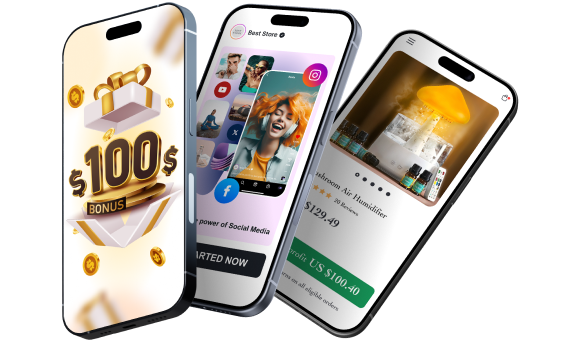
Shopify vs Amazon – it is one of the most searched questions by anyone thinking about starting an online business in 2026. Both platforms are legitimate. Both have made real people real money. But the debate tends to leave out a third option that quietly outperforms both for people starting from scratch – and that is exactly what this guide covers.
Quick answer: Shopify gives you a standalone store with full brand control but requires you to drive your own traffic. Amazon gives you a built-in audience of hundreds of millions of buyers but charges heavy fees and owns your customer relationship. Sellvia gives you a fully built store pre-loaded with digital products, a built-in advertising system, and a clear path to income – without the startup costs or learning curves of either platform.
This guide breaks down the real differences between Shopify and Amazon – fees, ease of use, earning potential, pros and cons – and explains why neither is necessarily the best starting point for a beginner in 2026. Before diving into the comparison, it helps to understand what each platform was actually built to do. Shopify is a store builder. Amazon is a marketplace. They solve different problems – and that distinction matters more than most comparisons admit.
Understanding each platform’s purpose makes the choice much clearer. Shopify is designed for entrepreneurs who already have a product idea, a marketing plan, or an existing audience to sell to. Amazon is designed for sellers who want access to a massive, ready-made pool of buyers. Neither was built specifically with the complete beginner in mind – which is why so many people try both and end up frustrated by the hidden costs they never anticipated.
What is the Shopify vs Amazon debate really about?
At its core, the Shopify vs Amazon question is about control versus convenience. Shopify hands you a blank canvas – you build, brand, and market everything yourself. Amazon hands you a pre-built audience of hundreds of millions of active shoppers, but it sets the rules and takes a significant cut of every sale.
Neither platform is inherently better. They are different tools for different stages of a business. The problem is that most people asking “Shopify vs Amazon which is better” are in their earliest days of thinking about selling online – and for that group, neither option is as beginner-friendly as its marketing materials suggest.
Shopify requires real marketing skills, a working ad budget, or an existing audience. Without traffic, even the most polished Shopify store earns zero. Amazon, on the other hand, has a steep learning curve around listing optimization, pay-per-click advertising, and constant competition from other sellers – including Amazon itself, which sometimes stocks competing products under its own private label.
Important note: This is not a criticism of either platform. Both work. But the gap between “it works for some” and “it works for me as a complete beginner” is significant – and that gap is exactly where Sellvia becomes worth examining seriously.
How much can you realistically earn?
Earnings on all three models vary enormously based on product selection, marketing spend, and consistency. The table below gives a realistic overview for someone working part-time in their first 6–12 months on each model.
These figures reflect realistic outcomes for part-time operators – not headline success stories. Shopify sellers without an existing audience or paid ad budget typically see very slow growth in the first 90 days. Amazon FBA can deliver strong results but requires significant upfront capital before a single sale is made.
One note on these figures: Reaching the higher end of any range typically takes 6–9 months of consistent effort, product testing, and traffic-building. No platform delivers results from day one without real work.
Sellvia sits in a compelling middle ground. Startup costs are near zero compared to the other two models – with a free store and digital products already loaded and ready to sell. The earning ceiling is real for store owners who find a niche they connect with and build consistent traffic over time. That combination of low risk and real upside is difficult to match for anyone starting out in 2026.
Shopify – what it offers and where it falls short
Shopify is one of the most polished ecommerce platforms ever built. It gives you a professional store with customizable themes, a wide app ecosystem, and full control over your brand identity. If you already have an audience – on social media, YouTube, or through existing customers – Shopify is an excellent tool for monetizing that audience on your own terms.
What Shopify does well
Shopify’s core strength is flexibility. You can sell physical products, digital downloads, subscriptions, or services from a single dashboard. Payment processing, abandoned cart recovery, and basic analytics are all built in. The app store contains thousands of add-ons covering everything from upsells and loyalty programs to advanced SEO and email marketing automation.
For store owners who already have a marketing plan, Shopify provides everything needed to build a polished, brand-owned presence online. The platform also scales well – from a solo side hustle to a multi-product store handling thousands of orders per month – which makes it a natural choice for sellers who already know what they are doing and have traffic to work with.
Where Shopify falls short for beginners
The biggest hidden cost of Shopify is not the monthly subscription fee – it is the advertising budget required to get any traffic at all. Shopify does not come with a built-in audience. You are starting at zero. Most beginners discover this after signing up, paying for a subscription, and installing a theme – only to watch their store sit idle for weeks while they try to figure out Facebook Ads or TikTok marketing.
Add app costs, transaction fees if you use a third-party payment gateway, and the inevitable failed ad experiments, and Shopify’s real cost of entry is significantly higher than its $39/month base price suggests. For beginners without a clear traffic strategy, Shopify often costs more than it earns in the first 90 days.
Earning potential: $500–$5,000/month with an established audience or consistent ad spend; $0–$300/month for most complete beginners in the first 90 days.
Amazon – the marketplace giant and its real drawbacks
Amazon is the largest ecommerce marketplace in the world, with over 300 million active customer accounts globally. Selling on Amazon means instant access to buyers who are already in purchase mode. That is the appeal – and it is genuine. Amazon FBA (Fulfilled by Amazon) lets sellers ship physical inventory to Amazon’s warehouses and have the platform handle packing, delivery, and customer service on their behalf.
What Amazon does well
Amazon’s biggest advantage is trust. Shoppers trust Amazon at a level that independent stores take years to build. Conversion rates on Amazon listings are consistently higher than on most new independent stores because buyers already feel comfortable handing over their payment details. For sellers with unique or branded products, Amazon’s organic search traffic can drive real revenue without a single paid ad.
Amazon also handles logistics at a scale no small business can replicate on its own. Prime delivery, returns management, and customer support are all part of the FBA package – which means once your inventory is in the warehouse, a significant portion of the operational work disappears from your plate.
Where Amazon falls short for beginners
Amazon FBA has a high cost of entry that surprises most first-time sellers. You need to source physical inventory upfront – typically $2,000–$5,000 minimum for a viable first product run – before you make a single sale. Factor in Amazon’s referral fees (typically 8–15% per sale depending on category), FBA fulfillment fees, monthly storage fees, and pay-per-click advertising to boost listing visibility, and profit margins compress quickly.
More critically, Amazon owns the customer. You cannot email your buyers directly, build a retargeting list, or re-market to people who purchased from you. Every sale you make belongs to Amazon’s ecosystem. And if Amazon decides to stock a competing version of your product under its own private label, your listing visibility can drop overnight with no recourse.
Earning potential: $1,000–$10,000/month for experienced sellers with a proven product and optimized listing; unpredictable and often below break-even for first-time sellers in the first 3–6 months.
Shopify vs Amazon fees – the real cost breakdown
Fees are one of the most searched angles in the Shopify vs Amazon debate – and for good reason. They are where the real difference in profitability shows up for day-to-day operations. Here is a side-by-side breakdown of what each platform actually costs once you move beyond the headline subscription price.
The headline numbers look similar – both platforms charge around $39–$40 per month to get started. But the true costs diverge sharply once you factor in advertising, fulfillment, and inventory. Shopify becomes expensive through ad spend; Amazon becomes expensive through per-sale referral fees, storage costs, and upfront inventory risk.
Important: With Sellvia, there are no per-sale referral fees and no inventory costs eating into your earnings. Your store comes pre-loaded with digital products, and you keep 50–70% profit on every sale. That is the difference between a business model designed to drain you and one designed to work for you from day one.
Shopify vs Amazon for beginners – which is easier to start?
If you are asking “Shopify vs Amazon for beginners,” the honest answer is that neither is as beginner-friendly as the marketing suggests. Both have real learning curves, and both carry financial consequences for the mistakes beginners inevitably make during the learning phase.
Shopify’s interface is clean and intuitive enough to get a basic store live in a single day. But going live is not the same as generating revenue. The skills required to drive organic traffic through SEO, or paid traffic through Meta and TikTok ads, take months – sometimes a full year – to develop to a profitable level. Many beginners spend more on apps and failed ad campaigns in their first 90 days than they earn back in sales.
Amazon’s Seller Central dashboard is considerably more complex. New sellers need to navigate listing optimization, keyword research for Amazon’s internal search algorithm, inventory management at FBA warehouses, and a policy rulebook that can result in account suspension if violated – sometimes without much warning. The capital required to start on Amazon also means the stakes of early mistakes are financially meaningful.
Where Sellvia wins for beginners
Sellvia removes the two biggest barriers to getting started: upfront cost and setup time. You receive a fully built store – professionally designed, pre-loaded with digital products, and ready to promote from day one. There is no blank-canvas problem to solve, and there is no capital to raise before your first sale.
Your job from day one is simply to make sales – in the context of an already-live, fully stocked store with a built-in advertising system that starts working the moment you turn it on. That is a fundamentally faster path to your first sale than either Shopify or Amazon FBA can offer a complete beginner.
Why Sellvia beats both for getting started in 2026
The Shopify vs Amazon comparison assumes you have to pick one of two expensive options. But Sellvia is a third path that removes nearly every barrier those platforms introduce for first-time sellers. Here is what Sellvia gives you that neither Shopify nor Amazon can match for a complete beginner:
- No inventory, ever – Your store sells digital products that are delivered instantly to buyers after purchase. No restocking, no warehousing, no logistics costs to manage.
- A fully built store – Sellvia builds and delivers a professionally designed, product-stocked store, so you start with something real instead of a blank template that takes hours to configure.
- Full brand ownership – Unlike Amazon, you own your customer list, your domain, and your store identity from day one. No marketplace can remove your store or undercut you with a competing product.
- Built-in advertising system – Sellvia’s ad system handles targeting, creatives, and optimization. Set a daily budget between $10 and $50, and many store owners see their first orders come in on day one.
The most realistic path to $30–$80 per day in online income for a beginner in 2026 is not a $5,000 Amazon product launch, and it is not a blank Shopify store waiting for ad dollars to kick in. It is a product-stocked, professionally built store with low overhead and room to grow at your own pace – which is exactly what Sellvia is built to deliver.
Why this works in 2026: Global ecommerce continues to expand, with total online sales projected to grow well past $6 trillion in the next few years. Selling digital products captures this growth without the capital requirements of traditional retail, making it one of the most accessible models for first-time sellers entering the market today.
For complete beginners
If you have zero marketing experience, zero audience, and limited startup capital, neither Shopify nor Amazon is the recommended starting point. The capital and skill requirements are real enough to cause most beginners to quit before seeing meaningful results. Sellvia is the cleaner entry point – a live store, digital products already loaded, and a built-in ad system – without having to figure out everything from scratch before you can make your first sale.
For intermediate sellers
If you already have some traffic – a social media following, a blog, or an email list – Shopify becomes a much stronger option. You can build a brand-owned store and drive that existing audience directly to it. Sellvia still works well at this stage, especially if you want a complete, done-for-you setup with a built-in promotion system so you can focus on growth rather than maintenance.
For advanced or full-time sellers
Experienced sellers with capital and a validated product have a genuine case for Amazon FBA. The fulfillment infrastructure and built-in audience justify the fees at scale. But even at this level, many successful Amazon sellers maintain a parallel independent store – precisely because they want to own their customer relationships and not be entirely dependent on a single marketplace they do not control.
The choice between Shopify, Amazon, and Sellvia ultimately depends on where you are today. But if you are just getting started with limited time, limited budget, and a goal of earning income online as quickly as possible, Sellvia gives you the fastest, most cost-efficient path from idea to first sale.
Why Sellvia is a game-changer for your online store 🚀
Sellvia isn’t just another ecommerce tool. We are a trusted name in the industry, recognized by Forbes and even ranked in Inc.’s list of the 5,000 fastest-growing companies in the U.S. So if you’re serious about starting as a solopreneur, this is a smart place to begin.
Starting an online business can feel overwhelming, but that’s exactly where Sellvia steps in. It takes care of the tricky parts, so you can focus on making sales and growing your brand. Let’s break down what makes it such a great choice.
Get a ready-to-go store hassle-free 🎯
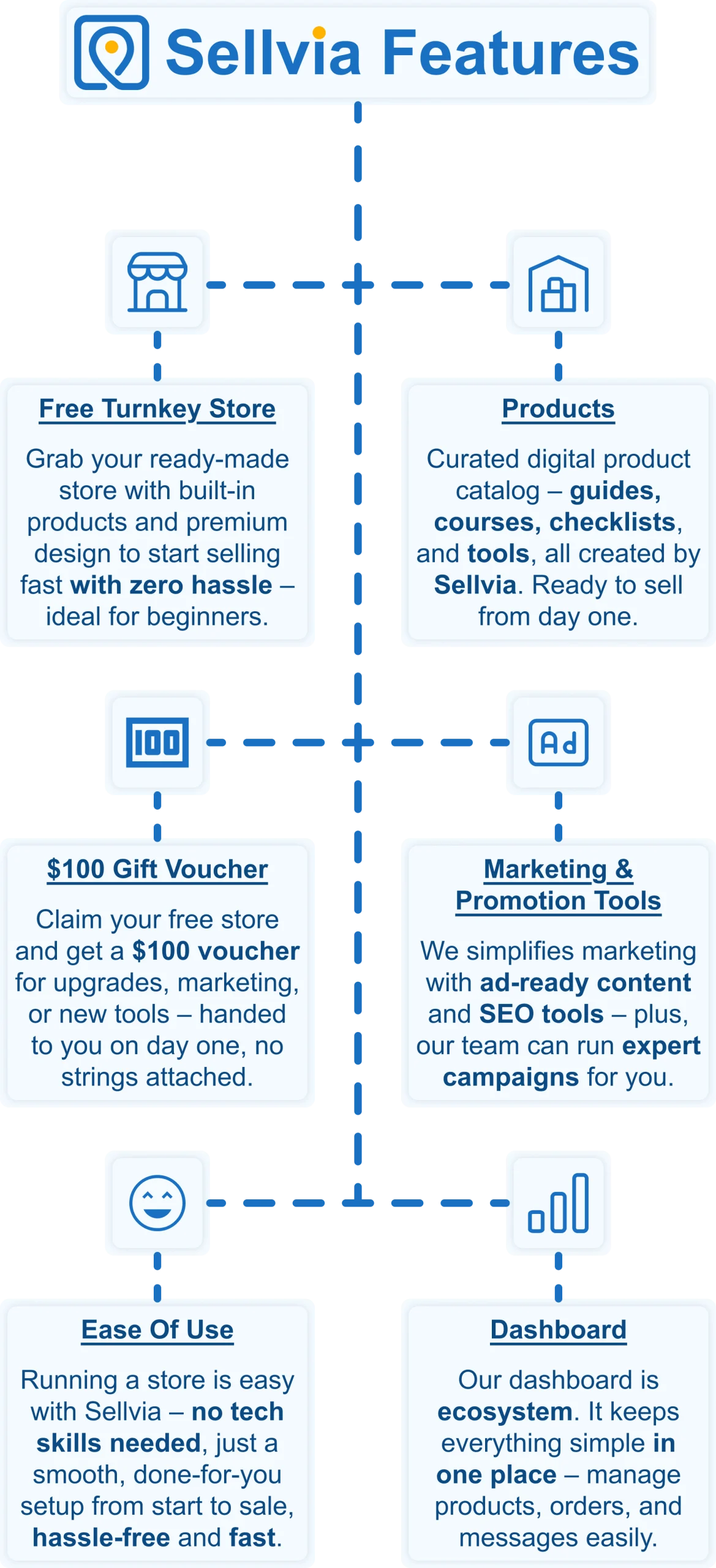
Want to start selling but don’t know where to begin? No worries! Just share your ideas, and Sellvia’s team will build a free ecommerce website that’s fully set up and ready to take orders from day one. No coding, no stress – just a store that works right out of the box.
A $100 gift voucher to grow your business faster 🎁
Starting a business takes momentum – and Sellvia gives you a head start. When you claim your free store today, you also get a $100 gift voucher to put toward growing your business. Use it to upgrade your store, boost your marketing, or unlock new tools. It is a real dollar value, handed to you on day one, with no catch and no hoops to jump through.
A massive catalog of digital products to sell 🏆
One of the biggest struggles in starting an online business is figuring out what to sell. Sellvia solves that completely. Your store comes pre-loaded with digital products – guides, courses, checklists, and tools – all created by Sellvia. You keep 50–70% of every sale. No inventory. No shipping. No logistics headaches.
Everything in one easy-to-use platform 🔥
Managing an online store shouldn’t be complicated. With Sellvia, you can handle orders, add new products, and even chat with customers – all from a simple and user-friendly platform. No need to mess with confusing tools or deal with unnecessary tech stuff. It’s all smooth sailing.
No upfront costs, just start selling 💰
A big reason people hesitate to start an online business is the cost. But here’s the good news: With Sellvia, you don’t need to invest in stock, storage, or shipping supplies. You can run your store with no upfront costs, keeping things low-risk while still making money.
Support that’s always got your back 🤝
Running a business comes with questions, but you’re never alone. Sellvia’s dedicated support team is available 24/7 to help with anything you need. Whether it’s a small question or a big challenge, they’ve got you covered.
While the Shopify vs Amazon debate goes on, the clearest path for beginners in 2026 is a fully built store with digital products and built-in advertising – no platform fees, no inventory risk. Claim your free Sellvia store today and start building real income from day one.