Over 4.4 million online stores run on Shopify. BigCommerce powers some of the most recognized brands in modern ecommerce. So when you are trying to decide between the two, the question is not whether either platform is legitimate — it is which one actually fits the way you want to build and run your business in 2026.
Quick Answer: Shopify is the more beginner-friendly option, with a simpler setup, a larger app ecosystem, and strong support for first-time online sellers. BigCommerce offers more built-in features and zero transaction fees on all plans, making it the stronger pick for high-volume sellers who want to minimize ongoing platform costs. The right choice depends on your budget, technical comfort level, and growth goals.
This Shopify vs BigCommerce guide covers everything that actually matters — Shopify pricing, BigCommerce pricing, Shopify features, BigCommerce features, SEO capability, and long-term scalability — so you can make a confident decision without wading through pages of marketing copy.
Both platforms have genuine strengths and genuine limitations. The difference between a platform that suits your workflow and one that does not can cost you months of productivity and significant lost revenue. Here is what you need to know before you choose.
What is the Shopify vs BigCommerce debate really about?
Both Shopify and BigCommerce are fully hosted ecommerce platforms. They handle your website hosting, security, and software updates in exchange for a monthly subscription, giving you a centralized dashboard to manage products, orders, customers, and marketing without writing a single line of code.
The reason this ecommerce platform comparison generates so much ongoing debate is that both platforms are genuinely capable at the mid-range. Shopify, founded in 2006 in Ottawa, built its reputation on ease of use and an expansive third-party app ecosystem. BigCommerce, launched in 2009 in Austin, built its reputation on loading more functionality into the base subscription and scaling without the incremental costs that typically accompany growth on competing platforms.
In practical terms, most sellers start with Shopify because it is faster to set up and more intuitive to navigate day to day. BigCommerce tends to attract more experienced sellers who have hit the ceiling on what basic Shopify plans can deliver without continuously paying for more apps. Understanding this dynamic is the core of the Shopify vs BigCommerce decision in 2026.
The real-world impact of this choice compounds over time. A platform that is slightly more expensive but genuinely suited to your sales model will always outperform a cheaper one that creates daily friction in your workflow — which is why this comparison focuses on practical differences rather than headline feature lists.
How much does each platform actually cost?
Pricing is where the Shopify vs BigCommerce comparison becomes more nuanced than the advertised plans suggest. Both platforms tier their subscriptions, but the real-world monthly cost varies significantly depending on your sales volume, payment processor choice, and how many additional apps you need to fill gaps in your plan’s native feature set.
Here is how the core pricing stacks up side by side:
Shopify’s headline price is lower at entry level, but transaction fees and app costs shift that calculation quickly. BigCommerce’s revenue caps are an important consideration for fast-growing stores — exceed the annual threshold and your plan upgrades automatically, regardless of whether you opted in.
One note on transaction fees: Shopify’s fees only apply when using a third-party payment gateway rather than Shopify Payments. Shopify Payments is available in roughly 20 countries — sellers outside those markets pay an additional 0.5%–2% on every order processed. At $10,000 per month in sales on the Basic plan, that is $200 per month in fees that BigCommerce sellers do not pay at all.
BigCommerce also imposes annual revenue thresholds that trigger mandatory plan upgrades. The Standard plan is capped at $50,000 in annual store revenue — once you cross that figure, you are moved to the Plus plan automatically. This catches many fast-growing sellers off guard and is among the most commonly cited frustrations in BigCommerce user reviews on Reddit and Trustpilot.
For most new sellers and small businesses processing under $5,000 per month, Shopify’s lower entry price and simpler setup make it the more practical starting point. For stores consistently generating over $10,000 per month in sales, BigCommerce’s zero transaction fees and built-in feature depth frequently make it the cheaper and more capable platform overall — even at a higher base subscription rate.
With pricing mapped out clearly, the next question is what each platform actually delivers for that subscription cost — and where the real feature differences show up in daily use.
Shopify features — what you actually get
Shopify’s biggest competitive advantage is not any single feature — it is the overall experience. The platform is built from the ground up to minimize the distance between deciding to start an online store and actually having one live and generating revenue.
Ease of use
Shopify is consistently rated among the most beginner-friendly online store builders available. The guided setup walks you through domain connection, product upload, and payment configuration in a clear, logical sequence, and the drag-and-drop editor makes visual customization accessible without any technical background. Most new users can go from account creation to a published, functional store in a single afternoon. The interface uses plain language throughout, and Shopify’s help documentation is among the most thorough in the industry.
App marketplace
The Shopify App Store contains over 8,000 apps covering virtually every ecommerce need — upselling, loyalty programs, email marketing, advanced analytics, subscription billing, and considerably more. This breadth is Shopify’s single strongest differentiator over BigCommerce and the main reason experienced sellers often stay on the platform despite the cost. Almost any feature gap can be filled with a third-party integration. The tradeoff is that many of the most useful apps carry their own monthly fees — typically $10 to $50 each — which compounds your total operating cost as your workflow grows more reliant on them.
Payment processing
Shopify supports over 100 payment gateways globally, including PayPal, Stripe, and its own Shopify Payments solution. Using Shopify Payments eliminates all transaction fees and unlocks accelerated checkout options including Shop Pay, Apple Pay, and Google Pay. For sellers in supported countries, this is a meaningful cost saving and a convenience boost for customers at checkout. For sellers outside those regions, the standard per-transaction fee applies to every sale processed — a cost that scales directly with revenue growth.
Themes and design
Shopify’s theme library contains over 100 professionally designed templates, with roughly a dozen available free of charge and the remainder priced between $180 and $350 as one-time purchases. All themes are mobile-responsive by default, and the visual editor makes layout and color customization straightforward without developer involvement. Overall design quality is high across the library, and most themes are optimized for conversion from the start, with clean product pages and streamlined checkout flows that perform well without additional modifications.
Online seller ecosystem
Shopify is one of the most popular platforms for independent online sellers, and for good reason. Its intuitive setup, wide range of integrations, and active community resources make it a solid starting point for anyone building an online business from scratch. That said, the platform requires ongoing investment — monthly fees, app subscriptions, and ad spend — before you see a meaningful return. Most new sellers on Shopify report their first profitable month somewhere between 60 and 90 days in, assuming consistent effort and a clear niche focus.
Earning potential: Shopify sellers with well-optimized stores and consistent paid traffic typically report net profits of $30–$150 per day in the first 60–90 days, depending on niche selection, ad spend efficiency, and product margin structure.
Customer support
Shopify provides 24/7 support via live chat and email across all paid plans, with phone support available on higher-tier subscriptions. The Shopify Help Center is comprehensive and clearly structured, and the Shopify Community forum is consistently active with peer-to-peer troubleshooting. Response times are generally fast, and support quality is rated positively by the majority of verified users on Trustpilot and G2.
Shopify’s overall package is strong — particularly for new sellers launching their first online store. But BigCommerce takes a fundamentally different approach to platform economics, and for sellers at a certain revenue level, that difference changes the cost calculation completely.
BigCommerce features — what you actually get
BigCommerce’s core design philosophy is straightforward: rather than offering a lean base product and monetizing growth through app upsells, it loads the base subscription with functionality that typically costs extra on competing platforms. For sellers who value comprehensive tools without accumulating monthly add-on costs, this model has a compelling logic.
Built-in tools
BigCommerce’s Standard plan — the entry-level tier — includes product ratings and reviews, real-time shipping quotes from major carriers, discount codes and promotions, detailed professional reporting, and native integrations with Amazon, eBay, Facebook, and Instagram. On Shopify, most of these features require separate paid apps that can collectively add $50 to $150 per month to your operating costs. In any BigCommerce vs Shopify for small business comparison, this feature depth at the base price level is one of BigCommerce’s most significant and frequently underestimated practical advantages.
SEO capabilities
BigCommerce has a measurable advantage over Shopify in technical SEO out of the box. It gives you full control over URL structures for all page types, editable robots.txt files, automatic XML sitemap generation, and canonical tag management — all included on every plan, with no additional apps required. Shopify has improved its SEO capabilities meaningfully in recent years but still restricts certain technical settings by default, particularly around URL structure for blog content and subdirectory paths. For sellers whose primary customer acquisition channel is organic search, BigCommerce’s SEO flexibility can translate directly into lower acquisition costs and stronger long-term ranking performance without requiring ongoing paid tool subscriptions.
Multi-channel selling
BigCommerce includes native, built-in integrations for selling across Amazon, eBay, Facebook, Instagram, Google Shopping, and Walmart on all plans. These are not third-party apps bolted onto the dashboard — they are part of the core platform. For sellers running a multi-channel operation, this built-in capability removes a layer of app dependency and reduces monthly overhead compared to replicating the same setup on an equivalent Shopify configuration.
Scalability
BigCommerce is built with growth in mind at the infrastructure level. It handles large product catalogs, high concurrent traffic, and complex ordering configurations without performance degradation. Enterprise brands including Black Diamond Equipment and Solo Stove have selected BigCommerce for this reason. For teams with developer resources, BigCommerce’s headless commerce capabilities and open API documentation make custom integrations with analytics platforms and business management tools more accessible than on comparable Shopify configurations.
Earning potential: High-volume sellers migrating from Shopify Advanced to BigCommerce Pro report typical savings of $200–$500 per month in combined transaction fees and avoided app costs at the $50,000–$100,000 annual revenue level — savings that compound significantly as order volume grows.
App marketplace
BigCommerce’s app marketplace contains approximately 1,000 integrations — a fraction of Shopify’s 8,000-plus. This is BigCommerce’s most significant practical limitation for sellers who rely on niche tools or have specialized workflow requirements. While the built-in feature depth reduces app dependency for the core ecommerce workflow, the narrower selection can create real gaps for sellers in specific verticals. Before committing to BigCommerce, auditing your required integrations against what is available in the marketplace is an important and practical step.
Both platforms have invested meaningfully in development over the past 18 months, and the feature gap has narrowed in several areas. But the strategic difference — Shopify’s app-driven model versus BigCommerce’s built-in model — remains the defining factor for most sellers choosing between them in 2026.
Shopify vs BigCommerce: head-to-head comparison
Here is a direct feature-by-feature breakdown across the criteria that matter most to online store owners making this decision in 2026:
Shopify leads on ease of use and app variety. BigCommerce leads on built-in feature coverage, SEO control, multi-channel selling, transaction fee structure, and enterprise scalability. Neither platform is categorically better — the best ecommerce platform for 2026 is simply the one that maps to your specific selling model and growth trajectory.
It is also worth keeping in mind that the results you generate on either platform depend far more on your marketing execution, product selection, and operational consistency than on the platform itself. Both Shopify and BigCommerce are fully capable of supporting a profitable online business — the platform is the vehicle, not the engine that drives the results.
The next step is matching each platform’s genuine strengths to your actual situation — because the right choice for a first-time seller launching their first store is not the same as the right choice for an established brand building toward seven figures.
Which platform suits your online business best?
Here is how to think through the Shopify vs BigCommerce decision based on where you are right now and where you are planning to go.
Best for beginners and first-time sellers
If this is your first online store, Shopify is the cleaner starting point. The onboarding is guided, the interface is intuitive, and the platform is purpose-built for new sellers. Most people can build, stock, and publish a functional store in a single day without prior ecommerce experience. BigCommerce is not difficult, but its broader feature set introduces more configuration decisions at the setup stage — decisions that most beginners do not need to engage with until they have already made their first sales and have a clearer picture of what their business actually requires.
Best for sellers focused on SEO and content
If organic search is your primary traffic strategy, BigCommerce’s technical SEO tools offer more control and flexibility than Shopify without requiring paid add-ons. Full URL customization, editable robots.txt, structured data markup, and automatic sitemap generation are standard across all BigCommerce plans. For content-driven online businesses where blog traffic feeds product discovery and sales, BigCommerce provides a more capable and less workaround-dependent technical foundation over the long term.
Best for high-volume and scaling businesses
For stores processing more than $10,000 per month in sales, BigCommerce typically offers better overall value. Zero transaction fees, broader built-in functionality, and stronger API access combine to lower the total cost of ownership as sales volume increases. Shopify’s Advanced tier and Shopify Plus are competitive at enterprise scale, but at significantly higher price points — Shopify Plus starts at $2,300 per month, while BigCommerce’s enterprise pricing frequently comes in lower for a comparable feature set.
Other platforms worth noting
The best ecommerce platform for 2026 conversation extends beyond Shopify and BigCommerce. WooCommerce is a strong open-source option for sellers comfortable with WordPress, offering greater flexibility at lower cost for technically capable users. Wix ecommerce suits very small product catalogs or service businesses with minimal selling needs. Squarespace works for design-forward brands with a limited product range and a strong visual identity. For serious, growth-focused online businesses with genuine revenue ambitions, however, Shopify and BigCommerce remain the two most capable fully hosted platforms in the market.
Legal and ethical considerations for online sellers
Whichever platform you choose, a set of compliance obligations applies from the day you start accepting payments. Both Shopify and BigCommerce require users to comply with their acceptable use policies, which prohibit selling counterfeit goods, certain regulated products, and anything that infringes intellectual property rights. Violations can result in immediate account suspension or permanent termination — often without prior warning.
Sales tax is a legal obligation for online sellers in most jurisdictions, regardless of which platform powers your store. Both Shopify and BigCommerce include built-in tax calculation tools, but configuring them accurately for your specific markets is your responsibility. In the United States, nexus rules vary by state and have evolved significantly since the 2018 South Dakota v. Wayfair Supreme Court ruling. If you sell into the European Union or Australia, VAT and GST compliance applies once you exceed relevant revenue thresholds, regardless of where your business is registered.
Privacy compliance is relevant from day one. GDPR applies to any online store that sells to EU-based customers — even if the business is based entirely outside the European Union. Both platforms offer cookie consent and customer data management tools, but implementing them correctly is the store owner’s obligation. Email marketing practices must also comply with anti-spam regulations in your target markets, including CAN-SPAM in the US and CASL in Canada.
Key principle: A legitimate online business operates within its platform’s terms of service and its customers’ applicable consumer protection and privacy laws — not just within whatever it can technically get away with.
Understanding these obligations early prevents expensive compliance problems later — and is simply the right way to operate a business that serves customers fairly and sustainably.
Final thoughts — how to choose between Shopify and BigCommerce
After covering Shopify pricing, BigCommerce pricing, Shopify features, BigCommerce features, SEO, scalability, and compliance, here is the clearest summary of the decision by reader profile:
Complete beginner
Start with Shopify. The onboarding is smoother, the learning curve is shorter, and the platform is purpose-built for new sellers. You will pay more as your store scales, but the speed to a live, operational store justifies the entry cost before revenue justifies optimizing around it. The priority at this stage is launching, making your first sales, and learning from real data — not fine-tuning platform costs before you have meaningful revenue to work with.
Intermediate / part-time seller
At the $2,000–$5,000 per month revenue level, run a genuine cost audit of your actual Shopify spend — including all app subscriptions and transaction fees — and compare it against BigCommerce’s Plus plan at $105 per month. For some sellers at this stage, the switch saves $100–$200 per month without meaningful capability loss. For others, the Shopify app ecosystem contains specific tools that are directly driving revenue with no BigCommerce equivalent, and the premium is worth paying. Run the numbers against your actual cost breakdown, not the headline plan comparison.
Advanced / full-time goal
If you are building toward a full-time online income — $10,000 per month or more — BigCommerce’s fee structure and enterprise scalability make it the stronger long-term foundation. The total cost of ownership decreases relative to an equivalent Shopify setup as volume increases, the SEO tools support sustained organic growth without app dependency, and the open API enables integrations with enterprise analytics platforms that serious businesses require. For full-time sellers willing to invest the additional setup time, BigCommerce’s feature density pays measurable dividends over a 12 to 18-month horizon.
Ecommerce continues to grow at approximately 10% year-on-year globally, and both Shopify and BigCommerce are actively investing in platform development, AI-powered features, and international expansion. Whatever you choose today, you are entering a category with genuine and sustained long-term momentum. The platform decision matters — but consistent execution, smart product selection, and disciplined marketing matter considerably more.
Why Sellvia is a game-changer for your online store 🚀
Sellvia isn’t just another ecommerce tool. We are a trusted name in the industry, recognized by Forbes and even ranked in Inc.’s list of the 5,000 fastest-growing companies in the U.S. So if you’re serious about starting as a solopreneur, this is a smart place to begin.
Starting an online business can feel overwhelming, but that’s exactly where Sellvia steps in. It takes care of the tricky parts, so you can focus on making sales and growing your brand. Let’s break down what makes it such a great choice.
Get a ready-to-go store hassle-free 🎯
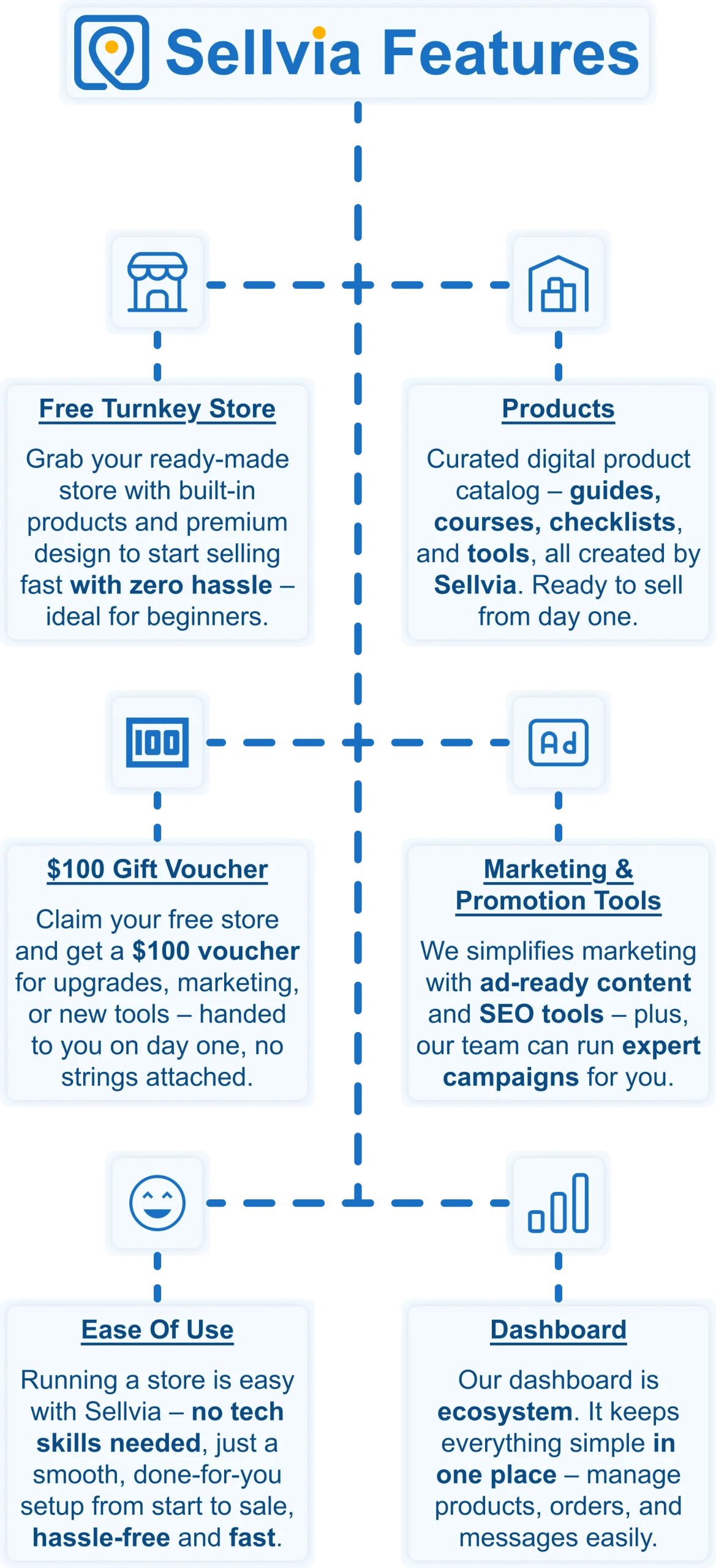
Want to start selling but don’t know where to begin? No worries! Just share your ideas, and Sellvia’s team will build a free ecommerce website that’s fully set up and ready to take orders from day one. No coding, no stress – just a store that works right out of the box.
A $100 gift voucher to grow your business faster 🎁
Starting a business takes momentum – and Sellvia gives you a head start. When you claim your free store today, you also get a $100 gift voucher to put toward growing your business. Use it to upgrade your store, boost your marketing, or unlock new tools. It is a real dollar value, handed to you on day one, with no catch and no hoops to jump through.
A massive catalog of digital products to sell 🏆
One of the biggest struggles in starting an online business is figuring out what to sell. Sellvia solves that completely. Your store comes pre-loaded with digital products – guides, courses, checklists, and tools – all created by Sellvia. You keep 50–70% of every sale. No inventory. No shipping. No logistics headaches.
Everything in one easy-to-use platform 🔥
Managing an online store shouldn’t be complicated. With Sellvia, you can handle orders, add new products, and even chat with customers – all from a simple and user-friendly platform. No need to mess with confusing tools or deal with unnecessary tech stuff. It’s all smooth sailing.
No upfront costs, just start selling 💰
A big reason people hesitate to start an online business is the cost. But here’s the good news: With Sellvia, you don’t need to invest in stock, storage, or shipping supplies. You can run your store with no upfront costs, keeping things low-risk while still making money.
Support that’s always got your back 🤝
Running a business comes with questions, but you’re never alone. Sellvia’s dedicated support team is available 24/7 to help with anything you need. Whether it’s a small question or a big challenge, they’ve got you covered.
While Shopify and BigCommerce both require months of fees and setup before real earnings begin, Sellvia gives you a ready-to-earn store from day one — with no platform subscription to worry about. Claim your free store today and start selling without the monthly overhead.