Most small business owners already know they need to market better. The problem is not motivation – it is knowing where to start without wasting time or money on tactics that do not move the needle. The good news? You do not need a big budget or a marketing degree to grow. You need the right mix of proven strategies applied consistently over time.
Quick Answer: The most effective small business marketing ideas in 2026 include local SEO, short-form video content, email marketing, referral programs, and social media engagement. Most cost little to nothing and can start delivering results within 30–90 days with consistent effort.
This guide walks through 17 actionable strategies grouped by category, with honest estimates on what each one can realistically do for your bottom line – and a clear-eyed look at where to start based on your situation right now.
Whether you run a local service business, an online shop, or a side hustle you are trying to turn into something real, the ideas in this guide apply directly to you. Let’s dig in.
What is small business marketing?
Small business marketing is the process of connecting what you sell with the people most likely to buy it – using channels, messaging, and timing that fit your budget and your audience.
Unlike big-company marketing with full departments and massive ad budgets, small business marketing almost always means doing more with less: fewer hands, smaller spend, and a heavier reliance on organic traffic, word of mouth, and community-driven tactics.
In 2026, small business marketing matters more than it ever has. Consumer attention is spread across a dozen platforms, and the bar for earning trust is higher than it was five years ago.
At the same time, the tools available to independent business owners have never been more powerful. Free social media, AI-assisted content creation, and zero-cost email platforms mean the gap between a well-marketed small business and a poorly marketed one comes down almost entirely to strategy – not spend.
Whether you are trying to get your first 10 customers or grow from $2,000 to $10,000 a month, the principles in this guide scale with you. The key is picking the right starting point – and that is exactly what this article helps you figure out.
How much can small business marketing realistically earn you?
Before diving into tactics, it is worth grounding your expectations. Marketing is not a direct income method – it is a multiplier on whatever you are already selling. The returns depend entirely on your product margins, your market size, and how consistently you execute.
These figures reflect realistic ranges across different industries. A local bakery and a B2B service firm will see very different numbers, but the relative ranking of effort-to-return holds up across most small business categories. Most owners doing two or three of these consistently see meaningful growth within 60–90 days.
One note on the upper figures: The high end of each range assumes a well-optimized offer, an existing audience, and sustained execution over 3–6 months. Do not plan your finances around best-case outcomes – plan around what you can realistically sustain every week.
The sections below break down each method in detail – what it involves, how to get started, and what a realistic result looks like for a typical small business owner working without a big team or budget.
The best small business marketing ideas for 2026
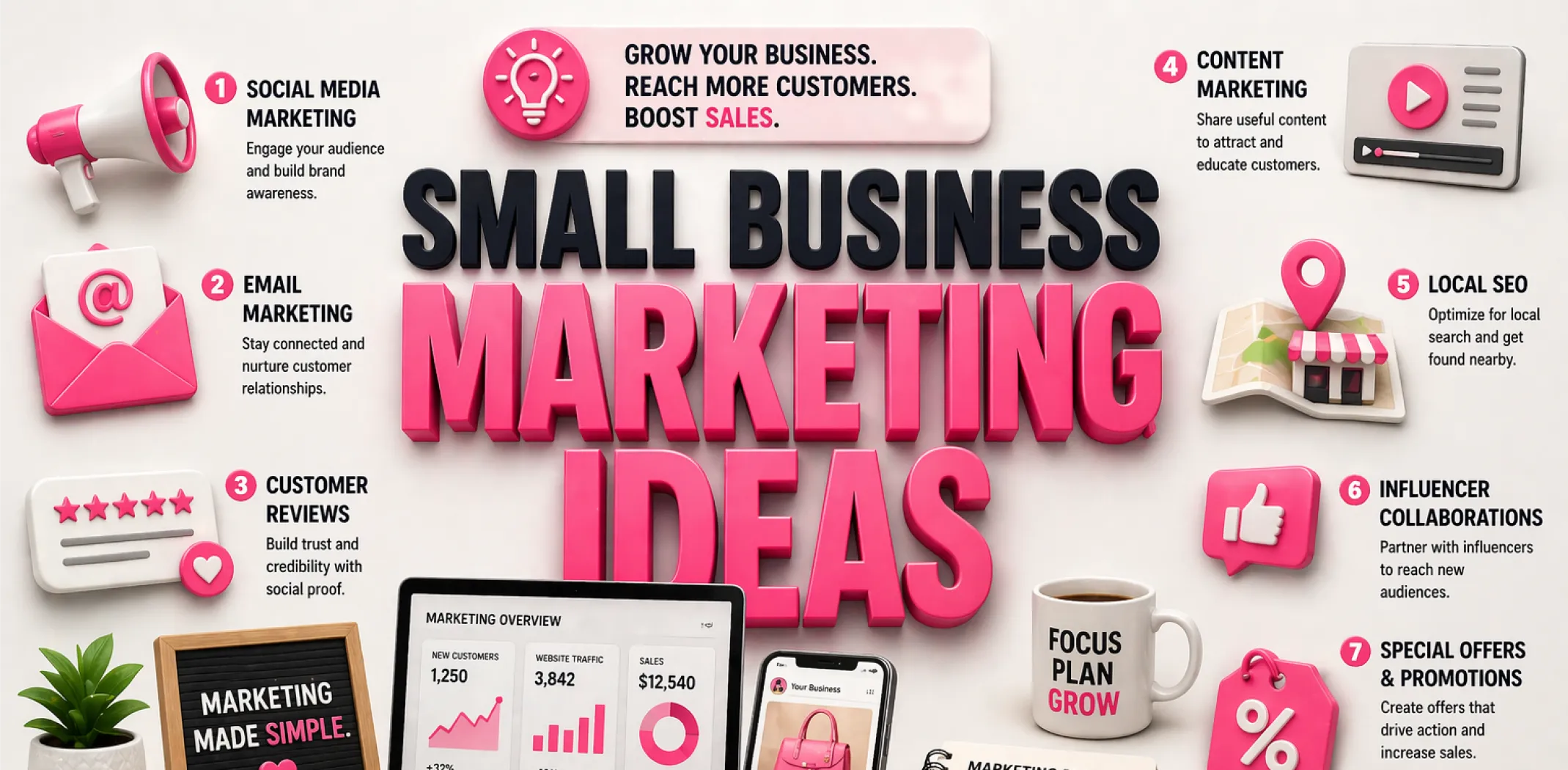
These 17 strategies are grouped by category so you can focus on the channels most relevant to your type of business. Start with two or three from different categories rather than trying to implement everything at once – consistency beats volume every time.
Online presence and SEO
1. Optimise your Google Business Profile
If you serve local customers and you have not claimed and fully filled out your Google Business Profile, this is the single highest-return task you can do this week. A complete profile – with photos, hours, service categories, and regular posts – significantly improves your visibility in local search results and on Google Maps.
According to Google’s own research, businesses with complete profiles receive roughly 7x more clicks than those with incomplete ones.
Getting started is free. Claim your listing at business.google.com, verify ownership, fill in every field, upload at least 10 photos, and ask your five most loyal customers to leave an honest review. Post a short update once a week – a new product, a seasonal promotion, or a behind-the-scenes moment. It takes less than 10 minutes and compounds over time.
Earning potential: Local SEO improvements can drive $500–$3,000/month in added walk-in or inquiry revenue within 60–90 days for most service businesses.
2. Start a blog targeting long-tail keywords
Content marketing compounds in a way that paid ads do not. A well-written blog post targeting a specific question your ideal customer is already searching for can drive free, qualified traffic for years. The key is targeting long-tail keywords – specific phrases like “how to choose a wedding photographer in Austin” rather than broad terms like “photographer.”
Use free tools like Google Search Console, Ubersuggest, or AnswerThePublic to find questions your audience is asking. Aim for one solid post per week at 800–1,500 words. Within 6–12 months of consistent publishing, organic search can become your top traffic source.
Why this works in 2026: AI-generated content has flooded the internet with generic articles. Original, experience-driven content from a real business owner now stands out more than ever in search results.
3. Build simple location pages if you serve multiple areas
If your business operates across several towns, suburbs, or cities, create a dedicated landing page for each location. Each page should include locally relevant content – not just a copy-paste of the same text with a different city name. Mention local landmarks, community events, or neighborhood context that signals genuine local relevance to both search engines and visitors.
Important: Thin location pages with identical content can hurt your search rankings. Each page needs at least 400 words of genuinely distinct content to be worth creating.
Social media marketing
4. Post short-form video consistently
TikTok, Instagram Reels, and YouTube Shorts are the highest-organic-reach formats available to small businesses in 2026. Unlike static posts, short videos can reach hundreds of thousands of new viewers without any ad spend – especially in the first 24–48 hours after posting. You do not need professional equipment. A phone, decent lighting, and a clear point work better than overproduced content on these platforms.
Start with one video per weekday. Show your product, answer a common customer question, share a quick tip related to your niche, or document a day in the life of your business. The format rewards authenticity over polish.
Earning potential: Businesses with 5,000–50,000 followers on short-form platforms report $300–$5,000/month in directly attributed sales, with top creators in niche markets earning significantly more.
5. Use Instagram and Facebook Stories for daily engagement
Stories disappear after 24 hours, which makes them lower-stakes than permanent posts and ideal for frequent, casual touchpoints with your audience. Polls, question boxes, countdown timers for sales, and quick product demos all perform well. Stories keep your business top-of-mind between purchase cycles and drive direct messages from warm prospects who are already interested.
Aim for 3–5 Story frames per day. This sounds like a lot, but a 15-second clip from your morning, a quick poll about a new product, and a reshare of a customer post takes under five minutes to put together – and it keeps the algorithm showing your content to more people.
6. Build a Facebook or LinkedIn community group
Owning a community is more valuable long-term than renting attention through a feed algorithm. A niche Facebook group or LinkedIn group positions you as the go-to authority in your space, gives you a direct channel to your most engaged customers, and generates organic content – questions, discussions, testimonials – that keeps the community alive without much effort on your part.
Why this works in 2026: Platform reach for business pages has declined significantly, but group content still gets strong organic distribution. A group of 500 engaged members can outperform a page with 10,000 passive followers.
Email and direct communication
7. Build your email list from day one
Email marketing consistently delivers the highest return of any digital channel – typically $36–$42 for every dollar spent, according to benchmarks from Litmus and Campaign Monitor. Unlike social media, your email list is an asset you own. Algorithm changes, platform shutdowns, and account suspensions cannot take it from you.
Start collecting emails immediately – via a pop-up on your website, a lead magnet like a free PDF or checklist, or simply asking at the point of sale. Mailchimp and MailerLite both offer free tiers that support up to 500–1,000 subscribers, which is more than enough to get started. Send at least one email per week. Newsletters, product updates, how-to content, and exclusive offers all perform well.
Earning potential: A list of 1,000 subscribers with a 2% conversion rate and a $50 average order value generates $1,000 per promotional email. That math scales quickly as your list grows.
8. Set up automated email sequences
A welcome sequence, an abandoned cart sequence, and a post-purchase follow-up sequence together can add 15–25% to your email revenue without any manual effort after the initial setup. Most email platforms include automation builders with pre-built templates.
A welcome sequence of 3–5 emails over the first two weeks after signup consistently outperforms one-off broadcast emails in open rate, click rate, and conversion – because the timing is right and the relevance is high.
9. Use SMS for time-sensitive promotions
SMS open rates hover around 98% compared to 20–25% for email, and most messages are read within three minutes of delivery. For flash sales, limited-stock alerts, or same-day appointment reminders, SMS is unmatched. Platforms like Klaviyo, Postscript, and SimpleTexting integrate with most online store platforms and offer pay-as-you-go pricing that works for small budgets.
Important note: Always obtain explicit opt-in consent before adding anyone to your SMS list. Unsolicited texts are illegal in most jurisdictions and will damage your brand reputation fast.
Referrals, partnerships, and community
10. Launch a referral program
Word of mouth is the oldest and most trusted form of marketing – and a structured referral program turns it into a repeatable system. Offer an existing customer a discount, store credit, or small gift for every new customer they refer. The referred customer gets a first-time discount too. Both sides win, and you acquire a new customer at a fraction of the cost of paid advertising.
Tools like ReferralCandy, Friendbuy, or a simple coupon code system make this easy to set up in an afternoon. The best referral programs are simple enough to explain in one sentence.
Earning potential: Businesses with active referral programs report 10–30% higher customer acquisition rates at 40–60% lower cost per new customer than paid channels.
11. Partner with complementary local businesses
Cross-promotion with a business that shares your customer base but does not compete with you is one of the most underused small business marketing ideas available. A florist and a wedding photographer, a personal trainer and a nutritionist, a children’s clothing boutique and a toy shop – these combinations create natural referral flows that cost nothing beyond the relationship itself.
Formalize the arrangement: agree on what you will promote for each other, how often, and through which channels. Even a simple social media shoutout swap or a co-hosted giveaway can expose both businesses to hundreds of new qualified prospects without spending a dollar.
12. Get featured in local press and online directories
Local newspapers, neighborhood blogs, community Facebook groups, and niche online directories still drive meaningful traffic and trust signals for small businesses. Reach out to local journalists with a genuine story angle – a community impact story, a milestone, a unique product – rather than a generic press release. For directories, focus on Yelp, Tripadvisor (if relevant), Houzz, Angi, and any industry-specific listings for your niche.
Pro Tip: When pitching local media, lead with the community benefit of your story rather than your product features. Journalists are looking for stories that serve their readers, not advertisements.
Paid and performance marketing
13. Run targeted Facebook and Instagram ads
Meta’s advertising platform remains one of the most powerful tools available to small businesses, particularly for consumer products and local services. The ability to target by location, age, interests, and behaviors means even a $5–$20 per day budget can reach a precisely defined audience. The key is testing multiple creative formats – single image, video, carousel – with small budgets before scaling what works.
Start with retargeting before going after cold audiences. Show ads to people who have already visited your website or engaged with your social profile. These audiences convert at 3–5x the rate of cold traffic and typically cost less per click.
Earning potential: Well-optimized Meta ad campaigns for online businesses typically achieve a 3–8x return on ad spend once creative and targeting are dialed in, which usually takes 4–8 weeks of testing.
14. Use Google Ads for high-intent search traffic
Google Ads places your business in front of people actively searching for what you sell. Unlike social ads that interrupt users mid-scroll, search ads reach people at the exact moment of intent. For service businesses especially, Google Search campaigns often outperform every other paid channel.
Start with exact-match and phrase-match keywords, set a clear negative keyword list, and use call extensions if phone inquiries matter to your business.
Important: Google Ads can waste budget quickly without proper setup. If you are new to it, start with a $300–$500 test budget and keep your targeting tight before scaling.
Content and thought leadership
15. Create a YouTube channel for your niche
YouTube is the second-largest search engine in the world, and video content has a long shelf life. A tutorial or how-to video you upload today can still be discovered and driving traffic three years from now. For small businesses, YouTube works particularly well for demonstrating expertise – home improvement contractors, beauty professionals, fitness trainers, and consultants all build significant audiences this way.
Aim for one video per week at 5–12 minutes. Keyword-optimize your titles, descriptions, and tags. It typically takes 6–12 months to see meaningful organic growth, but the compounding returns make it one of the best long-term small business marketing investments available.
16. Collect and showcase customer reviews systematically
Reviews are one of the most powerful conversion tools a small business has – and most businesses are passive about collecting them. A systematic approach means asking every satisfied customer for a review, making it easy by sending a direct link to your Google or Trustpilot profile, and responding professionally to every review, positive or negative.
Research from BrightLocal consistently shows that over 90% of consumers read online reviews before visiting a local business, and that the average consumer reads at least 10 reviews before trusting a business. More reviews means higher trust and higher conversion rates.
Why this works in 2026: Authentic, detailed reviews from verified customers carry more weight than ever with both consumers and search algorithms – especially as AI-generated fake reviews become easier to detect and penalize.
17. Repurpose one piece of content across multiple channels
Creating original content from scratch for every platform is exhausting and unsustainable for a small team. Instead, build around a single core piece of content per week and repurpose it everywhere. A 10-minute YouTube video becomes a short-form clip for TikTok and Reels, a written summary for your blog, a carousel post for LinkedIn, and three talking points for your email newsletter. One effort, five outputs.
This approach keeps you consistent across platforms without burning out – and consistency, more than any single viral moment, is what actually builds an audience over time.
Legal and ethical considerations for small business marketing
Most small business marketing tactics are straightforward – but a few grey areas can damage your reputation or expose you to legal risk if you are not careful. Here is what to watch out for and what to do instead.
What to avoid absolutely
Fake reviews are the most common ethical mistake small businesses make – often without fully understanding the consequences. Writing them yourself on secondary accounts, paying for them, or offering discounts in exchange for positive reviews all violate Google’s Terms of Service and, in many cases, consumer protection law.
The FTC has issued significant fines to businesses caught doing this, and the reputational damage lasts far longer than any short-term ranking boost.
Misleading advertising – including before-and-after photos that do not reflect typical results, income claims without proper disclaimers, or “limited time” offers that never actually expire – is illegal in most markets and erodes the trust that marketing is supposed to build in the first place.
Spam, whether by email or SMS, is both illegal under CAN-SPAM and CASL legislation and deeply counterproductive. Purchased email lists produce near-zero conversions, damage your sender reputation, and can get your domain blacklisted – undoing months of legitimate list-building work.
Key principle: Every marketing claim you make should be something you can back up with evidence, and every communication you send should go only to people who have explicitly asked to receive it.
What to do instead
Build your review strategy around making it genuinely easy for happy customers to share their experience – no incentives needed, just a well-timed ask and a direct link. Keep all promotional claims specific and qualified. Build your list through genuine opt-ins and treat every subscriber as a person who trusted you with their inbox.
Transparent, honest marketing takes slightly longer to build momentum but compounds into a durable brand reputation that paid tactics simply cannot buy. That reputation is one of the most valuable assets a small business can own.
How to choose the right approach for your situation
Not every small business marketing idea in this guide will be equally relevant to where you are right now. Here is a straightforward way to prioritize based on your current stage.
Complete beginner
If you are just starting out, focus on two things first: your Google Business Profile and your email list. Both are free, both have a high return relative to the effort involved, and both build assets you own outright. Add one short-form video per day once those two are in place. Do not spend money on ads until you have validated your offer through organic channels first.
Intermediate – part-time effort
If you have been in business for 6–12 months and already have some customers, your priority is referrals and content. Set up a referral program this week. Start publishing one blog post and one YouTube video per week. Begin testing paid social retargeting with a small daily budget. At this stage, your goal is to turn satisfied customers into a growth engine and build an organic traffic base that compounds over time.
Advanced – full-time focus
If you are treating your business as a full-time income goal, invest in a proper content repurposing system, paid search, a structured email automation stack, and community building.
At this level, the compounding effect of multiple channels working together – SEO feeding email, email feeding paid retargeting, video building brand trust – is where the real step-changes in revenue come from. Budget 10–15% of revenue back into marketing, test continuously, and cut what does not perform within 90 days.
Online store owners
If you sell products online, the channel mix shifts toward short-form video, paid social, and email automation – all of which are optimized for product discovery and repeat purchase. The challenge for most online store owners is not the marketing itself – it is having the right products and a store built to convert.
The tools available in 2026 have dramatically lowered the skill floor required to run a profitable online store. Getting started is the hard part. Once the store is live and generating its first sales, the marketing strategies in this guide take over.
Why Sellvia is a game-changer for your online store 🚀
Sellvia isn’t just another ecommerce tool. We are a trusted name in the industry, recognized by Forbes and even ranked in Inc.’s list of the 5,000 fastest-growing companies in the U.S. So if you’re serious about starting as a solopreneur, this is a smart place to begin.
Starting an online business can feel overwhelming, but that’s exactly where Sellvia steps in. It takes care of the tricky parts, so you can focus on making sales and growing your brand. Let’s break down what makes it such a great choice.
Get a ready-to-go store hassle-free 🎯
Want to start selling but don’t know where to begin? No worries! Just share your ideas, and Sellvia’s team will build a free ecommerce website that’s fully set up and ready to take orders from day one. No coding, no stress – just a store that works right out of the box.
A $100 welcome gift to grow your business faster 🎁
Starting a business takes momentum – and Sellvia gives you a head start. When you claim your free store today, you also get a $100 welcome gift to put toward growing your business. Use it to upgrade your store, boost your marketing, or unlock new tools. It is a real dollar value, handed to you on day one, with no catch and no hoops to jump through.
A massive catalog of digital products to sell 🏆
One of the biggest struggles in starting an online business is figuring out what to sell. Sellvia solves that completely. Your store comes pre-loaded with digital products – guides, courses, checklists, and tools – all created by Sellvia. You keep 50–70% of every sale. No inventory. No shipping. No logistics headaches.
Everything in one easy-to-use platform 🔥
Managing an online store shouldn’t be complicated. With Sellvia, you can handle orders, add new products, and even chat with customers – all from a simple and user-friendly platform. No need to mess with confusing tools or deal with unnecessary tech stuff. It’s all smooth sailing.
No upfront costs, just start selling 💰
A big reason people hesitate to start an online business is the cost. But here’s the good news: With Sellvia, you don’t need to invest in stock, storage, or shipping supplies. You can run your store with no upfront costs, keeping things low-risk while still making money.
Support that’s always got your back 🤝
Running a business comes with questions, but you’re never alone. Sellvia’s dedicated support team is available 24/7 to help with anything you need. Whether it’s a small question or a big challenge, they’ve got you covered.
All the small business marketing ideas in this guide work best when you have a great product and a store built to convert. Claim your free Sellvia store today and start putting these strategies to work.
What are the most effective small business marketing ideas for beginners?
How much should a small business spend on marketing?
Most small business owners spend between 5 and 12 percent of annual revenue on marketing, depending on their growth stage and industry. Startups and newer businesses typically sit at the higher end of that range because they are building awareness from scratch. Service businesses with strong referral networks can often operate effectively at 5 percent or less. The most important thing is tracking which channels drive actual revenue and allocating the majority of budget there, rather than spreading it evenly across everything.
What is the fastest small business marketing method to see results?
Paid advertising on Google or Meta can drive results within days, but it requires budget and some testing time to optimize. For low-cost or free tactics, Google Business Profile updates and short-form video posts on TikTok or Instagram Reels have produced significant traffic spikes within 24 to 48 hours for many small businesses. Email campaigns to an existing list also tend to generate same-day responses when the offer is strong. The fastest results always come from channels where you already have a warm, engaged audience.
How do small businesses market with no budget?
Small businesses with no marketing budget have more options than ever in 2026. Free tactics include claiming and optimizing your Google Business Profile, posting consistently on social media, building an email list using a free Mailchimp or MailerLite account, joining and contributing to relevant online communities, asking satisfied customers for reviews, and creating content that answers questions your ideal customers are already searching for. None of these require ad spend. They do require consistent time and effort over 60 to 90 days before results become meaningful.
Which small business marketing ideas work best for online stores?
Online stores benefit most from short-form video content on TikTok and Instagram Reels, which drive product discovery among new audiences; email automation sequences including welcome flows and abandoned cart emails, which recover lost revenue automatically; and paid social retargeting, which converts site visitors who did not purchase on their first visit. These 3 channels together account for the majority of revenue for most high-performing small online stores. Starting with organic video content to build an audience before investing in paid ads is the most common path for stores that grow without large upfront budgets.