Most online stores fail not because they sell bad products – but because they give shoppers no real reason to pick them over everyone else. That is where a unique selling proposition comes in. If you are starting an online business or trying to grow one you already have, your USP is one of the most powerful things you will ever write. It tells the right people why they should choose you – and not someone else.
Quick Answer: A unique selling proposition (USP) is a clear, specific statement that explains what makes your business different from competitors and why that difference matters to your target customer. It is not a slogan – it is the core reason someone should buy from you and not anyone else.
In this guide you will learn what a strong unique selling proposition actually looks like, how to write one from scratch even if you are brand new to selling online, and which USP types work best in 2026. Whether you are looking for your first side hustle or dreaming of leaving the 9-to-5 for good, there is a clear path forward – and it starts with knowing exactly what makes you different.
What is a unique selling proposition?
A unique selling proposition – also called a unique selling point or USP – is a short statement that identifies the one thing your business does better than, or differently from, every other option available to your customer. It answers the question your potential buyer is silently asking: “Why should I buy from you and not someone else?”
A good USP is not vague. “We sell quality products at great prices” is not a unique selling proposition – every store claims that. A real unique selling point is specific, believable, and meaningful to the people you are trying to reach.
Think of Domino’s Pizza back in the day: hot, fresh pizza delivered in 30 minutes or you get it free. That is a USP. It is measurable, it speaks to a real fear (cold pizza, slow delivery), and it is a promise the company can actually keep.
In an online business, your unique selling proposition shapes everything – your product page copy, your ads, your emails, even the way you talk to customers. It is the thread that connects every part of your brand. Without one, you are just another option in a very crowded room.
Why this works in 2026: Online shoppers are overwhelmed with choices. A clear unique selling proposition cuts through the noise instantly and gives your ideal customer a reason to stop scrolling and start buying.
How much can your online business realistically earn?
Before you write your unique selling proposition, it helps to understand what is actually at stake. Your USP directly affects how much you earn – not in theory, but in practice. Stores with a clear, specific positioning consistently outperform generic competitors in sales, repeat customers, and word-of-mouth referrals. Here is what the earning picture tends to look like:
These ranges reflect real-world patterns across online stores and vary by niche, traffic source, and how much effort you put in. A USP alone will not fix a broken business – but it is one of the highest-leverage things you can do to improve your results, especially early on.
One note on the top figures: Reaching $100–$150/day typically takes 60–90 days of consistent effort after launch. Results vary based on niche, ad spend, and how well your USP matches what your specific customers actually want.
The good news is that you do not need a marketing degree or a big budget to develop a compelling unique selling point. You need clarity about who your customer is, what they actually want, and what gap your store fills. That process is simpler than most beginners expect – and the steps below will walk you through it.
How to create a unique selling proposition step by step
Writing a USP is not about being clever. It is about being honest and specific. The following process works whether you are building your first online store or refining a business you have been running for years.
Understanding your customer first
Identify the core customer problem
Every strong unique selling proposition starts with a customer pain point, not a product feature. Before you write a single word, ask yourself: what frustration, desire, or fear does my ideal customer have that my store directly addresses?
If you sell eco-friendly home products, the pain point might be guilt – people who want to live more sustainably but cannot find simple, affordable options. If you sell digital guides for personal finance, the pain point is the stress of feeling like money is always slipping away. The more precisely you can name that problem, the sharper your unique selling proposition will be.
Earning potential: Stores built around a specific customer problem – rather than a broad product category – typically earn $30–$80/day within 60–90 days of launch, compared to $5–$15/day for stores with no clear focus.
Research what your competitors are actually saying
Spend 30 minutes reading the homepage copy of your five closest competitors. What words do they use? What claims do they make? Most online stores in any given niche say almost the same things – “premium quality,” “fast delivery,” “great prices.” That sameness is your opportunity.
If every competitor focuses on product quality, you can win on customer experience. If they all compete on price, you can win on trust and community. Your unique selling proposition only needs to be different from theirs – not different from every business in the world. That is a much more achievable goal than it sounds.
Map your genuine strengths
List everything your store actually does well – not what you wish it did, but what it genuinely delivers. Are you more focused on a specific niche? Do you serve a community your competitors ignore? Do you offer a no-hassle return policy that removes all the risk? Is your product selection tighter and more curated than the big generalist stores?
Be honest with yourself here. A unique selling proposition built on a real strength is sustainable. One built on wishful thinking will fall apart the moment a customer puts it to the test. Identify what you genuinely bring to the table – and lead with that.
Writing and testing your USP
Use the USP formula that actually works
Once you know your customer’s problem, your competitors’ weaknesses, and your genuine strengths, plug them into this structure: [What you do] + [For whom] + [That solves X] + [Unlike competitors, because Y].
You do not need to use every part in every version, but filling in each slot forces clarity. An online store selling minimalist home goods for small-space living might land on: “Space-smart home essentials for city renters who are tired of cluttered living – curated for under 400 square feet.” That is specific, relatable, and immediately different from every generic home decor store out there.
Test it with real people before you commit
Before you put your unique selling proposition on your homepage, run it past five people who match your target customer profile. Do not ask “do you like this?” Ask “what does this make you think the store sells?” and “would this make you want to browse?”
If they understand it immediately and feel something – curiosity, relief, excitement – you are on the right track. If they are confused or indifferent, go back and sharpen the specificity. Reddit communities, Facebook groups, and even friends with no business knowledge make useful quick-test audiences. Free feedback like this is worth more than most paid research.
Place your USP everywhere, not just your homepage
A unique selling proposition is not a tagline that lives in your header and nowhere else. It should inform your product descriptions, your about page, your ad copy, your email subject lines, and every touchpoint your customer has with your brand.
The most effective online businesses repeat their core positioning so consistently that customers could describe it themselves after a single visit. That level of clarity does not happen by accident – it happens because the USP was embedded into every piece of customer-facing content from the very beginning.
Important note: A unique selling proposition is a living document, not a one-time exercise. Revisit it every 6–12 months as your store grows and your customer base gives you more feedback to work with.
Unique selling proposition examples that work in 2026 – and why
Looking at real unique selling proposition examples is the fastest way to understand what good positioning actually feels like. These are not all massive brands – some are the kind of small, focused stores that consistently outperform bigger competitors because they know exactly who they are for.
Product-focused unique selling proposition examples
“The only running shoes designed for flat-footed runners”
This is a niche USP that immediately signals to a specific customer: this brand sees me. It does not try to appeal to all runners – it intentionally excludes most of them in order to become the go-to source for a smaller group. That trade-off is exactly right for a new online store. You cannot out-market huge competitors. You absolutely can own “flat-footed runners who have tried everything else.”
Why this works in 2026: Shoppers are more skeptical of generic claims than ever. Specificity builds instant credibility because it signals expertise, not just a catalog.
“Skincare for men who hate skincare routines”
This unique selling proposition works because it meets the customer where they are – not where the brand wishes they were. It acknowledges the real barrier (complexity and time) and promises to remove it. It also has personality, which makes it memorable. The best unique selling propositions sound like something a real person would say, not a corporate mission statement.
Service and experience-focused unique selling proposition examples
“Free returns, no questions, no forms, forever”
This USP removes the single biggest psychological barrier to buying online: the fear of being stuck with something that does not work. It does not compete on price or product quality – it competes on trust. For any online store, where customers cannot physically inspect products before buying, a generous and clearly communicated policy can be one of the most powerful differentiators available to you.
“Curated by a practising nutritionist, not an algorithm”
The human-curation unique selling proposition is increasingly powerful in 2026 because so much of what people find online feels machine-generated and generic. If you have genuine expertise in your niche – whether that is nutrition, fitness, interior design, or personal finance – making that expertise the centrepiece of your USP can justify higher prices and build a loyal following that no price-cutter can steal from you.
Important: A service-based USP only works if you can actually deliver on it. If your policy is generous on paper but a nightmare in practice, the USP becomes a liability. Under-promise and over-deliver, every time.
Legal and ethical considerations when positioning your store
Your unique selling proposition is a promise. If you build it on claims you cannot back up, you are not just risking customer trust – you may also be crossing into false advertising territory, depending on where you operate and who your customers are.
Here is what to avoid absolutely when crafting your positioning copy:
- Superlatives you cannot prove: “The world’s best,” “the only store that,” or “guaranteed results” all invite problems if you cannot substantiate them with data, reviews, or certifications. Stick to claims you can actually verify.
- Fake scarcity or urgency: Countdown timers that reset, fake stock levels, and manufactured “limited time” offers erode trust the moment a customer notices the pattern. Real urgency is fine. Manufactured urgency is both dishonest and increasingly illegal in many places.
- Fabricated social proof: Fake reviews, inflated review counts, or paid testimonials presented as organic feedback violate platform rules and consumer protection laws in most countries. Build your review base honestly from day one – it takes longer but it lasts.
Key principle: Your unique selling proposition should be something you are proud to be held accountable to – a promise you actively work to keep, not a claim you hope no one tests.
What to do instead: build your USP around genuine advantages – your curation, your community, your expertise, your service standards. These are differentiators that grow over time and cannot be copied overnight by a bigger competitor.
How to choose your USP approach based on where you are now
Not every unique selling proposition strategy suits every seller. Where you are in your journey should shape what kind of USP you lead with – and how ambitious it needs to be right now.
Complete beginner
If you are just starting out, keep your unique selling proposition simple and niche-focused. Pick a specific group of people within a broad category and build everything around their particular needs. You do not need a grand brand story yet – you need clarity.
“Minimalist gifts for people who hate clutter” is a better starting point than “beautiful gifts for everyone.” Specificity is your competitive advantage when you have no track record and no budget for brand-building.
Earning potential: Beginner stores with a focused niche USP typically start seeing $20–$50/day within the first 30–60 days of consistent effort. Results depend on how well the USP matches real customer demand.
Intermediate – running a store part-time
At this stage you probably have some customer feedback to work with. Use it. The exact words your buyers use to describe the problem your store solves are pure gold for refining your unique selling proposition. Read your reviews, your support messages, your social comments.
The most compelling positioning you can write is often borrowed directly from happy customers – the language they use to describe why they came back.
Advanced – aiming for full-time income
At the full-time level, your unique selling proposition needs to be defensible – not just different, but difficult to replicate. This might mean exclusive supplier or content relationships, a proprietary product bundle, a community layer, or a content-driven brand with genuine authority in your niche.
Aim for $80–$200/day as a realistic full-time benchmark, understanding that reaching that level typically takes 6–12 months of consistent positioning, testing, and learning.
Regardless of where you are today, the forward-looking reality of selling online in 2026 is this: differentiation is no longer optional. The stores that survive and grow are the ones with a clear unique selling proposition that gives customers a reason to return, refer, and trust. The tools to build those stores are more accessible now than they have ever been.
Why your unique selling proposition is only as strong as the store behind it
Here is something that does not get said enough: a brilliant unique selling proposition attached to a broken or hard-to-navigate store will not save you. The USP gets people in the door. The store keeps them there and turns them into buyers. That is why getting both right – your positioning and your platform – matters so much.
Most people who are serious about building income online spend weeks (sometimes months) on the store setup alone. Choosing the right products. Building pages. Figuring out ads. All of that eats time you could be spending on the thing that actually moves the needle: understanding your customer and talking to them in a way that makes them feel seen.
That is exactly the problem Sellvia was built to solve.
Why Sellvia is a game-changer for your online store 🚀
Sellvia isn’t just another ecommerce tool. We are a trusted name in the industry, recognized by Forbes and even ranked in Inc.’s list of the 5,000 fastest-growing companies in the U.S. So if you’re serious about starting as a solopreneur, this is a smart place to begin.
Starting an online business can feel overwhelming, but that’s exactly where Sellvia steps in. It takes care of the tricky parts, so you can focus on making sales and growing your brand. Let’s break down what makes it such a great choice.
Get a ready-to-go store hassle-free 🎯
Want to start selling but don’t know where to begin? No worries! Just share your ideas, and Sellvia’s team will build a free ecommerce website that’s fully set up and ready to take orders from day one. No coding, no stress – just a store that works right out of the box.
A $100 welcome gift to grow your business faster 🎁
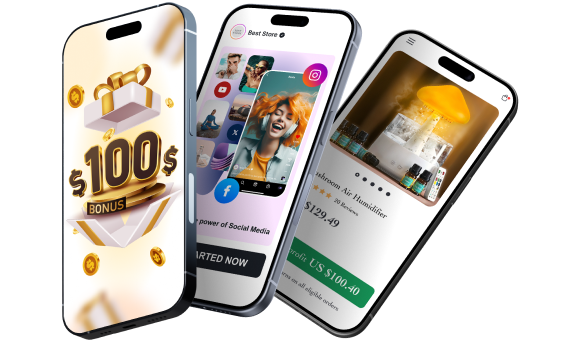
Starting a business takes momentum – and Sellvia gives you a head start. When you claim your free store today, you also get a $100 welcome gift to put toward growing your business. Use it to upgrade your store, boost your marketing, or unlock new tools. It is a real dollar value, handed to you on day one, with no catch and no hoops to jump through.
A massive catalog of digital products to sell 🏆
One of the biggest struggles in starting an online business is figuring out what to sell. Sellvia solves that completely. Your store comes pre-loaded with digital products – guides, courses, checklists, and tools – all created by Sellvia. You keep 50–70% of every sale. No inventory. No shipping. No logistics headaches.
Everything in one easy-to-use platform 🔥
Managing an online store shouldn’t be complicated. With Sellvia, you can handle orders, add new products, and even chat with customers – all from a simple and user-friendly platform. No need to mess with confusing tools or deal with unnecessary tech stuff. It’s all smooth sailing.
No upfront costs, just start selling 💰
A big reason people hesitate to start an online business is the cost. But here’s the good news: With Sellvia, you don’t need to invest in stock, storage, or shipping supplies. You can run your store with no upfront costs, keeping things low-risk while still making money.
Support that’s always got your back 🤝
Running a business comes with questions, but you’re never alone. Sellvia’s dedicated support team is available 24/7 to help with anything you need. Whether it’s a small question or a big challenge, they’ve got you covered.
A strong unique selling proposition tells customers why to choose you – and Sellvia gives you the store that delivers on that promise from day one. Claim your free store and start building a business that stands out.
What is a unique selling proposition in simple terms?
How do I write a unique selling proposition for my store?
Start by identifying the main problem your target customer wants solved, then research what your competitors are saying and look for gaps they are missing. List your genuine advantages – your niche focus, your product curation, your return policy, your expertise, or your service standards – and combine them into a clear statement. A useful structure is: what you do, for whom, and why it is different. Test it with 5 real people who match your customer profile before you put it on your homepage. The clearest unique selling propositions are written in plain, direct language, not marketing jargon.
What are some examples of a strong unique selling point?
Strong unique selling point examples share one thing in common: they are specific and customer-focused rather than generic. A store selling eco-conscious pet products might use: accessories made from 100 percent recycled materials, for pet owners who care about the planet. A store targeting beginner fitness enthusiasts might use: simple, no-intimidation gear for people who have never set foot in a gym. What makes these work is that they speak directly to one person, address a real frustration, and make a promise the business can keep. Vague phrases like "quality you can trust" or "great prices" are not unique selling points because every store claims the same thing.
How long should a unique selling proposition be?
A unique selling proposition should be short enough to be understood immediately – ideally 1 to 2 sentences or around 10 to 20 words. The goal is not to explain everything about your business but to give the right customer an instant signal that your store is exactly what they have been looking for. Longer versions can appear on your about page or in ad copy, but the core statement used in headers and hero sections should be scannable in under 5 seconds. If someone has to read it twice to understand what you sell, it needs to be sharpened.
Can a brand new online store have a unique selling proposition?
Yes – and a clear unique selling proposition is actually one of the most powerful tools available to a new online store. Because many stores sell similar products, the differentiation has to come from curation, community, branding, customer experience, or niche focus rather than from having a unique product. A store that positions itself as the go-to source for minimalist home goods for small apartments, for example, can earn higher trust and better conversion rates than a generic home decor store selling the same items with no clear positioning. Starting focused is always better than starting broad.