
College is expensive. Between tuition, textbooks, rent, and everything else life throws at you, most students are running on empty before the month is over. The good news? There are more ways to make money in college right now than at any point in history – and a lot of them do not require a fixed schedule, a car, or any prior experience.
Whether you are looking to knock down your student loans, cover rent without calling your parents, or build a real income stream from your dorm room, this guide covers every realistic option available to you in 2026 – and gives you honest numbers for each one.
Quick Answer: The best ways to make money in college include freelancing, on-campus jobs, gig work, online tutoring, selling digital products, and running your own online store. Students who combine the right method with consistent effort can realistically earn $300 to $2,000 or more per month without sacrificing their grades.
Not every income method is created equal. Some pay a flat hourly rate with a hard ceiling. Others scale with effort and can grow well beyond what a part-time job would ever pay. The key is finding what fits your schedule, your skill set, and your goals – then going all in on it.
What does making money in college actually look like?
For most students, “earning money in college” means picking up a shift at the campus dining hall or delivering food on weekends. Those options work – but they trade time directly for money, and your time in college is genuinely limited. You can only pick up so many hours before your GPA takes the hit.
The smarter move in 2026 is to identify income methods that flex around your schedule – or better yet, ones that can generate sales without requiring you to be physically present for every transaction. The methods that scale best are the ones tied to digital delivery: services you can perform remotely, products that sell automatically, or platforms that do the heavy lifting for you.
Important note: None of these methods are effort-free. Every income stream worth having requires real setup and consistent attention – especially in the first 30 to 90 days. What separates the best methods from the rest is what happens after that initial ramp-up period.
The seven methods below cover the full spectrum – from low-barrier options you can start this week to higher-ceiling opportunities that can grow into something substantial before you graduate.
How much can you realistically earn in college?
Earnings vary depending on the method, how many hours you put in, and how quickly you build momentum. Here is a realistic breakdown of what each approach typically pays:
Lower-effort methods like surveys are great for filling gaps but will not replace a meaningful paycheck. Freelancing and running your own online store have far higher ceilings – but also require more setup time in the first 60 to 90 days.
One note on the top figures: The $5,000/month range for online stores reflects results from store owners who activate the built-in advertising system and stay consistent. Most beginners see modest first-month results that grow significantly in months two and three.
Running your own online store sits at the top of the table for a reason. Platforms like Sellvia give you a ready-made store pre-loaded with digital products – guides, courses, checklists, and tools – all created and managed by Sellvia. You keep 50 to 70% of every sale, and every delivery is instant and fully digital. No inventory, no shipping, no logistics.
The best ways to make money in college in 2026
Here is a closer look at each method – what it involves, how much you can realistically earn, and how to get started today.
On-campus and local jobs
Campus part-time jobs
Campus jobs are the most accessible starting point for most students. They are designed around academic schedules, located on-site, and almost universally flexible during finals periods. Common positions include library assistant, campus tour guide, research assistant, resident assistant, and dining hall staff.
Most campus jobs pay between $12 and $18 per hour depending on your school’s location and the role. The big advantage is stability – you know your hours and your income. The downside is the ceiling. Most campus employers cap students at 15 to 20 hours per week, which limits what you can bring home each month.
Earning potential: $400–$900/month depending on hourly rate and hours available.
Gig economy work
Apps like DoorDash, Uber Eats, Rover, and TaskRabbit give you complete control over your schedule. Work when you want, stop when you need to study. That flexibility is genuinely valuable during midterms and finals week.
Food delivery typically pays $15 to $25 per hour including tips in most mid-size and larger cities. Pet sitting and dog walking through Rover can bring in $20 to $30 per visit. Task-based gigs through TaskRabbit average around $18 to $22 per hour depending on the job type.
The main limitation is the same as campus jobs: these methods exchange time directly for money. Stop working, stop earning. They are excellent for filling income gaps but harder to grow into something bigger.
Earning potential: $200–$800/month based on hours and local demand.
Freelancing and digital services
Freelancing is one of the fastest-growing income paths for students because the skills you already have – writing, research, design, and communication – are in high demand online. Platforms like Fiverr, Upwork, and PeoplePerHour make it easier than ever to connect with paying clients, build a portfolio, and grow your rates over time.
Freelance writing and content creation
If you can write clearly and meet a deadline, there is consistent work available. Blogs, newsletters, website copy, and marketing teams all need writers who can produce readable content on time. Starting rates on platforms like Fiverr typically run $15 to $40 per article. With a solid portfolio built over two to three months, $50 to $100 per piece becomes achievable.
Earning potential: $300–$1,500/month with a consistent client base.
Graphic design
Students with design skills – even self-taught ones – can earn solid income creating logos, social media templates, presentations, and marketing materials for small businesses. Tools like Canva have lowered the barrier to entry significantly, making this accessible even to students without a formal design background.
New designers on platforms typically charge $25 to $75 per project. With a strong portfolio and good client reviews, rates of $100 to $300 per project are achievable within a few months.
Earning potential: $400–$2,000/month with steady clients.
Online tutoring
If you do well in a subject, someone else is struggling with it and willing to pay for help. Platforms like Chegg Tutors, Wyzant, and Tutor.com connect tutors with students and handle scheduling and payment processing on your behalf.
Platform rates typically run $15 to $35 per hour. Independent tutors working through word-of-mouth or their university network can charge $30 to $60 per hour, especially in high-demand subjects like math, science, and test preparation.
Earning potential: $300–$1,200/month depending on subject demand and available hours.
Social media management
Small businesses need consistent social media presence but rarely have the time to create content themselves. If you are comfortable on Instagram, TikTok, LinkedIn, or Facebook, you can offer this as a paid service. Most social media managers for small local businesses charge $200 to $500 per month per account. Managing two or three accounts simultaneously adds up quickly without a proportional increase in your time.
Earning potential: $400–$1,500/month managing multiple clients.
Building your own income stream
This is where the real earning potential is – and where the most exciting opportunity for college students exists right now. Instead of trading time for money, you build something that can generate sales on its own.
Sell digital products online
Digital products – guides, checklists, mini-courses, templates, and tools – can be created once and sold repeatedly without any inventory or delivery hassle. Every sale is instant and fully digital. Students who go this route typically sell in niches they already know well: study strategies, budgeting for college, fitness plans, or skill-building resources.
Platforms like Gumroad make it straightforward to list and sell digital downloads. The main challenge is creating the product in the first place and then building enough traffic to generate consistent sales. Expect 60 to 120 days before you see reliable results.
Earning potential: $200–$2,500/month once products and traffic are established.
Start an online store with Sellvia
If you want the earning potential of selling digital products but do not want to spend months creating them from scratch, Sellvia solves that problem entirely.
Sellvia builds you a complete online store and loads it with digital products – all created and managed by Sellvia’s team. You keep 50 to 70% of every sale. There is no inventory to manage, no shipping to arrange, and no logistics headaches. When a customer buys, the product is delivered instantly and digitally.
What makes Sellvia especially powerful for students is the built-in advertising system. Instead of learning Google Ads or Meta Ads from scratch, Sellvia handles the targeting, creative, and optimization for you. You set a daily budget – as low as $10 per day – activate the ads, and many store owners see their first orders on day one. A $40 ad coupon is included free during the 14-day trial.
Sellvia is featured by Forbes and ranked by Inc. among America’s 5,000 fastest-growing companies. Over 1.5 million stores have been launched on the platform, and store owners have collectively earned over $1.5 billion.
Earning potential: $500–$5,000+/month with consistent effort and ad spend.
Monetize your skills and hobbies
Photography, fitness coaching, music tutoring, gaming – almost any skill can be monetized online if you bring it to the right platform. Photographers can sell stock photos on Shutterstock or Adobe Stock and earn royalties for each download. Musicians can offer lessons through TakeLessons. Gamers can stream on Twitch and earn through subscriptions and viewer donations.
These methods take longer to build but can generate meaningful income once you have an established audience. Budget 90 to 180 days of consistent effort before seeing significant returns.
Earning potential: $100–$1,000/month depending on platform, skill level, and audience size.
Tips for balancing work and study
Finding ways to make money in college is only half the equation. The other half is keeping your grades intact while you do it. Here is what actually works for students who manage both successfully.
Create a weekly schedule
Map out your classes, study blocks, and work hours at the start of every week. Seeing your time visually prevents the classic trap of saying yes to too many shifts and arriving at midterms with zero study time left. Free tools like Google Calendar or Notion make this simple.
Prioritize your highest-value tasks
Not every hour of work is worth the same. One hour of managing your online store or completing a freelance project can earn more than three hours of food delivery. Identify your most financially rewarding and academically important tasks, and protect time for both – everything else fills in around them.
Communicate with your employer or clients
Whether you are working a campus job or managing freelance clients, be upfront about your academic calendar. Most employers respect students who plan ahead. Give advance notice before finals weeks and project deadlines, and most scheduling conflicts can be avoided entirely.
Take care of yourself
Sleep, food, and mental health are not optional extras – they are the foundation everything else runs on. Students who burn out trying to maximize income in their first semester almost always end up earning less in the long run. Build recovery time into your schedule the same way you build in work and study time.
Which method is right for you?
The best income method depends on where you are starting from and what you are trying to achieve. Here is a quick breakdown by student profile.
Complete beginner with no experience
Start with on-campus jobs or gig economy apps to build immediate income and confidence. These are the lowest-barrier entry points and give you cash while you learn. Once you have a rhythm, layer in a Sellvia store on the side – the setup is handled for you, so it does not compete with your time during that early ramp-up period.
Part-time earner who wants to scale
If you are already earning some income and want to push higher, freelancing is the logical next step. Pick one skill – writing, design, social media – and build a client base over 60 to 90 days. At the same time, activating a Sellvia store with a low daily ad budget gives you a second income stream running in parallel.
Ambitious student aiming for full-time income
For students who want to build something real before graduation – income that follows them beyond college – an online store is the highest-ceiling option available. Sellvia gives you the store, the products, and the advertising infrastructure. Your job is to grow it. Many store owners who treat this as a serious business are earning full-time income within six months.
Whichever profile fits you today, the path forward is the same: pick your starting point, commit to 90 days of consistent effort, and adjust based on what is working. The students who earn the most are not the ones who pick the “best” method – they are the ones who stay consistent longest.
Legal and ethical considerations
Making money in college is straightforward – but a few rules are worth knowing before you get started.
Report your income: Any money you earn from freelancing, gig apps, or your online store is taxable income in the United States. The IRS requires you to report earnings above $400 per year from self-employment. Track your earnings from day one and set aside roughly 25 to 30% for taxes if you are self-employed. Tools like Wave or a simple spreadsheet are enough to start.
Know your campus policies: Some universities have rules about operating businesses from university housing or using campus resources for commercial purposes. Check your student handbook before setting up anything that involves running a business from your dorm.
Avoid academic integrity violations: One specific thing to watch: writing essays or assignments for other students to submit as their own is a serious academic integrity violation at virtually every institution. This applies even when money changes hands. Stick to legitimate content writing – blog posts, marketing copy, newsletters – rather than anything that crosses into academic fraud.
Key principle: If a platform promises guaranteed daily earnings with no effort required, it is not a legitimate income opportunity. Real income from any method in this guide takes real work – especially in the first 30 to 90 days.
Final thoughts on ways to make money in college
There is no single best way to make money in college – there is only the best method for your situation right now. Campus jobs and gig apps give you immediate, reliable income with the flexibility students need. Freelancing rewards skill-building and scales with your reputation. And running your own online store offers the highest ceiling of anything on this list.
The smartest approach for most students is to stack methods: start with something that pays immediately, then build a longer-term income stream alongside it. A Sellvia store, for example, can run on $10 to $20 per day in ad spend while you are in class – generating orders that do not require your direct involvement for every sale.
Sellvia is trusted by over 1.5 million store owners and recognized by Forbes, Inc., and Entrepreneur as one of the most credible platforms in the space. The 14-day free trial gives you full access – a ready store, digital products loaded, and a $40 ad coupon – for nothing upfront. The only question is whether you start this week or six months from now.
Why Sellvia is a game-changer for your online store 🚀
Sellvia isn’t just another ecommerce tool. We are a trusted name in the industry, recognized by Forbes and even ranked in Inc.’s list of the 5,000 fastest-growing companies in the U.S. So if you’re serious about starting as a solopreneur, this is a smart place to begin.
Starting an online business can feel overwhelming, but that’s exactly where Sellvia steps in. It takes care of the tricky parts, so you can focus on making sales and growing your brand. Let’s break down what makes it such a great choice.
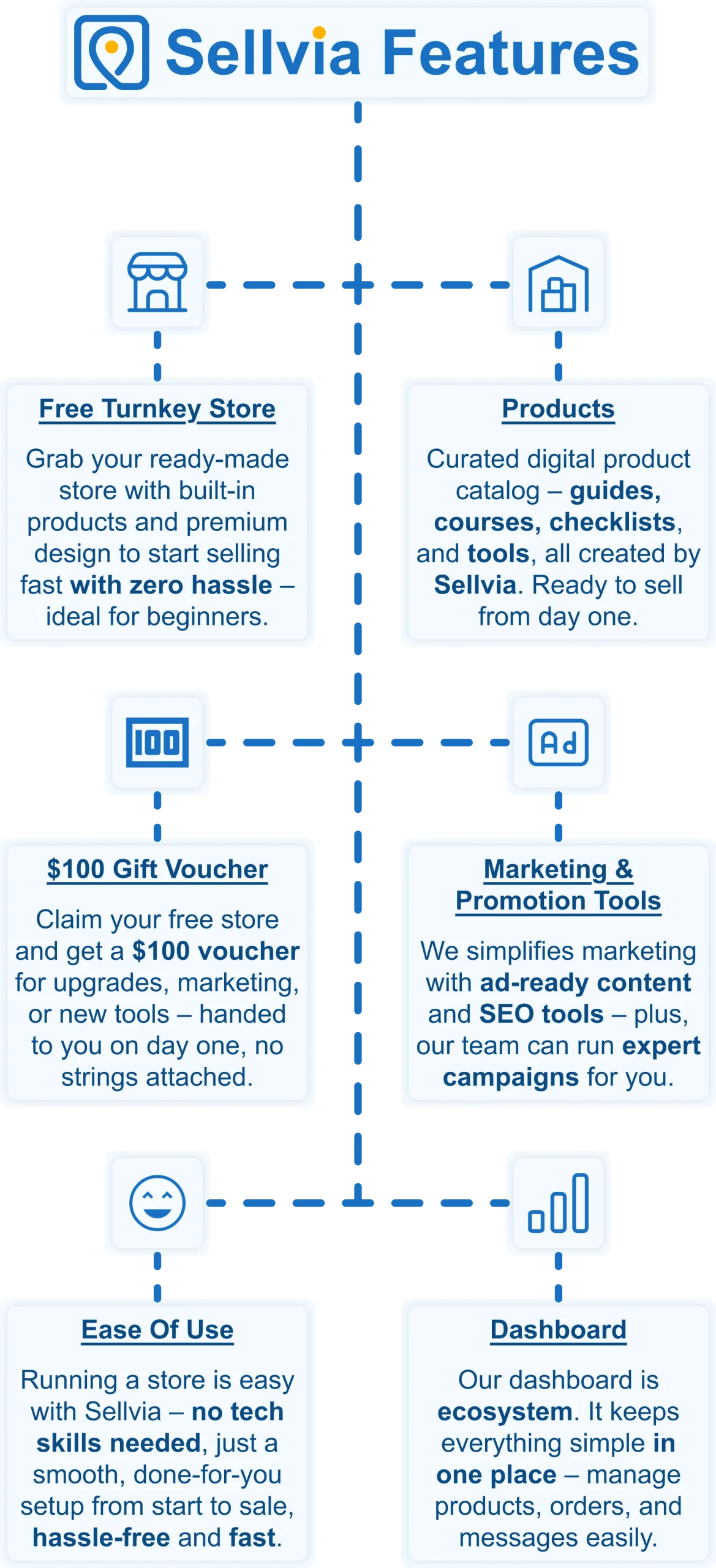
Get a ready-to-go store hassle-free 🎯
Want to start selling but don’t know where to begin? No worries! Just share your ideas, and Sellvia’s team will build a free ecommerce website that’s fully set up and ready to take orders from day one. No coding, no stress – just a store that works right out of the box.
A $100 gift voucher to grow your business faster 🎁
Starting a business takes momentum – and Sellvia gives you a head start. When you claim your free store today, you also get a $100 gift voucher to put toward growing your business. Use it to upgrade your store, boost your marketing, or unlock new tools. It is a real dollar value, handed to you on day one, with no catch and no hoops to jump through.
A massive catalog of digital products to sell 🏆
One of the biggest struggles in starting an online business is figuring out what to sell. Sellvia solves that completely. Your store comes pre-loaded with digital products – guides, courses, checklists, and tools – all created by Sellvia. You keep 50–70% of every sale. No inventory. No shipping. No logistics headaches.
Everything in one easy-to-use platform 🔥
Managing an online store shouldn’t be complicated. With Sellvia, you can handle orders, add new products, and even chat with customers – all from a simple and user-friendly platform. No need to mess with confusing tools or deal with unnecessary tech stuff. It’s all smooth sailing.
No upfront costs, just start selling 💰
A big reason people hesitate to start an online business is the cost. But here’s the good news: With Sellvia, you don’t need to invest in stock, storage, or shipping supplies. You can run your store with no upfront costs, keeping things low-risk while still making money.
Support that’s always got your back 🤝
Running a business comes with questions, but you’re never alone. Sellvia’s dedicated support team is available 24/7 to help with anything you need. Whether it’s a small question or a big challenge, they’ve got you covered.
If you are looking for ways to make money in college that can actually grow into something real, Sellvia gives you the store, the products, and the tools – all in one place. Claim your free store today and see how far it can take you.