YouTube Shorts has crossed 70 billion daily views. That number tells you the platform has serious reach – but reach and income are not the same thing. If you have been posting Shorts and wondering where the money actually comes from, you are not alone. YouTube Shorts monetization works differently from long-form video, and the gap between what people expect and what they actually earn is wide.
Quick answer: YouTube Shorts monetization in 2026 works primarily through the YouTube Partner Program, which distributes ad revenue from ads shown between Shorts in the feed. Qualifying channels earn roughly $0.03–$0.07 per 1,000 views – meaning most creators will need strong secondary income streams alongside ad revenue to build meaningful earnings from the format.
The short format is powerful for discovery and audience growth, but the RPM on Shorts is significantly lower than on long-form YouTube content. Understanding that distinction early shapes a smarter strategy – one where Shorts become a funnel and a brand-building tool, not just a standalone revenue source. Whether you have 500 subscribers or 500,000, the approach is the same: qualify for the basics, then layer additional income streams on top.
The rest of this guide walks you through exactly how YouTube Shorts monetization works in 2026 – with realistic earning figures at every stage and a clear breakdown of which methods are worth your time.
What is YouTube Shorts monetization?
YouTube Shorts monetization refers to the various ways creators can earn revenue from vertical videos under 60 seconds posted to YouTube’s dedicated Shorts feed. Since 2023, YouTube has integrated Shorts earnings into the main YouTube Partner Program (YPP), replacing the original Creator Fund model – a fixed pool that paid fractions of a cent per view regardless of individual channel performance.
Under the current system, YouTube aggregates ad revenue from ads shown between Shorts in the feed across each country, then distributes 45% of that pooled revenue to eligible creators based on their proportional share of total views. Creators using original audio receive a higher proportion of that split than those using licensed music from the Shorts audio library – an important detail if you are building a channel around original content.
To qualify for YPP and access Shorts ad revenue, a channel must meet one of two thresholds:
- 1,000 subscribers + 10 million Shorts views in the last 90 days
- 1,000 subscribers + 4,000 watch hours from long-form content in the last 12 months
The Shorts-specific path – 10 million views in 90 days – is the most relevant route for creators focused purely on the short format. It is a high bar for most new channels, but a single viral Short can push a small channel across that threshold faster than years of slow organic growth.
Important note: YPP ad revenue is separate from Super Thanks, channel memberships, and brand deals. Those have their own eligibility requirements, and most are accessible well before a channel hits YPP thresholds – meaning you do not have to wait to start earning.
The 2026 YouTube Shorts monetization landscape is meaningfully better than it was just a few years ago. YouTube has progressively increased creator revenue share, improved Shorts-specific analytics, and rolled out shopping integrations that make direct product sales easier within the platform. Monetization is more mature – and more competitive.
Getting a clear picture of realistic income ranges before committing significant time to the format is the smartest first move. The next section breaks that down with actual numbers.
How much can you realistically earn from YouTube Shorts?
The honest answer: less than most people hope, more than most people assume – if you are strategic about it. Shorts ad revenue per 1,000 views (RPM) sits between $0.03 and $0.07 for most creators, compared to $1–$5+ RPM for long-form content in the same niche. The lower figure reflects the format: ads between Shorts are brief, frequently skipped, and compete with extremely fast viewer scroll behavior.
Here is a realistic breakdown of what each major revenue stream looks like across different effort levels:
Shorts ad revenue is the most passive stream but delivers the lowest return per view. Brand deals and digital products consistently deliver the highest revenue per hour of effort – they require more upfront setup but pay off significantly once established. Most creators generating $500–$2,000+/month combine at least three of these streams simultaneously.
One note on the ceiling figures: The upper ranges above reflect channels with strong niche authority, consistent posting schedules, and active audience relationships – not just raw view counts. A channel earning 5 million views from a single viral Short with no returning subscribers will underperform a channel with 800,000 steady monthly views and an engaged community. The realistic timeline to $500+/month is 6–12 months of consistent, niche-focused content.
The most successful Shorts creators treat ad revenue as a passive bonus rather than a primary income source. Their real earnings come from sponsorships, affiliate links, and owned products – all of which are covered in detail below. That shift in mindset is what separates creators stuck at $20–$50/month from those building toward $1,000–$2,000+/month on the same upload frequency.
Building a sustainable income from Shorts is entirely achievable – but it requires knowing exactly which levers to pull and in what order. The next section breaks down every proven method, so you can start stacking streams from day one.
Ways to monetize YouTube Shorts in 2026
There is no single best approach to YouTube Shorts monetization – the smartest creators stack multiple revenue streams on top of each other, using Shorts as both a discovery engine and a conversion tool for higher-margin income sources. Here is a full breakdown of every proven method, organized by how you access it and what returns to expect.
Through the YouTube Partner Program
The YPP is the monetization foundation for most serious Shorts creators. Qualifying unlocks not just ad revenue but several additional features that layer meaningful income on top of the base RPM figures.
Shorts ad revenue
This is the baseline – the RPM-based share of the country-level Shorts feed ad pool. For most creators, it will be the smallest income stream, but it runs passively once the channel is monetized and requires no active selling. Posting consistently in a high-CPM niche – finance, tech, business, or personal development – increases your proportional share of the ad pool relative to lower-CPM categories like entertainment or reaction content. A finance-niche channel earning $0.06 RPM with 5 million monthly Shorts views would bring in roughly $300/month from ad revenue alone. That is enough to matter, not enough to build a business around on its own. Think of it as the floor, not the ceiling.
Earning potential: $20–$2,000+/month depending on view volume and niche CPM.
Channel memberships
Once a channel reaches 500 subscribers and YPP approval is granted, channel memberships become available – recurring monthly payments from viewers in exchange for perks like exclusive content, custom emojis, and community access. Shorts are an excellent top-of-funnel driver for memberships: they introduce you to new viewers at scale, some of whom convert to paying subscribers after exploring your wider catalog. Education, fitness, and finance niches consistently report the strongest membership conversion rates from Shorts traffic.
Earning potential: $50–$500/month once the channel has an engaged core audience of 2,000+ subscribers.
Super Thanks
Super Thanks lets viewers tip on individual videos, including Shorts. It is a lower-volume stream than memberships but requires zero ongoing commitment from the creator. A well-timed Short that genuinely helps, surprises, or entertains can attract Super Thanks from viewers who want to show appreciation beyond a like. The average Super Thanks payment sits between $5 and $10, and high-engagement Shorts with active comment sections can receive dozens per week.
Earning potential: $10–$200/month, highly variable.
Through brand deals and sponsorships
Brand deals are where Shorts creators with even modest audiences can make serious money. Brands pay for access to engaged, niche-specific audiences – and a creator with 15,000 loyal subscribers in the right vertical is worth more to the right sponsor than a general-interest channel with 200,000 passive followers.
Sponsored Shorts
A sponsored Short is a dedicated video where the creator integrates a brand message – usually a 5–10 second segment woven naturally into the content. Rates vary widely by niche and audience quality, but a working benchmark: channels with 10,000–50,000 subscribers typically command $100–$500 per sponsored Short; channels above 100,000 subscribers move into $500–$3,000+ territory. Niche authority and engagement rate matter more than raw subscriber count in most sponsorship negotiations, which means a smaller but highly targeted channel can often outperform a much larger generalist one.
Earning potential: $100–$5,000 per deal, 1–4 deals per month for active creators in brand-friendly niches.
Product integrations
More organic than a pure sponsorship, product integrations weave a brand directly into the content itself – a fitness creator demonstrating a supplement, a tech creator reviewing a gadget, a lifestyle creator incorporating a product into a daily routine video. These tend to convert better for brands, which means creators can charge a premium and build longer-term partnerships rather than one-off deals. Finding partners directly through email outreach or platforms like Creator.co, Grin, or Aspire typically delivers better rates than waiting for inbound approaches.
Earning potential: $150–$2,000+ per integration depending on niche and audience quality.
Through affiliate marketing
Affiliate marketing is one of the most scalable income streams for Shorts creators because it requires no minimum subscriber count and generates income once links are live. You promote a product, share your unique tracking link, and earn a commission on every resulting sale – typically 5–30% depending on the affiliate program.
Linking in the first comment
YouTube does not allow clickable links within Short captions the same way it does in long-form video descriptions. The standard workaround is pinning your affiliate link in the first comment immediately after publishing, combined with a verbal call-to-action inside the Short itself – “link in comments” – to guide viewers to find it. Programs like Amazon Associates, ShareASale, PartnerStack, and individual brand affiliate programs all work well through this method. Product-review and recommendation niches are particularly well-suited since viewer intent is already purchase-oriented when they engage with this kind of content.
Earning potential: $50–$800/month with consistent content in product-focused niches.
Bio and profile links
The YouTube channel About section supports external links, and most creators use this to host a link-in-bio page – Linktree, Beacons, or a custom landing page – aggregating their top affiliate products. This is the most evergreen placement, capturing affiliate clicks from viewers who explore the channel after discovering a Short. Reviewing and updating your top affiliate links quarterly to reflect trending products in your niche keeps conversion rates consistent as your channel grows.
Earning potential: $20–$300/month, depending on channel size and niche.
Through merchandise and digital products
Selling directly to your audience – through physical merchandise or digital products – removes the middleman entirely and delivers the highest margin of any monetization method. It requires more upfront work than ad revenue or affiliate links, but the return per transaction is dramatically higher.
Merch shelf
YouTube’s built-in merch shelf integrates with print-on-demand services like Spreadshop and Printful, letting viewers buy branded products directly from your channel page. Margins on print-on-demand are thin (20–40%), but the setup cost is zero and the nature of the income makes it worth having active once you have an established visual brand identity. Shorts that reinforce your brand – catchphrases, running visual gags, a distinctive on-screen style – consistently drive stronger merch click-through rates than purely informational content.
Earning potential: $50–$500/month for channels with a loyal, brand-aware audience.
Digital downloads
E-books, templates, editing presets, mini-courses, and guides can be sold directly through platforms like Gumroad or Payhip, linked from your YouTube profile. Digital products have near-zero delivery costs and can be priced anywhere from $7 to $97+, making the revenue per transaction significantly higher than ad revenue or most affiliate commissions. A creator in the productivity, fitness, or creative niche selling a $27 guide and converting just 30 buyers per month from Shorts traffic earns $810/month from that single product – more than most channels earn from ad revenue with three times the view count.
Earning potential: $100–$3,000+/month for creators with a targeted niche audience and a well-positioned product.
All of these methods work best when combined rather than used in isolation. A creator running Shorts ad revenue, one brand deal per month, and a single active affiliate program will comfortably outperform a channel relying on any one stream alone – and adding a direct digital product makes the whole system meaningfully more scalable.
Legal and ethical considerations for YouTube Shorts creators
YouTube Shorts monetization operates in a real regulatory environment, and ignoring the rules – even unknowingly – can cost you your channel, your YPP status, or both. The platform enforces content policies strictly for monetized accounts, and there are FTC regulations that apply independently of YouTube’s own guidelines.
What to avoid
Undisclosed sponsorships: The FTC requires clear disclosure when you are paid to promote a product, including brand deals, gifted products, and affiliate relationships. On Shorts, this means including “#ad” or “#sponsored” in the caption or stating the relationship verbally within the video. Failing to disclose is not a minor technicality – it is a legal liability for US-based creators and a direct violation of YouTube’s monetization policies.
Reposting content without transformation: Uploading other creators’ videos – even with minor edits – can result in copyright strikes and permanent demonetization. The fair use doctrine has a narrow application, and YouTube’s Content ID system flags suspected infringement automatically. Original creation is the only safe path.
Engagement manipulation: Buying views, subscribers, or likes violates YouTube’s Terms of Service and can result in channel termination. It also corrupts your analytics, making it impossible to accurately evaluate what is actually working. Third-party services offering “guaranteed growth” for payment are almost universally in violation of YPP policy.
Misleading titles and thumbnails: Clickbait that does not match the actual content of the Short raises viewer dissatisfaction signals that the algorithm penalizes – and in severe cases, YouTube manually removes monetization from channels with a pattern of deceptive practices.
What to do instead
Disclose every paid relationship clearly and early in the video. Build content around genuine value rather than manufactured engagement. Use YouTube’s own Creator Studio analytics to understand real audience behavior rather than chasing vanity metrics. If a YouTube Shorts monetization tactic feels deceptive or borderline, it almost certainly is – and the long-term cost to channel reputation and YPP eligibility is not worth the short-term gain.
Key principle: A channel built on authentic content and transparent brand relationships is both more monetizable and more durable than one that cuts corners on disclosure or content quality.
Following the rules is not just about avoiding penalties – it is about building the kind of channel that brands want to work with and audiences trust. Those two qualities compound over time and become the foundation for every serious income stream covered in this guide.
Final thoughts: how to choose your approach
YouTube Shorts monetization is not a binary on/off switch – it is a layered system that rewards patience, niche consistency, and smart product thinking. How you approach it depends entirely on where you are starting from and what you are trying to build.
Complete beginner (0–1,000 subscribers)
Focus on niche clarity and content quality before monetization. Pick one topic area, post 3–5 Shorts per week, and set up an affiliate link in your bio from week one – there is no minimum requirement for affiliate marketing and it costs nothing to implement. Your first meaningful income will likely come from a product recommendation rather than ad revenue. Target: first $50/month within 60–90 days of consistent posting in a product-friendly niche.
Intermediate creator (1,000–50,000 subscribers)
With a growing audience, you now have three viable income tracks running in parallel: YPP ad revenue if qualified, affiliate commissions, and your first brand outreach. Start pitching sponsorships directly – do not wait for brands to come to you. One $300 sponsored Short per month doubles or triples what most channels earn from ad revenue at this stage. This is also the right window to create your first digital product – a guide, template, or resource tied to your core content niche.
Advanced creator (50,000+ subscribers)
At this scale, brand deals, digital products, and channel memberships should all be active simultaneously. Shorts at this level function as a primary audience acquisition channel – feeding new viewers into a broader content ecosystem that includes long-form videos, newsletters, or a product catalog. The ceiling on YouTube Shorts monetization here is not defined by the platform; it is defined by how aggressively you pursue direct monetization outside of YouTube’s revenue share.
The long-term trajectory for Shorts creators is positive. YouTube has continued expanding creator monetization options – shopping integrations, affiliate link support within Shorts, and expanded Super Thanks features are all part of a broader push to make the platform more competitive for creator revenue. Creators who build now, with strong niche authority and multiple income streams, are best positioned to benefit as those tools mature.
Why Sellvia is a game-changer for your online store 🚀
Sellvia isn’t just another ecommerce tool. We are a trusted name in the industry, recognized by Forbes and even ranked in Inc.’s list of the 5,000 fastest-growing companies in the U.S. So if you’re serious about starting as a solopreneur, this is a smart place to begin.
Starting an online business can feel overwhelming, but that’s exactly where Sellvia steps in. It takes care of the tricky parts, so you can focus on making sales and growing your brand. Let’s break down what makes it such a great choice.
Get a ready-to-go store hassle-free 🎯
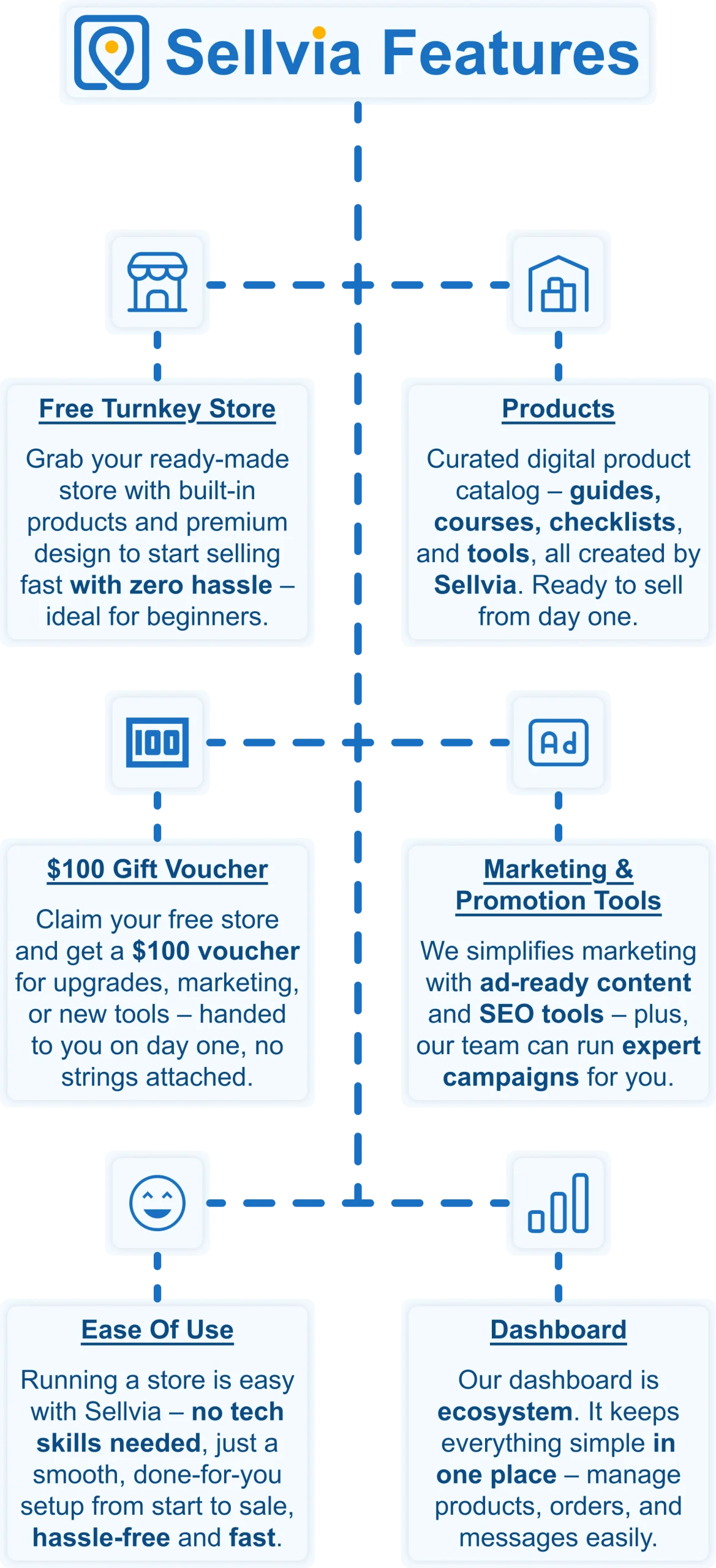
Want to start selling but don’t know where to begin? No worries! Just share your ideas, and Sellvia’s team will build a free ecommerce website that’s fully set up and ready to take orders from day one. No coding, no stress – just a store that works right out of the box.
A $100 gift voucher to grow your business faster 🎁
Starting a business takes momentum – and Sellvia gives you a head start. When you claim your free store today, you also get a $100 gift voucher to put toward growing your business. Use it to upgrade your store, boost your marketing, or unlock new tools. It is a real dollar value, handed to you on day one, with no catch and no hoops to jump through.
A massive catalog of digital products to sell 🏆
One of the biggest struggles in starting an online business is figuring out what to sell. Sellvia solves that completely. Your store comes pre-loaded with digital products – guides, courses, checklists, and tools – all created by Sellvia. You keep 50–70% of every sale. No inventory. No shipping. No logistics headaches.
Everything in one easy-to-use platform 🔥
Managing an online store shouldn’t be complicated. With Sellvia, you can handle orders, add new products, and even chat with customers – all from a simple and user-friendly platform. No need to mess with confusing tools or deal with unnecessary tech stuff. It’s all smooth sailing.
No upfront costs, just start selling 💰
A big reason people hesitate to start an online business is the cost. But here’s the good news: With Sellvia, you don’t need to invest in stock, storage, or shipping supplies. You can run your store with no upfront costs, keeping things low-risk while still making money.
Support that’s always got your back 🤝
Running a business comes with questions, but you’re never alone. Sellvia’s dedicated support team is available 24/7 to help with anything you need. Whether it’s a small question or a big challenge, they’ve got you covered.
YouTube Shorts is one of the most powerful audience-building tools available today – and pairing that reach with a fully operational online store is one of the most effective income stacks a creator can build in 2026. Claim your free store plus a $100 gift voucher and start selling alongside your content today.