More Delaware residents are searching for ways to start an online product business from home than ever before. Whether you live in Wilmington, Dover, or a smaller town like Milford or Seaford, the appeal of earning income online – on your own schedule, from your own home – is real and growing. And with Delaware’s median household income sitting at around $87,500 (US Census Bureau, 2024) and over 1 million people living in the state, there is a growing community of people ready to take that step.
Quick Answer: Yes, you can start selling products online in Delaware in 2026, and it is more accessible than most people think. Traditional models that involve physical products come with real barriers – suppliers to find, stock to manage, and orders to fulfill. But a newer model built around digital products sidesteps all of that. You can run a complete online store from your phone or laptop, with no inventory and no shipping, and start selling from day one.
This guide covers everything a Delaware resident needs to know: how online selling works here, what business models actually make sense, how Delaware taxes apply, how to register your business, and where to get free local support. By the end, you will have a clear picture of the path forward.
Why online selling works in Delaware
Delaware may be the second-smallest state in the country, but it punches well above its weight when it comes to online business opportunity. The First State has always had a business-friendly reputation – it is famous as a preferred state of incorporation for Fortune 500 companies – and that same infrastructure supports everyday residents looking to start something online.
Delaware’s population reached just over 1 million people as of 2024 (US Census Bureau), with a median household income of approximately $87,500 – about 7% above the national median. That relative purchasing power matters because Delaware residents are active online shoppers. US ecommerce sales grew to over $1.2 trillion in 2025, accounting for more than 16% of all retail, and Delaware consumers are part of that shift. The state is also one of the best-connected in the country: Delaware averages download speeds of around 284 Mbps, among the highest in the nation, and the state has been actively working toward universal broadband access through its BEAD program.
One more factor that matters: Delaware has no state sales tax. That is not a typo. Delaware is one of only five states in the country with zero sales tax, which simplifies life enormously for anyone running an online store here. You still have federal income tax and Delaware state income tax obligations, but you do not have the added complexity of collecting and remitting sales tax on every transaction.
All of this adds up to a state that is genuinely well-positioned for online sellers – good connectivity, above-average income levels, and a tax structure that removes one of the biggest compliance headaches new sellers face in other states.
Online business models for Delaware residents – a real comparison
If you have been researching how to start dropshipping in Delaware, you have probably come across a range of options. It is worth taking a step back and looking at all the main models side by side – honestly, without hype – so you can make the right choice for your situation.
Here is a straightforward comparison of the four most common models people in Delaware use to start selling online:
Physical product models require coordination with suppliers and dealing with shipping issues that are outside your control. Affiliate marketing and freelancing can work, but they are slow to build or trade time directly for money. The digital product store model removes the biggest friction points – no sourcing, no fulfillment, no logistics – and lets you focus on one thing: getting customers.
Understanding the business model is just the first step. Once you have chosen your path, the next thing every Delaware seller needs to get right is taxes – and this is where the state gives you a genuine edge over sellers almost anywhere else in the country.
Tax considerations for online sellers in Delaware
One of the biggest advantages of running an online store in Delaware is the tax environment. Here is what you actually need to know as someone starting out.
No state sales tax – ever
Delaware has no state sales tax. There is no rate to collect, no filing to submit, and no nexus rules to worry about on the sales tax side. This is a significant advantage over sellers in states like California, New York, or Texas, who have to navigate complex sales tax collection and remittance rules from day one.
Important note: Delaware is also one of only four states in the country with no marketplace facilitator law – meaning even large online platforms are not required to collect sales tax on your behalf in Delaware. Since there is no sales tax to begin with, this is a non-issue for Delaware-based sellers, but it is worth understanding the picture clearly.
State income tax on your earnings
You will still owe Delaware state income tax on the money you earn from your online store. Delaware uses a progressive income tax structure with rates ranging from 2.2% up to 6.6% on income over $60,000. For most people just starting out, your effective rate will be well below the top bracket. Delaware does not tax Social Security income, which is worth noting for anyone starting an online business in retirement.
If you are running your store as a sole proprietor or through an LLC, your business income flows through to your personal return and gets taxed at these individual rates. Keep records of your earnings and expenses throughout the year – this makes tax time much simpler.
Gross receipts tax for businesses
Unlike most states, Delaware uses a gross receipts tax instead of a traditional corporate income tax for businesses. The rate depends on your industry and revenue level, but for most small online sellers just starting out, this is a minimal concern. A tax professional can help you determine whether it applies to your situation once your store is generating consistent revenue.
Federal income tax
Like all US residents, you will owe federal income tax on your net income. If you expect to owe more than $1,000 in federal taxes for the year, you should make estimated quarterly payments to avoid underpayment penalties. The IRS quarterly deadlines are typically in April, June, September, and January.
With the tax picture clear, the next step is making your business official. Here is what Delaware actually requires – and how to do it without overcomplicating things.
See your state tax breakdown at a glance
Simply enter your annual net profit, select your state, and the calculator will instantly generate a detailed tax breakdown while showing how your state’s tax burden compares to others.
How to register your online business in Delaware
You have options when it comes to registering your online business in Delaware, and the right structure depends on your goals and comfort level. Here is a plain-English breakdown of what is involved.
Sole proprietorship
If you are just starting out and want to keep things simple, you can operate as a sole proprietor with minimal paperwork. You do not need to file formation documents with the state to operate as a sole proprietor – your business and personal taxes are filed together. If you want to use a business name that is different from your own legal name, you can register a DBA (doing business as) trade name. As of June 2025, Delaware’s trade name registration is handled through the Division of Revenue’s OneStop portal with a $25 annual fee per HB 40.
LLC (Limited Liability Company)
An LLC gives you personal liability protection – it separates your business debts from your personal assets. For a Delaware LLC, the state filing fee is $110 to file your Certificate of Formation with the Division of Corporations. You will also need a Delaware business license, which costs $75. After formation, every Delaware LLC owes an annual franchise tax of $300 due by June 1 each year. Late payments carry a $200 penalty plus interest, so calendar that date early.
The official place to form your Delaware LLC is the Division of Corporations, reachable at corp.delaware.gov. Processing times are typically a few business days for standard filings, with same-day options available for an expedited fee.
Key principle: Most people starting a small online store can begin as a sole proprietor and upgrade to an LLC once they have consistent revenue. There is no rule that says you need to have everything perfectly structured before you make your first sale.
Step-by-step guide to starting an online product business in Delaware
Here is a practical walkthrough of everything involved in going from zero to a live online store in Delaware. Each step is actionable – no fluff, no filler.
Step 1: Choose what to sell
This is where most people get stuck. Physical products seem obvious at first, but the complexity of sourcing, pricing, and fulfillment can overwhelm a beginner fast. The lower-friction path is digital products – guides, courses, checklists, and tools that people buy and download instantly. There is no physical item to store, package, or ship. Sellvia’s platform comes with 1,000 pre-loaded digital products across dozens of niches, so you do not have to create anything. You pick your focus area and start selling what is already there.
Step 2: Register your business in Delaware
For most new sellers, starting as a sole proprietor is the simplest and lowest-cost path. If you want an LLC from day one, file your Certificate of Formation at corp.delaware.gov ($110 filing fee plus $75 for your business license). Either way, register for a Delaware business license through the Division of Revenue – this is separate from entity formation and required for most commercial activity in the state. You can do it online at onestop.delaware.gov.
Step 3: Set up your store
If you want the lowest-barrier option available – no coding, no design, no product sourcing – Sellvia’s free 14-day trial gives you a fully built online store loaded with products, ready to take orders. No credit card is required to start. If you want to understand the broader options first, you can read our guide on how to start an online business in Delaware for a full overview of business models and setup steps.
Step 4: Handle Delaware taxes
Because Delaware has no sales tax, your tax obligations are simpler than in most states. You will file a Delaware personal income tax return at the end of the year that includes your business earnings. If you expect to owe $800 or more in Delaware state income tax for the year, you may need to make estimated quarterly payments. The Delaware Division of Revenue’s online portal at revenue.delaware.gov handles all filing and payment electronically. At the federal level, plan for self-employment tax (15.3% on net earnings) in addition to regular income tax – a good rule of thumb is to set aside 25–30% of your net revenue for taxes until you know your actual rate.
Step 5: Start marketing
You do not need a marketing degree or a big budget to get started. Sellvia includes a built-in advertising system where you set a daily ad budget between $10 and $50, activate it with one click, and the platform handles the targeting. Many customers see their first orders on the same day they activate ads – though results vary based on effort, consistency, and niche. For organic growth, short-form video on TikTok and Instagram Reels has proven effective for digital product sellers, even with zero followers to start.
Best niches for Delaware online sellers
Delaware has a distinct economic and demographic profile that shapes which digital product niches perform well. Here are five that make particular sense for Delaware residents in 2026.
Personal finance and money management
With 11.9% of Delaware households earning under $25,000 per year and a significant fixed-income population (over 210,000 residents are age 65 or older), guides around budgeting, debt reduction, and income generation have a real and local audience. Digital products in this category – budget planners, debt payoff guides, savings checklists – address needs that thousands of Delaware residents feel every day.
Career transition and remote work
Delaware’s job market is anchored by finance, healthcare, and government sectors, but remote work has opened up new options for residents outside Wilmington’s business corridor. Guides around transitioning into remote work, landing work-from-home jobs, and building freelance income serve an audience that is actively searching for options. Delaware’s relatively high broadband adoption rate means this audience can access and use digital products easily.
Small business and entrepreneurship
Delaware’s reputation as a business-friendly state has always attracted entrepreneurs. Guides around starting and running a small business – business plan templates, pricing guides, marketing checklists – serve a local culture that is already entrepreneurially minded. The state’s active SBDC and SCORE communities also mean there is an existing support ecosystem that drives demand for this type of practical content.
Health, wellness, and self-care
Health and wellness guides consistently perform well across all US states, and Delaware is no exception. From fitness plans and meal prep guides to stress management tools and sleep improvement resources, this niche has a broad audience and strong repeat-purchase potential. Digital delivery means no fulfillment complexity – customers buy and download instantly.
Education and skill-building
Delaware has a strong educational infrastructure, including the University of Delaware and Delaware State University, but lifelong learning extends well beyond formal schooling. Online courses, how-to guides, and skill-building checklists in areas like writing, photography, coding basics, and financial literacy serve an audience that values self-improvement and practical knowledge.
Common challenges for Delaware online sellers
Starting an online store comes with real challenges. Here are the ones Delaware residents run into most often – and what to do about each one.
Challenge 1: Not knowing where to start
The sheer number of options – platforms, products, marketing channels – can make it hard to take the first step. Many people spend weeks researching and never actually launch. The fix is to start with a complete, pre-built solution rather than trying to build everything yourself. Sellvia gives you a store, products, and an advertising system in one place, so you are not making dozens of decisions before you make your first sale.
Challenge 2: Worrying the opportunity is not real
If you have been burned by online schemes before – and many Delaware residents have – skepticism is healthy. Look for verifiable proof before you commit to anything. Sellvia is ranked by Inc. Magazine among America’s 5,000 fastest-growing private companies, is a Forbes Communications Council member, and has launched more than 1.5 million stores. Those are public, checkable credentials. The free 14-day trial also means you can explore the platform with no financial risk before deciding whether to continue.
Challenge 3: Finding time alongside existing obligations
Delaware residents, like people everywhere, are busy. Many are working multiple jobs, raising kids, or caring for family members. The time required to start an online store is a real concern. The advantage of digital products and a pre-built store is that the heaviest lifting – product creation, store design, technical setup – is already done. You can realistically get a store live in a weekend and manage it in a few hours a week once it is up and running.
Resources for Delaware online sellers
Delaware has a solid support network for people starting a business. All of the following resources are free or low-cost and available to Delaware residents.
SBA Delaware District Office – The US Small Business Administration’s Delaware office is located at 1105 Market Street, Suite 401, Wilmington, DE 19801. They offer business guidance, loan program information, and connections to other resources. Visit sba.gov/district/delaware or call the office directly. Hours are Monday through Friday, 8 a.m. to 5 p.m.
Delaware SBDC – The Delaware Small Business Development Center, operated in partnership with the University of Delaware, provides free one-on-one business advising, training, and consulting services to Delaware residents. They have been supporting Delaware entrepreneurs since 1984. Visit delawaresbdc.org to sign up for free advising.
SCORE Delaware – Delaware SCORE is one of the founding chapters of the national SCORE network and offers free mentoring from experienced business professionals. Over 40 volunteer counselors are available to work with you one-on-one. Visit score.org/delaware to find a mentor.
Delaware Division of Small Business – The state’s own small business agency offers Regional Business Managers who provide one-on-one counseling and connects you with state-level resources. Visit business.delaware.gov for more information.
Division of Corporations (Secretary of State) – For LLC formation, registered agent requirements, and business entity filings, visit corp.delaware.gov.
Why Sellvia is a game-changer for your online store 🚀
Sellvia isn’t just another ecommerce tool. We are a trusted name in the industry, recognized by Forbes and even ranked in Inc.’s list of the 5,000 fastest-growing companies in the U.S. So if you’re serious about starting as a solopreneur, this is a smart place to begin.
Starting an online business can feel overwhelming, but that’s exactly where Sellvia steps in. It takes care of the tricky parts, so you can focus on making sales and growing your brand. Let’s break down what makes it such a great choice.
Get a ready-to-go store hassle-free 🎯
Want to start selling but don’t know where to begin? No worries! Just share your ideas, and Sellvia’s team will build a free ecommerce website that’s fully set up and ready to take orders from day one. No coding, no stress – just a store that works right out of the box.
A $100 welcome gift to grow your business faster 🎁
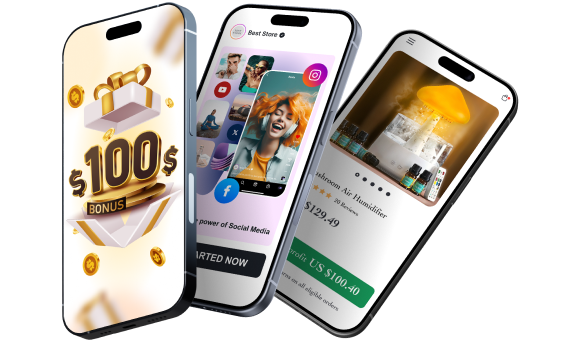
Starting a business takes momentum – and Sellvia gives you a head start. When you claim your free store today, you also get a $100 welcome gift to put toward growing your business. Use it to upgrade your store, boost your marketing, or unlock new tools. It is a real dollar value, handed to you on day one, with no catch and no hoops to jump through.
A massive catalog of digital products to sell 🏆
One of the biggest struggles in starting an online business is figuring out what to sell. Sellvia solves that completely. Your store comes pre-loaded with digital products – guides, courses, checklists, and tools – all created by Sellvia. You keep 50–70% of every sale. No inventory. No shipping. No logistics headaches.
Everything in one easy-to-use platform 🔥
Managing an online store shouldn’t be complicated. With Sellvia, you can handle orders, add new products, and even chat with customers – all from a simple and user-friendly platform. No need to mess with confusing tools or deal with unnecessary tech stuff. It’s all smooth sailing.
No upfront costs, just start selling 💰
A big reason people hesitate to start an online business is the cost. But here’s the good news: With Sellvia, you don’t need to invest in stock, storage, or shipping supplies. You can run your store with no upfront costs, keeping things low-risk while still making money.
Support that’s always got your back 🤝
Running a business comes with questions, but you’re never alone. Sellvia’s dedicated support team is available 24/7 to help with anything you need. Whether it’s a small question or a big challenge, they’ve got you covered.
Delaware’s tax-friendly environment and strong broadband connectivity make it one of the best places in the country to launch an online store in 2026. Start your free Sellvia store today and put Delaware’s advantages to work for you.